
Research Areas
Adaptive Processing
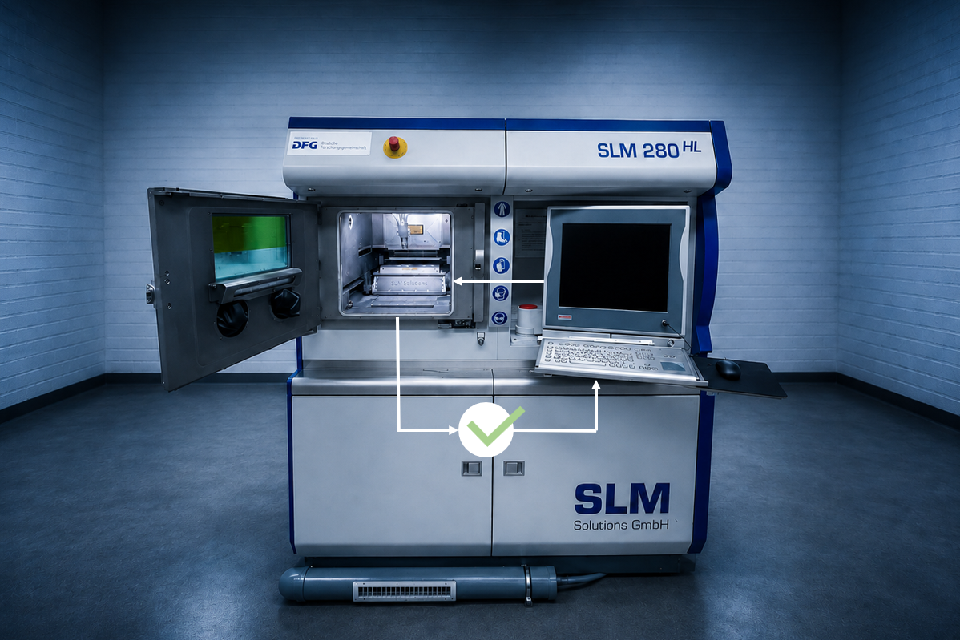
Additive manufacturing processes are characterized by highly dynamic and strongly coupled thermal, fluid-dynamic and metallurgical phenomena. Changes in component geometry, local heat transfer conditions, material state or environmental conditions continuously influence the respective process states and can lead to instabilities, defect formation or undesirable changes in material properties. Conventional manufacturing strategies are often based on static parameter sets developed using simple test specimens, which are frequently not transferable to more complex manufacturing tasks.
Within the Adaptive Processing research area, we develop state-based process strategies that enable manufacturing processes to be continuously analyzed and deliberately influenced during processing. These strategies are based on real-time information from process monitoring and physically grounded models for describing process states. Our goal is to dynamically adapt process parameters to current conditions and local requirements rather than relying on globally constant, predefined settings.
A particular focus lies on Laser Powder Bed Fusion of Metals (PBF-LB/M). Here, we investigate strategies for stabilizing thermal conditions, deliberately influencing melt pool characteristics and temperature fields and locally tailoring microstructure and material properties. Process variables such as laser power, spot size, intensity distribution and scan path planning are dynamically adjusted to compensate for critical conditions at an early stage and maintain reproducible process conditions.
Adaptive process control opens up possibilities that extend beyond defect prevention alone. By locally and temporally adjusting process states, material properties can be tailored in a controlled manner and functional gradients can be created within a component. In the longer term, this enables manufacturing processes that not only respond to instabilities, but also autonomously adapt their process control strategies to changing requirements.
Our research combines real-time measurement technology, model-based control, data-driven state assessment and industrial manufacturing systems within integrated adaptive process platforms. Our objective is to develop robust and scalable manufacturing technologies that deliver stable and reproducible results even under complex industrial boundary conditions.