

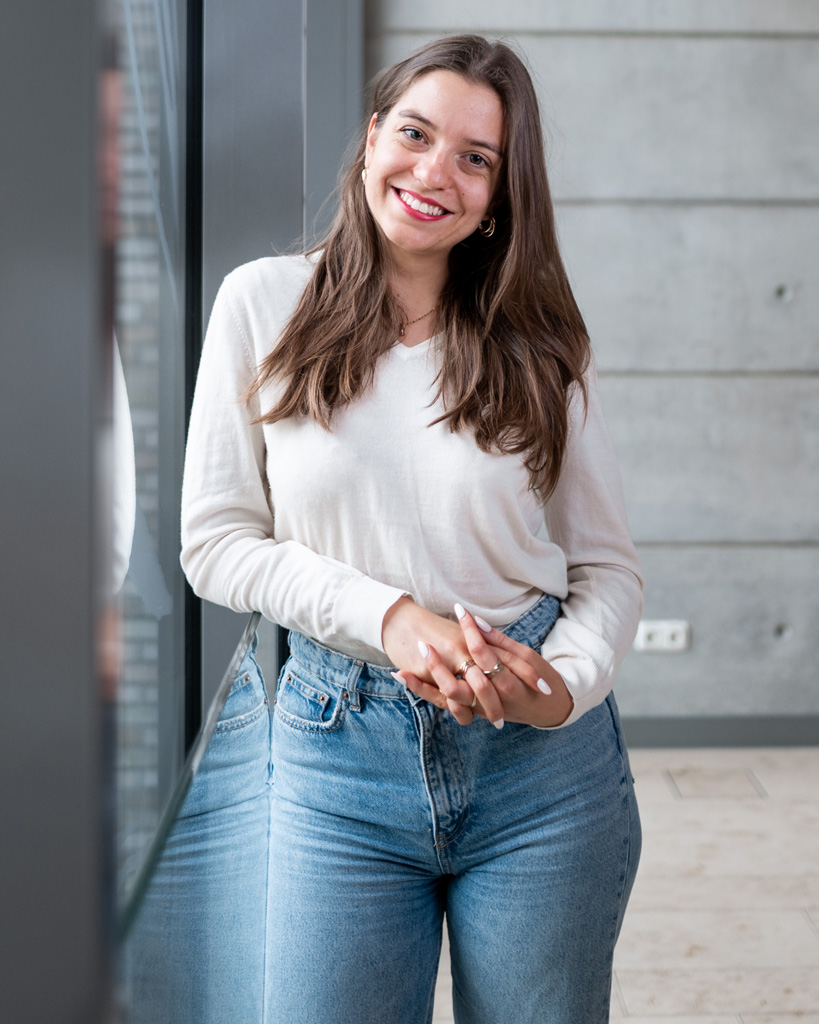
Naemi Bitzer
The atmosphere at the Faculty of Medicine is motivating and empowering.
This is what I did before I went to the university
My degree programme
I find this offer from the University of Duisburg-Essen helpful
Naemi, what enabled you to study medicine?
In general, you need good grades, but you don’t need a 1.0 GPA. I took the test for medical studies (TMS) and earned extra points through my federal volunteer service in an intensive care unit.
Why did you come to the University of Duisburg-Essen?
I applied to study medicine all over Germany and was accepted at the University of Duisburg-Essen. So it was pure coincidence that I ended up in Essen. Many of my school friends also went to North Rhine-Westphalia, which made it easier to settle in.
You’re originally from Tübingen—how does your everyday life in Essen differ from that in Tübingen?
Tübingen is small, green, and friendly—you can get anywhere within ten minutes. Essen is more diverse and larger, with very different neighborhoods. I particularly appreciate the open, direct nature of the people here. While it often takes time to be accepted into a circle of friends in Tübingen, in Essen you are quickly welcomed with open arms.

“With a little initiative, you can also gain experience at the university hospital that isn’t on the curriculum.”

“I come from a small town in Baden-Württemberg – I appreciate the openness of the people in Essen.”

“I could also imagine a career in research.”
What’s currently on your agenda in your studies?
I am currently in my practical semester and switch between different departments every two weeks: I am currently in the pediatric clinic and will soon be in gynecology. After the more theoretical preclinical phase, this is now very practical. With a certain amount of initiative, you can also gain experience at the university hospital that is not on the curriculum. In my sixth semester, for example, I was allowed to sit in on a day of work and then attended an operation in urology and neurosurgery. I am currently in my eighth semester and, starting in October, I will be working on my doctoral thesis in gynecology to keep my options open for a future career in research.
What is the atmosphere like at the medical school?
We medical students have our own campus, which strengthens our sense of community. The student council is very active, and I am also involved in a committee: we plan champagne breakfasts and trips for first-year students. There are many other opportunities for networking and learning. My tip: seek out contact with students in higher semesters, as they can provide you with the best learning tips that are not found on any slides. The best thing about studying is doing it together with friends.
Would you choose the University of Duisburg-Essen again today?
Yes – and not just in theory. I had been planning to transfer to the University of Ulm for a long time, had found an exchange partner, and had already paid for the apartment. And then, within 48 hours, I decided to stay. It was a gut decision—and I haven’t regretted it for a single day.
(The interview with Naemi was conducted by Helene Gerhards in April 2025.)