- MobileBody: Patientenindividuelle Ganganalyse
Das Diagnosesystem MobileBody kombiniert die Informationen aus Ganglabor-Messungen mit MRT- und Röntgen-Aufnahmen zu einem patientenspezifischen computergestützten Modell. Dieses bildet den individuellen Bewegungsapparat des untersuchten Patienten nach und ermöglicht umfassende Bewegungssimulationen …mehr
- MobileBody: Patient-specific gait reconstruction
The diagnosis system MobileBody combines the information gathered in Gait-Lab measurements with MRT and X-ray recordings into a patient-specific mechanical model. This model simulates the individual musculoskeletal system of the patient and provides full motion simulation in a 3D environment …more
Website: MobileBody
-
Visualisierung und Analyse der Wirbelsäulenbewegung
Die Wirbelsäulenbewegung ist an sich ein wichtiges Forschungsgebiet, kann aber auch zur Bewertung der Gangbewegung verwendet werden. In diesem Projekt wird die Wirbelsäulenbewegung mit Motion Capture Systemen aufgenommen und mit Splinekurven modelliert …mehr
- Human spine visualization and motion analysis
Motion of human spine is not only of interest per se, but also in combination with gait analysis, as it provides important information about the quality of walking. The present project uses spline modeling techniques developed for technical systems to reproduce the motion of the spine from motion capturing devices …more
- Modellierung der Unterarmbewegung
Im Rahmen dieses Projekts wird die Pro- und Supinationsbewegung des Unterarms durch ein elastokinematisches Mehrkörpermodell mit zwei Freiheitsgraden dargestellt. Die Modellparameter des Ersatzmechanismus werden durch Abgleich von Markraummittelpunkten auf MRT-Bildern mit berechneten Punkten bestimmt …mehr
- Biofidelic representation of lower-arm rotation
The project analyses the pro- and supination motion of the lower arm using a compliant surrogate four-bar mechanism with two degrees of freedom. The parameters of the surrogate mechanism are determined by fitting MRI-measured locations of the centers of the bone marrows at arbitrary slices with the computed centers …more
- Bewertung des Rehabilitationserfolges nach Hüftgelenksoperationen mit künstlichen neuronalen Netzwerken anhand des Trendelenburg-Zeichens
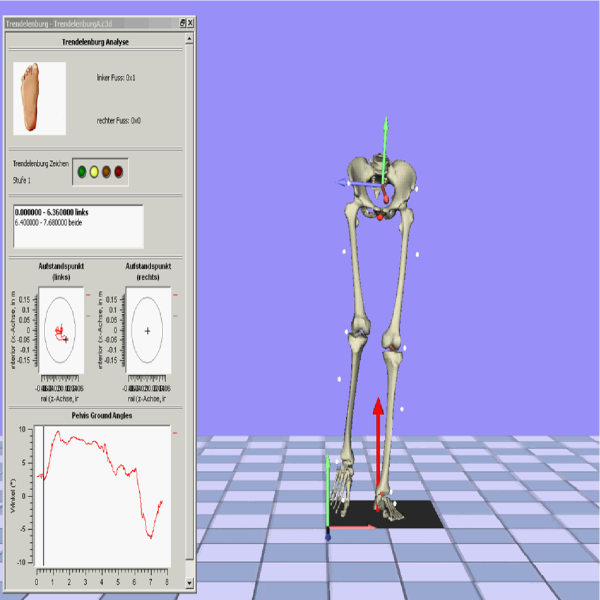
Kognitive Algorithmen werden zunehmend auf biomechanische Problemstellungen wie z. B. Bewegungsanalyse angewandt. In dieser Studie wird der Rehabilitationsfortschritt von Patienten quantifiziert, indem ein künstliches neuronales Netz Bewegungsanalysedaten als Eingang erhält, mit den Bewertungen von Orthopäden trainiert wird und den Grad des Trendelenburg-Zeichens liefert …mehr
- Application of an artificial neural network (ANN) for the prediction of a rehabilitation progress after a hip arthroplasty basing on the Trendelenburg sign
Over the past years, the application of cognitive algorithms in the field of biomechanics has increased. An example is the use of artificial neural networks (ANN) in the study of human locomotion, motor control and motor behaviour. This relatively new way of studying biomechanics using adaptive methods prompted several studies analysing the benefits and the application of machine learning to be published. …more
- Werkzeug für die Prothesenplanung
Ein Werkzeug für die Planung von Gelenksersatzoperationen zu entwickeln ist Ziel des vorliegenden Projektes. Mit diesem Werkzeug kann der Chirurg Prothesen aus einer Datenbank auswählen und in Röntgen- bzw. MRT-Bilder einpassen kann. Dieses Werkzeug wird in das vom Lehrstuhl in Zusammenarbeit mit ITBB entwickelte Ganganalysesystem eingebunden, sodass die Auswirkung der Prothese auf Muskellängen und -hebelarme während des Ganges simuliert werden kann …mehr
- Prosthesis planning tool
In this project, a prosthesis planning tool for surgical operations is being developed in which the surgeon can choose prosthesis components from a database and fit these into the X-ray or MRI segmented images, including their behavior during gait. This is targeted to be fitted into the general gait analysis and simulation environment developed at the chair of mechanics and robotics, in cooperation with ITBB …more
- HexaSpine: Parallelplattform zur Simulation der Halswirbelbewegung
In diesem DFG-Projekt wird eine Parallelplattform mit sechs Aktuatoren aus pneumatischen Muskeln und parallelen Druckfedern gesteuert. Durch modellgestützte Aktuatordruckregelung werden beliebige Zusammenhänge zwischen Endeffektorverschiebung und Endeffektorkraft erzeugt …mehr
- HexaSpine: parallel platform for vertebrae simulation
The DFG-funded project develops a parallel platform consisting of six legs actuated by fluidic muscles and coaxial springs. The valve pressures are controlled in such a way that model-prescribed forces are produced at the end-effector depending on displacement or time such that a given force at the platform is exerted …more
FAROMIR – Autonomes medizinisches Assistenzrobotersystem
Aufgrund des demographischen Wandels, spielt es heutzutage eine immer größere Rolle, älteren Menschen ein eigenständiges und selbstbestimmtes Leben zu ermöglichen oder Patienten rund um die Uhr zu betreuen. Autonome Roboter-Systeme können aufgrund technischer Innovationen mehr und mehr in diesen alltäglichen Situationen eingesetzt werden und den Menschen entlasten. Der medizinische Assistenzroboter FAROMIR (www.faromir.de) bietet hierzu die Möglichkeit, den Gesundheitszustand des Patienten autonom und tageszeitunabhängig zu beobachten. Die Beaufsichtigung des Patienten kann sowohl in der eigenen Wohnung als auch in einer öffentlichen Einrichtung geschehen. Sollte dort ein Notfall eintreten, kann umgehend eine Rettungsleitstelle hinzugezogen werden. FAROMIR siedelt sich im Pflege- und Krankenhaussektor an und kann hier im Bedarfsfall Informationen über den Patienten an eine Leitzentrale übermitteln. In Situationen, bei denen es auf Sekunden ankommt, wird so die erforderliche Hilfe gerufen oder einem Arzt, unter Einbeziehung eines Kamerabildes, die Kommunikation mit dem Patienten ermöglicht. Features: eigenständige Identifizierung von Notfällen, identifizierung verletzter Menschen, Skelett-Parametrierung und Erkennung der Bewegungsmuster, Handzeichen Identifizierung, Spracherkennung über Richtmikrofon, Kommunikation bei Bedarf mit einer Rettungsleitstelle, statische und dynamische Umgebungserkennung. In Kooperation mit dem Lehrstuhl für Mechatronik, Fertigungstechnik und der Innovationsfabrik der UDE.
Bio- und Thermofluiddynamik – Bio- and Thermo-Fluid Dynamics
- Untersuchung der Strömung in der aufsteigenden Aorta mit Dissektion
Dissektion der Aorta ascendance erweist sich seit vielen Jahren als Gegenstand der klinischen Forschung. Da die Thoraxchirurgie große Fortschritte macht, und neue Behandlungsmethoden prüft, müssen auch die Strömungsverhältnisse in der Aorta untersucht werden. Diese Studie hat die Simulation und Visualisierung der Strömungsverhältnisse zum Ziel, wobei experimentelle und numerische Verfahren verwendet werden …mehr
- Investigation of a fluid flow in a model ascending aorta with dissection
An aortic dissection as one of possible diseases of the blood circulation system is investigated from the clinical point of view since many years. As the cardiac surgery techniques and methods undergo very rapid development, at the same time many questions arise that have to be regarded not only from the medical but also from the engineering perspective. Exactly the influence of a dissection lamella on the changes in a blood flow pattern within the aorta has to be investigated in more details. The current study aims at the visualisation and analysis of the fluid flow behaviour in a model ascending aorta with dissection by means of both experimental and numerical approach …more
- Modeling and numerical simulation multiphase flow induced by aortic cannulas
There is still a lack of quantitative information concerning optimal blood flow in the aorta and in the carotid arteries during extracorporeal circulation (ECC). Problems are not only based on the location of the aortic cannula, they are furthermore associated with the cannula design itself and the effects on blood cells and aortic wall shear stresses. We simulated a two-phase fluid flow induced by different cannulas in the ascending aorta during ECC. Three commercially available cannulas (s. picture) have been examined according to their influence on red blood cells (RBC). Additionally, mass flow in the carotid vessels and wall shear stresses acting on the aortic wall were evaluated. A constant volume flow of blood (3.4 L/min) was applied. Numerical results demonstrate a strong relation of mass flow rate in the carotid vessels depending on the geometry of the aortic outflow cannula. RBC distributions both in the aorta and the carotid vessels changed depending on the cannula geometry. Maximum blood velocities, shear stresses on the aortic wall, and the fluid mechanical load acting on RBCs varied depending on each cannula design. This numerical approach demonstrates the significant influence of the cannula design on the distribution of RBC in the carotid vessels during ECC. In cooperation with: Department of Thoracic and Cardiovascular Surgery West-German Heart Center Essen, University Hospital Essen.
In order to optimize blood flow in an aorta, improve the blood distribution in the carotid vessels and minimize fluid dynamic loads acting on RBCs a novel aortic cannula was developed. According to this innovation a patent application has been submitted.
- Modeling and numerical simulation of bileaflet mechanical heart valve prosthesis
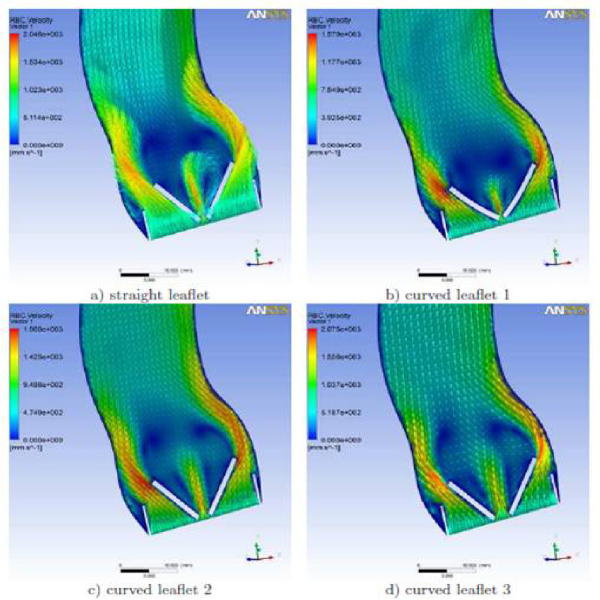
In this project, the blood flow fields induced by different bileaflet mechanical heart valve prostheses are studied. The aorta models considered in this work include four different bileaflet mechanical heart valves with three different types of leaflets, i.e. straight leaflet, upwards curved leaflet and centering curved leaflets; two of the valves have the centering curved leaflet with different levels of bending. The blood is defined as a multiphase non-Newtonian fluid that consists of plasma and red blood cells. The simulation is carried out using a quasi-dynamic procedure. Seven different opening angles are applied for one complete systole and diastole cycle. The numerical results reveal a significant influence of the heart valve geometry on hemodynamics, wall shear stresses and fluid mechanical loads acting on red blood cells.
In cooperation with: Department of Thoracic and Cardiovascular Surgery West-German Heart Center Essen, University Hospital Essen.
…more (Video)
- In vitro investigation of blood flow in an artificial aortic arch
Using Particle Image Velocimetry (PIV) in vitro, investigations of blood flow in an artificial aortic arch are carried out. The measurements are performed for different flexible models of aorta. The aim of this study is to analyse the velocity distribution of blood induced by aortic dissections and heart valve prostheses. The applied measuring system consists of a complete 3D PIV device based on a double pulsed Nd:YAG Laser, CCD camera Flow Master 3 and light sheet optics with focus length f = -10 mm. The data capture and the evaluation of images are realized with a special software package DaVis 7.1. Glass hollow spheres with density of 1.1 g/cm3 and diameter of 4 – 21 µm are used as tracer particles. In cooperation with: Department of Thoracic and Cardiovascular Surgery West-German Heart Center Essen, University Hospital Essen.
…more(Video)
- Fluid-dynamical and physico-chemical aspects of capillary membrane backwashing (BaCaMe)
The application of membrane filtration with Inside-Out Dead-End driven UF-/ MF- capillary membranes increases in water treatment exponentially. Thereby the required backwash process, which still is a widely unexplored field, has a high potential to enhance the efficiency of the filtration process. In order to optimize the backwash process, which should also minimize irreversible membrane fouling, an improved fundamental comprehension of the mechanisms, which are relevant for the detachment and transport-out of particles and fouling layers from Inside-Out Dead-End driven capillary membranes, is necessary. For a systematic elucidation of these mechanisms as well filtration (target-oriented build-up of fouling layers) and backwash experiments will be performed under defined operation conditions with especially designed laboratory plants. The obtained results (which parts from the fouling layer will detach under what conditions and from which zone of the capillary membrane) will be used as process parameters for a CFD supported numerical simulation of multiphase flow in capillary membranes. The multiphase flow modelling bases on the Euler-Euler method considering the most important forces acting on non-Brownian particles. Additionally, hydrodynamic wall effects, particle interactions (collisions and agglomeration) as well was porosity of particle collectives will be regarded. The attained knowledge of backwash mechanisms will be applied to develop optimized backwash conditions with regard to different geometries of the capillary. The optimized backwash modes will be verified using an automated commercial membrane system for long-term experiments.
- Modeling and numerical simulation of multiphase flow in shear flow bioreactor
To investigate biofluid mechanical phenomena and aggregation processes in bioreactors and optimize the performance and of wastewater treatment plants, modeling and numerical simulations of physical processes are carried out. Several aspects govern this evolving technology and have not been completely resolved so far. The fluid mechanical investigations of multiphase flow provide an insight in the granulation process and the hydrodynamic forces acting on the particles in these reactors. The current project is concerned with studying the factors influencing granule formulation and destruction with respect to different methods of mechanical load generation, i.e. rotating inner cylinder (see Fig.). The numerical simulations are performed with the open source code OpenFOAM 1.6. …more (Video)
- Multiphase flow and collision of droplets
The interactions between different phases of multiphase fluids play a crucial role in many technical and biological processes. To contribute to a better understanding of such processes, several modeling and numerical simulations of multiphase flow are carried out. In this project, the Eulerian-Eulerian approach is applied to investigate a two phase flow in a channel. Hereby, a collision of two droplets immersed in an incompressible fluid is simulated. The behavior of the droplets is analyzed according to different boundary conditions and material properties of the droplets, e.g. viscosity and surface tension. …more (Video)
- Molecular dynamics simulations of two-phase systems
Fluid flow phenomena, which occur in very small scales, cannot be described by the laws of continuum mechanics (Kn > 0.1). In such cases, the behavior of the fluid during the flow around an obstacle or during the mixing of two phases can be simulated using molecular dynamics (MD). In this study, the molecular dynamics simulator LAMMPS was applied to calculate some 2D and 3D two-phase flows and mixing phenomena. Particle ensembles consisting of 0.2−0.6×10⁶ particles were simulated. Both substances are superimposed Lennard-Jones particle systems that mixed under artificial gravity environment. The mixing of both substances has been investigated considering different density ratio, particle diameter and temperature.
Robotik - Robotics
- Physikalischer Kuka KR 500 Bewegungssimulator Moving Dome®
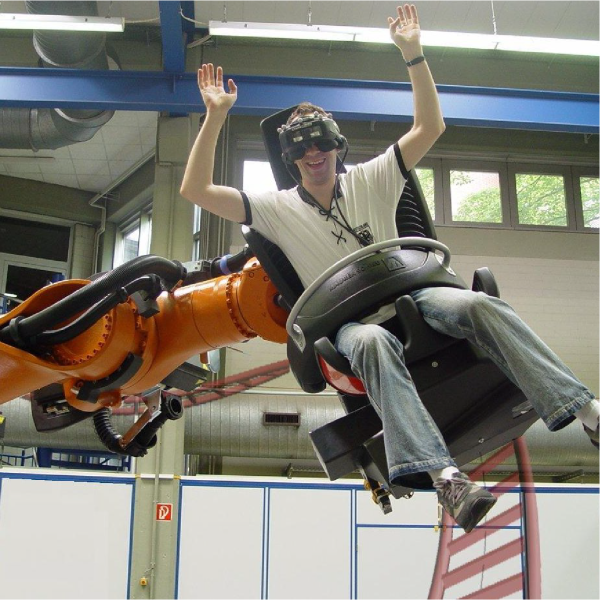
Herkömmliche Bewegungssimulatoren benutzen Parallelplattformen zur Darstellung gemessener oder simulierter Beschleunigungen. Serielle Roboter bieten einen größeren Arbeitsraum, der für Überschlagssimulationen eingesetzt werden kann. Im vorliegenden Projekt wird ein industrieller KR 500 TÜV Roboter verwendet …mehr
- Kuka KR 500 Motion Simulator Moving Dome®
Current flight or car simulators use parallel platforms to mimic a given physical maneuver by reproducing a measured or simulated motion on the platform. For general motion simulators, serial robots offer a larger workspace which can be employed for example for roll-over situations. The present project utilizes the industrial robot Kuka KR 500 TÜV to move passengers in space …more
- Bestimmung innerer Achsen mit kooperierende Robotern
Ziel dieses Projektes ist die kraftgeregelte Bewegung zweier Industrieroboter, so dass sie die unbekannte Bewegungsachse eines Mechanismus nichtinvasiv bestimmen können. Eine mögliche Anwendung ist die Bestimmung der Flexions/Extensionsachse des Ellbogens. Im Projekt werden Kuka-Roboter mit RSI-Steuerung und ein Ersatzmechanismus verwendet, der aus Gelenken und elastischen Elementen besteht
- Detecting internal motion axes by cooperating robots
The aim of this project is to control two serial industrial robots such that they are able to recognize an unknown internal motion axis of a device in a non-invasive way. A possible future application is e.g. the recognition of flexion/extension axis of an elbow. The project emulates such situations by mimicry devices made of rigid joints and flexible suspensions, utilizing two Kuka robots and the RSI for control
- IntelliSpline: Bahnplanung mit dynamischen Nebenbedingungen
Dieses Projekt behandelt die Einbindung optimierter, quintischer Splinekurven in objektorientierte Mehrkörpersimulationsumgebungen. Anwendungen ergeben sich in der Roboterbahnplanung, im Achterbahnentwurf und in der Automatisierungstechnik …mehr
- IntelliSpline: Trajectory planning with dynamic criteria
This project involves the incorporation of optimized quintic splines based on dynamical criteria in an object-oriented multibody library with applications in rigid-body motion for robot motion planning, roller coaster design and industrial machines. The outcome is a library which can be easily used by industrial motion planners to fulfill technical conditions such as minimal/maximal forces, accelerations together with spatial restrictions …more
Virtual Reality
- Entwurf und Simulation von Achterbahnen
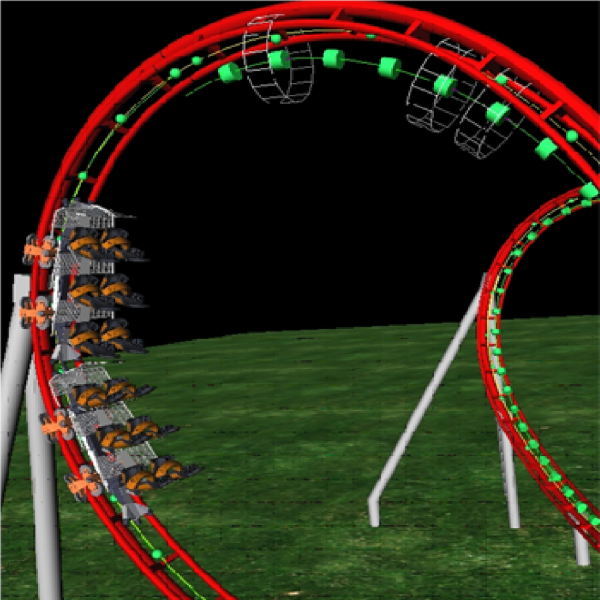
In diesem Industrieprojekt werden Objekte für die Spline-Interpolation entwickelt, mit denen die Bewegung entlang räumlicher Bahnen simuliert werden kann. Diese werden in einer Entwurfsumgebung für Achterbahnen verwendet, welches die Bewegung der Fahrzeuge simuliert und die Optimierung der Fahrgastbe-schleunigungen erlaubt …mehr
- Roller coaster virtual design and simulation
The industry-funded project develops a family of spline interpolating objects capable of transmitting motion and forces along arbitrarily long tracks. These are used for a design-environment for roller coaster tracks which produce realistic simulations of car motion and optimizes the track geometry such as to render best passenger accelerations …more
- 3D Visualisierung
In diesem Projekt wird die Anwendung von 3D-Visualisierungswerkzeugen wie Stereoprojektionsverfahren und Headmounted Displays im Entwurf von räumlichen Bahnen, in der Bewegungssimulation und in der Biomechanik untersucht …mehr
- 3D Visualisation
This project analyzes the application of 3D interactive visualization tools including screen stereo projection with shutter glasses and head-mounted devices for augmented reality in the design of complex trajectories, in motion simulators and in biomechanics …more
- Virtual-Reality-Modellierung von Minenbaggern
Minenbagger sind Großgeräte mit bis zu 1000 Tonnen Eigengewicht, die auch für Grabungsarbeiten unter Wasser eingesetzt werden. Im Rahmen dieses Industrieprojekts werden Modelle entwickelt, mit denen der Kraftarbeitsräume, zeitoptimale Arbeitszyklen und Hydraulikregelungskonzepte bestimmt werden …mehr
- Virtual modeling of mining excavators
Mining excavators are heavy equipment with up to 1000 tons machinery weight which are used also in under-water environments. The industry-funded project develops virtual models of excavators suitable for designing force-based work-space, minimum cycle trajectories, and hydraulic control …more