DNA macht Schule
DNA macht Schule
hands-on science for schools in NRW

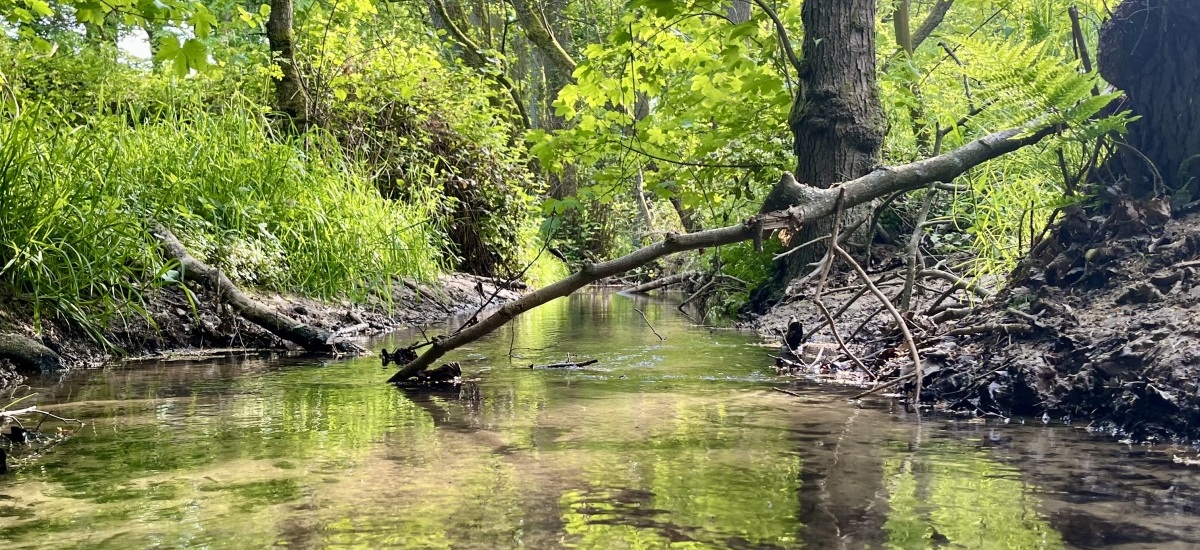
Watercourses are important ecosystems, not only for us humans as a transport route, for local recreation and drinking water supply, but also as a hotspot for biodiversity. The protection and renaturalisation of these ecosystems are important tasks for society, the relevance of which is also reflected in the school curricula of the state of NRW. However, learners often lack knowledge about these ecosystems and their protection (Ladrera et al., 2020). This is where Citizen Science (CS) projects (‘hands-on science’) can provide support. CS projects in environmental education offer the opportunity to ‘combine the teaching of science with nature experience in action-orientated projects [...]’ (Moormann & Sturm, 2021, p. 379) and thereby raise awareness of nature.
The project is a cooperation between the Biology Education Research and Learning Lab and the Aquatic Ecosystem Research group at the University of Duisburg-Essen.
Funding Federal Environment Agency as part of the Federal Environment Ministry's departmental research programme
Term 01/2025 - 12/2027
Project DNA macht Schule - hands-on science for schools in NRW
The Citizen Science-project ‘DNA macht Schule’ aims to promote water protection-related issues in school in order to strengthen pupils' interest in the river ecosystem and modern research methods. To this end, the pupils examine a watercourse near their school and take a water sample for environmental-DNA-metabarcoding. This method uses DNA traces and various genetic methods (including PCR and sequencing) to determine the species present in the water body in a time-efficient manner (cf. Leese et al. 2017). The water samples are analysed by the Aquatic Ecosystem Research working group at the University of Duisburg-Essen and the results are sent back to the schools. This allows pupils to analyse the results of their school's water body and draw conclusions about the ecological status of their water body based on the species composition.
At the same time, the project aims to find out to what extent CS-projects in schools can support official water monitoring. Of the 5,590 kilometres of watercourses in NRW, only around 27 % are monitored by the authorities. Smaller watercourses in particular are usually not included in the monitoring programme, meaning that little data is available on their ecological status. These watercourses are particularly suitable for investigations by school classes due to their smaller size (and often high species abundance).
Further information and a registration form can be found here (german).
DNA macht Schule (FKZ 3724 11 7050) is funded by the Federal Environment Agency as part of the Federal Environment Ministry's departmental research programme.
References
Ladrera, R., Rodríguez-Lozano, P., Verkaik, I., Prat, N., & Díez, J. R. (2020). What Do Students Know about Rivers and Their Manage-ment? Analysis by Educational Stages and Territories. Sustainability, 12(20), Artikel 8719. https://doi.org/10.3390/su12208719
Leese, F., Hering, D. & Wägele, J.-W. (2017). Potenzial genetischer Methoden für das Biomonitoring der Wasserrahmenrichtlinie. WasserWirtschaft, 7-8, 49-53.
Moormann, A. & Sturm, U. (2021). Naturerfahrung durch Citizen Science-Projekte. In U. Gebhard, A. Lude, A. Möller & A. Moormann (Hrsg.), Naturerfahrung und Bildung (S.379-393). Springer VS.