
Surface Chemistry and Laser Processing
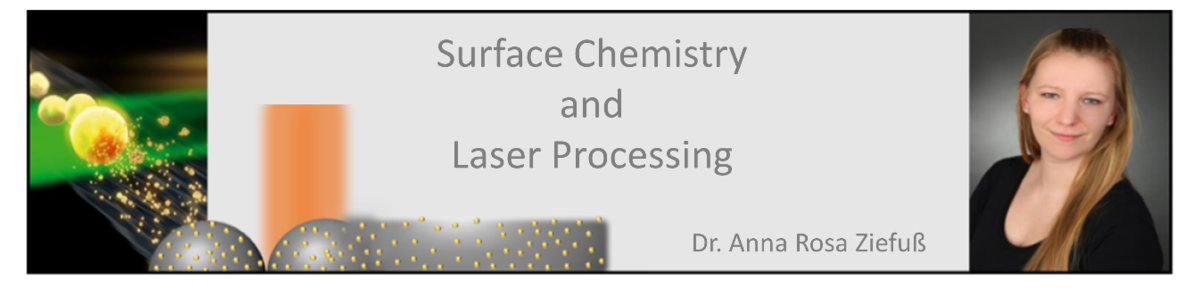
Bridging laser-based nanoparticle synthesis and additive manufacturing is at the core of the Surface Chemistry and Laser Processing group. Rather than treating nanoparticles as isolated products, we understand them as functional building blocks that enable control over laser–matter interaction during processing. In this context, surface chemistry becomes a key design parameter, governing how energy is absorbed, redistributed, and translated into material response.
In this context, microparticle laser fragmentation in liquids provides a scalable route to generate surfactant-free nanoparticles directly from technologically relevant materials. Crucially, the approach combines high productivity with well-defined and reproducible surface chemistry, conditions that are rarely met simultaneously, yet essential for integration into industrial powder feedstocks.
Integrated into powder-based additive manufacturing, these nanoparticles act as active modifiers of the process: in polymers, they enable energy absorption and thus processing in otherwise inaccessible wavelength regimes; in metals, they influence chemical dynamics, phase formation, and microstructure evolution during rapid melting and solidification.
By systematically linking nanoparticle generation, surface chemistry, and laser-based processing, this work establishes a materials-centered framework in which materials are no longer passive inputs, but active participants in additive manufacturing.
For further information on our Laser Processing AM activities, please refer to the Materials for Additive Manufacturing research page or contact Dr. Anna Rosa Ziefuß. Further reading on our Surface Chemistry studies please find here:
1. A. R. Ziefuss, N. Stratmann, C. Reifenrath, G. Kanu, N. Berndt, S. Disch, and S. Barcikowski, Thermal–penetration–driven, record nanoparticle yield and throughput by high-power, ultraviolet nanosecond microparticle laser fragmentation, Optics Letters, 51, 2, 2026, https://doi.org/10.1364/OL.582519
2. L. Krenz, T. Fromme, K. M. Tibbetts, S. Barcikowski, A. R. Ziefuss, Hydroxyl Radical Formation Is Linked to Fluence Threshold and Mass Conversion during Laser Fragmentation of Microparticles in Water, The Journal of Physical Chemistry C, 2026, https://doi.org/10.1021/acs.jpcc.5c07421
3. Philipp Gabriel, Varatharaja Nallathambi, Jianing Liu, Franziska Staab, Timileyin David Oyedeji, Yangyiwei Yang, Nick Hantke, Esmaeil Adabifiroozjaei, Oscar Recalde-Benitez, Leopoldo Molina-Luna, Ziyuan Rao, Baptiste Gault, Jan T. Sehrt, Franziska Scheibel, Konstantin Skokov, Bai-Xiang Xu, Karsten Durst, Oliver Gutfleisch, Stephan Barcikowski, Anna R. Ziefuss, Boosting Coercivity of 3D Printed Hard Magnets through Nano-Modification of the Powder Feedstock, Advanced Science, 2024, 2407972, https://doi.org/10.1002/advs.202407972
4. V. Nallathambi, P. Gabriel, X. Chen, Z. Rao, K. Skokov, O. Gutfleisch, S. Barcikowski, A. R. Ziefuss, B. Gault: Effect of Ag nano-additivation on microstructure formation in Nd-Fe-B magnets built by laser powder bed fusion, Acta Materialia, 2025, https://doi.org/10.1016/j.actamat.2025.121353
5. P. Gabriel, F. Eibl, S. Barcikowski, A. R. Ziefuss, Toward Real-Time Chemical Mapping during Laser Powder Bed Fusion: Robust In-Situ Spectroscopy and 3D Reconstruction, Additive Manufacturing, 105112, 2026, https://doi.org/10.1016/j.addma.2026.105112
6. N. Stratmann, M. Willeke, S. Leupold, K. Loza, A. Lüddecke, A. Kwade, M. Schmidt, S. Barcikowski, A. R. Ziefuss: Localized Energy Absorption through LaB6 Surface Modification of PA12 Enables Enhanced Tensile Performance in Diode Laser PBF-LB, Chemical Methods, 2025, https://doi.org/10.1002/cmtd.202500101