
DFG projects
Matti SchneiderModeling binder-jet 3D-printed sand microstructures
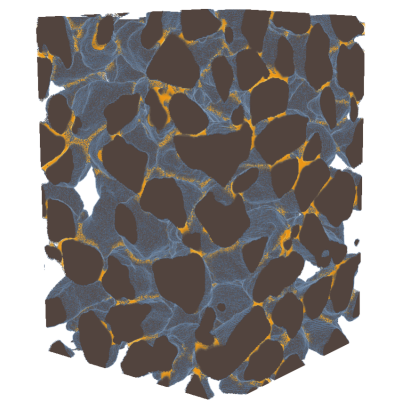
Generated microstructure of the 3D printed sand core material
(black: sand grains - orange: binder).
DFG-Project 507778349: Multi-scale simulation of molding materials for inorganic binders using binder-jet-3d-printing
The 3D printing of sand cores for casting allows for the design of more complex parts than the usual core shooting process. However, the composite material obtained by 3D printing features thermo-poro-mechanical properties that differ from those of materials produced by conventional methods. In particular, the layer-by-layer sand deposition process results in an anisotropy of the macroscopic properties. The present project, in collaboration with the Fraunhofer Institutes ITWM and IGCV and the University of Augsburg, aims to gain a deeper understanding of the 3D printing process of sand cores. This will enable us to identify the influence of process variables on the end product. To this end, we develop a microstructure generation approach that accurately reproduces the layer-by-layer deposition process of the sand and the addition of the binder. Based on the microstructures created, we evaluate the mechanical, thermal and flow properties and compare them to experimental results. By better understanding the microscopic processes involved in the 3D printing of sand cores, we aim to provide a basis for further development of environmentally friendly materials and optimization of the printing process.
Lukas Jabs, Matti SchneiderComputational homogenization of particle-filled hollow sphere structures
To increase the machining speed and thus the productivity of machine tools while maintaining precision, it is necessary to effectively dampen the increased induced vibrations. In addition to the use of active methods, the use of passive methods, i.e., damping materials, is recommended. Sandwich materials with a core of particle filled hollow spheres (PHSS) represent a promising class of composite materials because they are lightweight, structurally integrated and offer passive, locally adaptive high damping. To specify the local composition of the PHSS and subsequently the local damping during the design of components, it is necessary to predict the material behavior based on the local microstructure. To achieve this prediction, we aim to develop new modeling approaches for PHSS using and extending available FFT-based homogenization methods.
Mauli Mirajkar, Matti SchneiderEfficient Computational Micromechanics of Composites with Weak Interfaces
DFG-Project 571975633: Efficient Computational Micromechanics of Composites with Weak Interfaces
For composite materials, the significant influence of the mechanical properties of the interface between the constituents on the compound’s mechanical performance is well-known and documented. However, more often than not a perfect bonding between the phases is assumed in computational models of micromechanics, in particular for complex microstructures. In fact, prescribing a specific interface behavior requires resolving the interfaces. Conventional voxel-based methods - which are widely appreciated for their computational prowess - are not capable of resolving the interfaces. The goal of the proposed project is to provide a robust computational approach to the micromechanics of composites with strong discontinuities across internal interfaces. More precisely, we target a computational method based on the Fast Fourier Transform (FFT) which accounts for displacement jumps across the interfaces both for spring-type (elastic) laws and nonlinear traction-separation laws, converges under grid refinement (for elastic interfaces) and shows a grid-independent, efficient convergence behavior of FFT solvers. From a technological point of view, we build upon recent ideas for joining the eXtended finite element method (X-FEM) and FFT-based computational micromechanics: the X-FFT method, developed for weak discontinuities (strain/stress jumps). We also target dealing with non-smooth interfaces, e.g., for cylindrical inclusions. The proposed methodology will close a serious shortcoming of current voxel-based methods prevalent in micromechanics, enabling its users to investigate the influence of the interface adhesion on the effective mechanical behavior of matrix-inclusion composites, also shedding light on the size-dependent response of nanocomposites.