CoRE Interview Gabriel Fuhsy
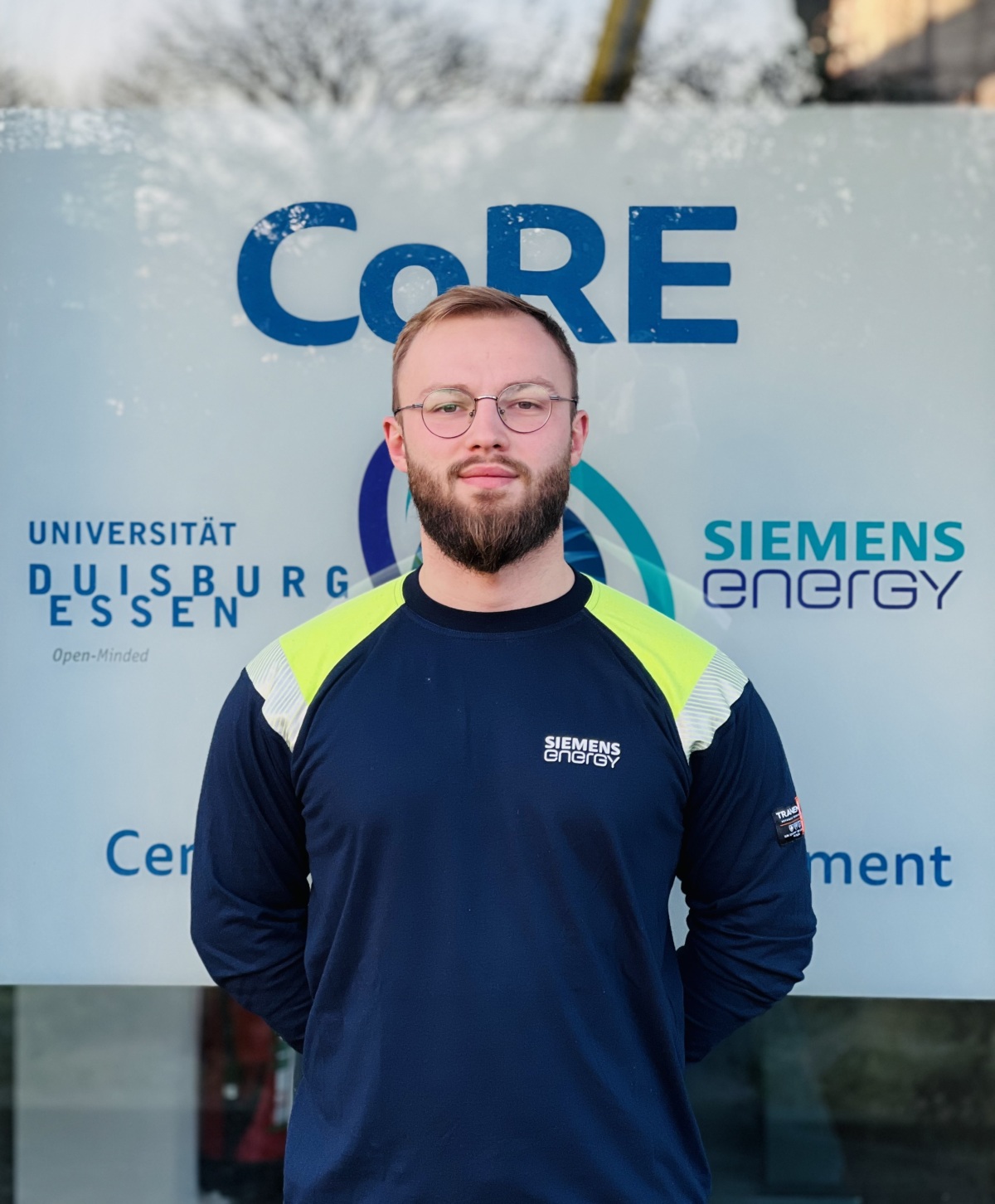
How did you become aware of the program?
I have been with Siemens Energy since 2019 and was about to complete my dual studies in Duisburg as an industrial mechanic and mechanical engineer. For this reason, I looked for potential positions on the Siemens Energy job portal that could support me in pursuing an M.Sc. in Mechanical Engineering at the university of Duisburg-Essen (UDE). During my search, I came across the working student position in the CoRE program and subsequently applied for it.
Why did you choose this program?
After submitting my application, I quickly had my first interview with Bruno Langela, the head of the training center in Duisburg, who provided a detailed explanation of the program. This sparked my interest in the program. One of its key advantages is the emphasis on completing the master’s degree while offering a clear pathway for a future career at Siemens Energy as a commissioning engineer for industrial steam turbines. This perfectly aligned with my goals: completing my master’s degree and transitioning into a future career at Siemens Energy.
How is the program structured?
The focus of the working student position is the completion of the master’s program in mechanical engineering. During lecture and exam periods, sufficient time is provided to focus on the master’s studies. Between the end of the exam period and the start of the next lecture period, there is enough time to complete specific training sessions at the training center. This allows theory to be combined with practice and provides the first foundational knowledge for a future career as a commissioning engineer.
What do you like the most about it?
What I appreciate most is the strong connection to the company and the combination of what is learned in lectures with the training sessions at the training center. Particularly in the field of turbomachinery, newly introduced theories quickly become familiar knowledge due to the prior or subsequent training sessions at the training center.
What role does the university play in the training program, and what could be improved in your opinion?
The chair of turbomachinery is responsible for the academic education and serves as an ideal partner for this program. The chair supports the path toward the master’s thesis by determining the topic, supervising its development, and ultimately evaluating and documenting the results.
Additionally, I appreciate that the chair, even outside the program, engages in numerous collaborations with Siemens Energy, resulting in guest lectures and site visits being integrated into several modules.
As an improvement, I would suggest even closer collaboration, ensuring that no questions remain unanswered at the start of the program and the master’s studies, allowing for a seamless entry into the process.
How does Siemens Energy support your education?
Siemens Energy has been very supportive since the beginning of my academic career, providing an optimal environment for advancing professionally and achieving academic goals. The CoRE program builds on this foundation by addressing questions or issues promptly to find straightforward solutions. This ensures that the necessary training sessions at the training center can be planned and completed in a highly communicative and uncomplicated manner over specific periods.
Which experiences have had the greatest learning impact on you?
The greatest learning experience I had was during the first training weeks with Bruno Langela. Experiencing the versatility of turbomachinery was particularly fascinating to me. When it comes to steam turbines, every machine is unique and complex, requiring a specific combination of knowledge in fluid mechanics, thermodynamics, mechanical engineering, and electrical engineering.