

AG Mittendorff
Welcome to the Mittendorff group
*** NEWS ***
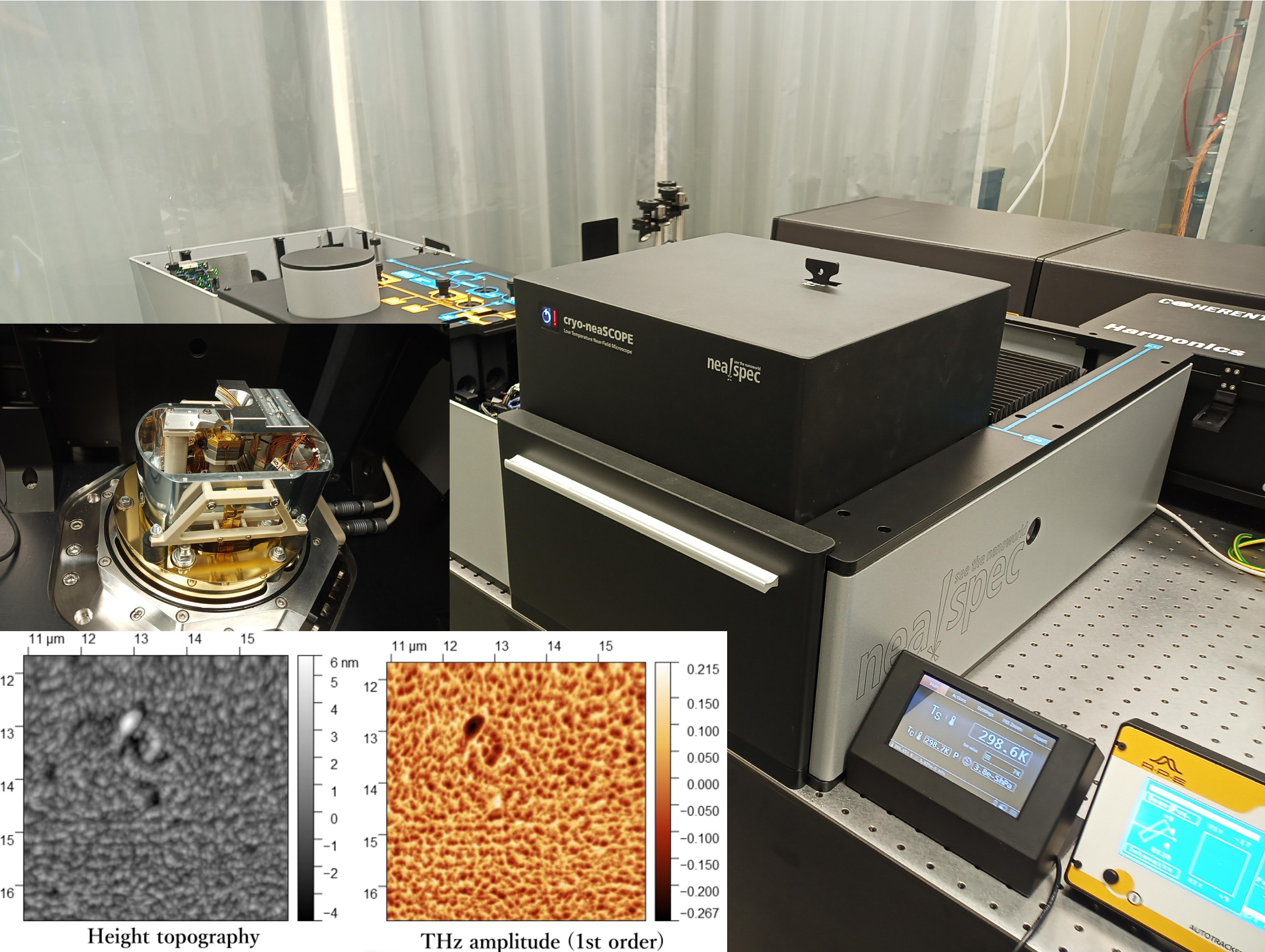 |
New large scale instrument for smallest structures
At the end of last year, we were able to put our new large-scale instrument into operation. It is a so-called near-field microscope, a combination of an atomic force microscope and an optical microscope. With this system, the smallest structures down to approximately 30 nm in size can be imaged, and the combination with ultrashort-pulsed lasers enables time-resolved measurements. This allows us, for example, to measure the behavior of electrons in nanostructures with high temporal resolution. Initial measurements on metal surfaces are already underway. |
|
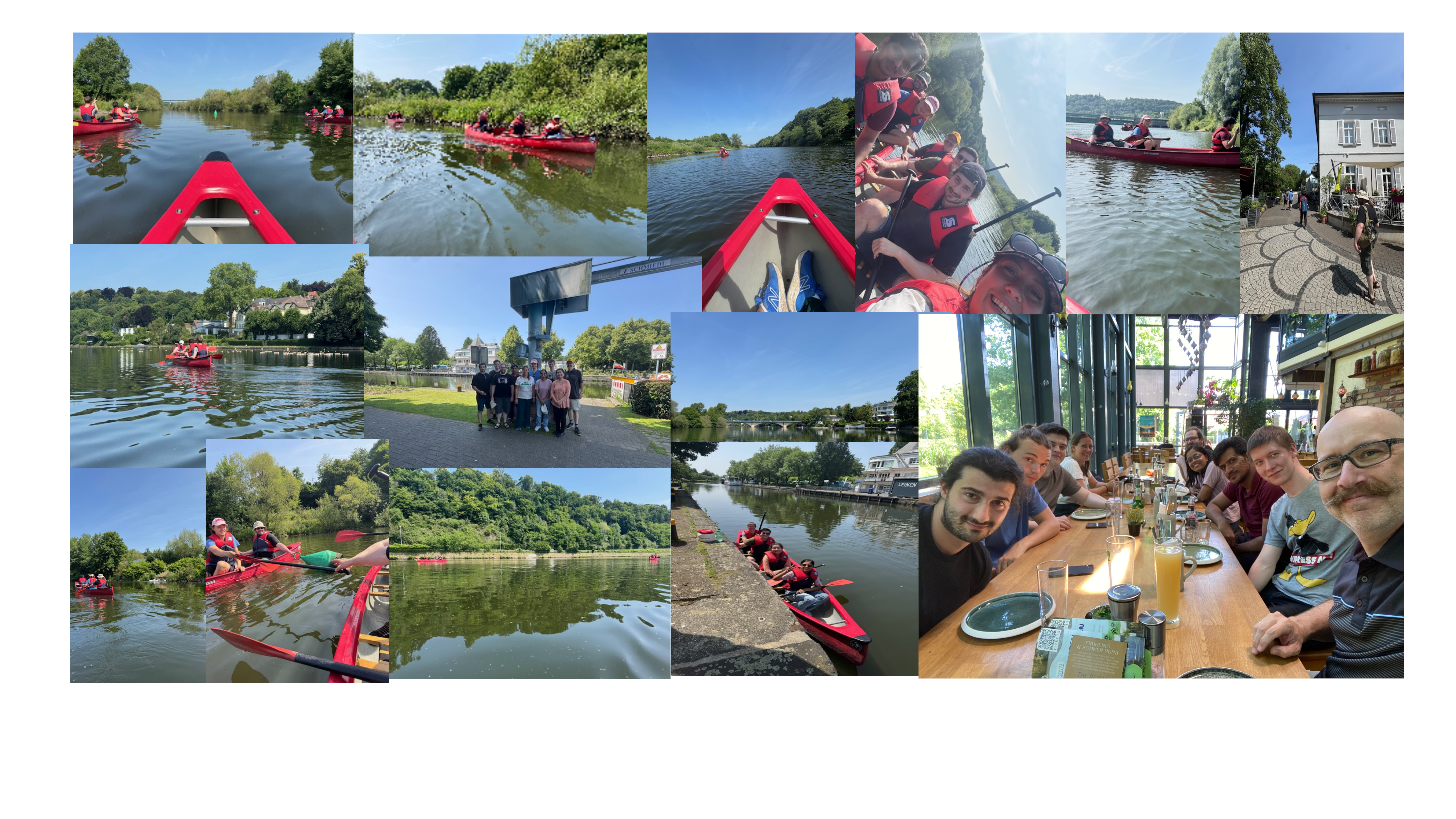
Team Day – Trip on the WaterIn June, we had a wonderful team day in glorious sunshine. We took canoes from Essen-Kettwig to Mülheim Water Station. After almost 10 km and 2 hours on the water, the day ended with a visit to a restaurant. |
|
|
New publication in Advanced Optical Materials:Our work on THz absorption in plasmonic crystals has been published recently. Combining structured electrodes on the surface of a semiconductor heterostructure lead to extremely strong nonlinear response, the transmission through the structure depends in this case on the intensity of the impinging THz radiation. This can be exploited e.g. for optical switches, to control the transmission through such a plasmonic crystal with a laser. This was successfully demonstrated, even at rather low laser power. You can read the whole publication here. |


In our research group, time-resolved Thz spectroscopy is the central method. THz radiation is long-wave infrared radiation that can penetrate many materials, e.g. semiconductors. A part of the THz radiation is absorbed by free charge carriers, for example.
The short THz pulses allow us to study the changes of a sample after optical excitation with high temporal resolution (~1ps). Among other things, we can observe how fast electrons release their energy to their surroundings. This depends strongly on the material and is often in the picosecond range (0.000000000001s). The results of these experiments allow us to draw conclusions about the interaction between the excited electrons and their environment.
On the one hand, this knowledge is important for the basic understanding of the processes in solids, but on the other hand it is also directly related to applications such as fast detectors for infrared radiation.
Especially so-called 2D materials, i.e. materials made of atomically thin layers such as graphene or plasmonic graphene structures, are the focus of our research. Ultra-short pulse lasers in the near-infrared range serve as radiation sources to excite the samples and generate the short THz pulses.
Kontakt
Head of Research Group Prof. Dr. Martin Mittendorff
Universität Duisburg-Essen
Fakultät für Physik
Experimentalphysik
Lotharstr. 1, MG 250
47057 Duisburg
Tel.: +49 (203) 37 9 2273
E-Mail: martin.mittendorff@uni-due.de
Administration Eva-Marie Heesen
Universität Duisburg-Essen
Fakultät für Physik
Experimentalphysik
Lotharstr. 1, MG 252
47057 Duisburg
Tel.: +49 (203) 37 9 3096
E-Mail: eva-marie.heesen@uni-due.de
Appointments Consultation hours
Appointments by arrangement