
Scientific Cooperations
15 July, 2026!!! NEW !!! Essen-Wuhan Seed Program - See call for projects below!

HUST Huazhong University, Tongji Medical College, Wuhan
and
University of Duisburg Essen, Medical Faculty
Seed Program
Call for projects
Application period 15 July - 15 September 2026
The Wuhan-Essen Seed Program is a new initiative from the long-standing contractual cooperation partners HUST Tongji Medical College and UDE Medical Faculty. The aim is to strengthen academic collaboration, in particular through joint research, high-quality publications and staff mobility. The funding amounts to up to EUR 20,000 per year (UDE, Faculty of Medicine) and CNY 180,000 (HUST), in a co-funding principle with each party bearing its own costs. Implementation is to take place via annual joint calls for proposals in the years 2026 to 2028, with two Wuhan-Essen researcher tandems per year to be funded for a fixed duration of two years each. In particular, travel costs, joint seminars and consumables are eligible for funding. Salaries are not eligible for funding. Funding is subject to mutual positive selection decisions. A separate project agreement (covering, among other things, IP, publications, data/material transfer and ethics) must be concluded prior to the use of funds. The Seed Program Agreement as a framework runs until the end of 2028 and may be extended if deemed successful.
Eligibility
In Essen: junior academic and research staff, full-time faculty members or senior scientists of the Medical Faculty of the University of Duisburg-Essen
In Wuhan: full-time academic and research staff, full-time faculty members or senior scientists of Tongji Medical College, Huazhong University of Science and Technology.
Priority: young scholars and those with an established foundation for collaboration.
Applications from all medical disciplines are accepted.
Number of projects
Limited to two projects (= two researcher tandems) simultaneously.
Funding amount
On the German side: 10,000 EUR /project/ year from the Medical Faculty of the University of Duisburg-Essen.
On the Chinese side: up to 90,000 CNY/project/year from HUST
Duration of support
Fixed two-year term, with funds provided on an annual basis.
Recipient of the application documents
For the German side applications by the researcher tandem shall be addressed to:
Prof. Mengji Lu, Institute for Virology,
Medical Faculty of the University of Duisburg-Essen
mengji.lu@uni-due.de
For the Chinese side applications by the researcher tandem shall be addressed to both:
Ms. Xian Yi, Research & Development Office, HUST: rdo@hust.edu.cn
Ms. Tongyue Song, Office of International Affairs, HUST: songtongyue@hust.edu.cn
Submission requirements and application documents:
All projects for which funding is requested must be submitted to both parties in Germany and in China simultaneously in English language, in electronic form only. Required documents:
- The application form (link)
- CVs of the collaboration partners, including information on the duration of the current work contract and including a list of (joint) publications
Application period
15 July - 15 September 2026
Funding evaluation
On the German side: evaluation of the researcher tandem’s application by the Forschungskommission (The Medical Faculty’s Research Committee).
On the Chinese side: evaluation of the researcher tandem’s application by a selection group according to the regulations of the Tongji Medical College
Panel review: early October 2026
Results announcement & project launch:
Early November 2026. Fund disbursement to the teams based in Essen and Wuhan.
Fund utilization
Starting in January 2027
For more information or questions please contact:
Prof. Mengji Lu
Institute for Virology
Robert-Koch-Haus
Room No. 315
Tel. 0201-723 3530
mengji.lu@uni-due.de
Research collaborations and projects: SGVIVI, Joint Laboratory, TRR60
Institute for Virology, Essen Sino-German Vitual Institute for Viral Immunology
The innovative structure of the SGVIVI provides a platform for all former TRR60 researchers from Essen, Wuhan, Bochum and Shanghai. It shall promote scientific exchange and joint publications, create joint funding proposals and support young researchers in their career. Scientists from other locations have also joined the network.
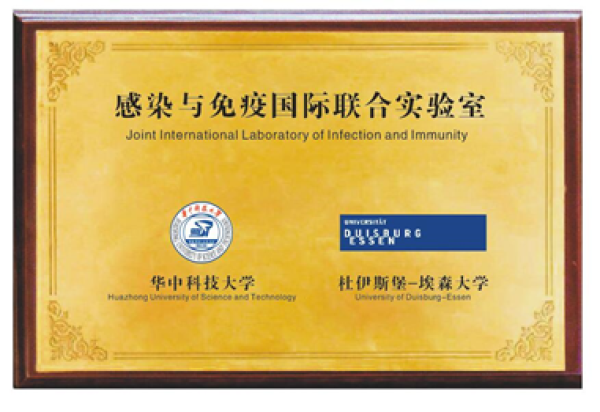
At Wuhan Union Hospital, HUST Wuhan-Essen Joint Laboratory
The Wuhan-Essen Joint International Laboratory of Infection and Immunity has been founded during the "University of Duisburg-Essen Day" at HUST in Wuhan in May 2017. A collaboration agreement was signed at university level by both universities, the University of Duisburg-Essen and Huazhong University (HUST). The Joint Lab shall facilitate the joint research on infectious diseases and sustain the long-lasting collaboration in the field of virology, which was previously supported over 9 years by the German Research Association and the National Natural Science Foundation China (see TRR60)
The Joint Lab is located at the Wuhan Union Hospital (HUST) in Wuhan and is dedicated to host researchers from both universities who work on viral pathogenesis and immunity. It is supported by funds from HUST and the government of Hubei Province. Prof. Dongliang Yang (Wuhan) is the director and Prof. Ulf Dittmer (Essen) the co-director of the laboratory.
The Joint Lab is fully equipped for virus research. It is a BSL2 safety laboratory with access to BSL3 conditions. German and Chinese members of the lab have access to a large sample collection form patients of the Department of Infectious Diseases for their research.

Essen-Wuhan-Bochum-Shanghai, 7/2009-6/2018 Transregional Collaborative Research Center TRR60
The German-Chinese Collaborative Research Centre “Transregio TRR 60” entitled “Mutual interaction of chronic viruses with cells of the immune system – from fundamental research to immunotherapy and vaccination”, had been established in 2009 and was funded by the German Research Foundation (DFG) and the National Natural Science Foundation of China (NSFC). The TRR60 was built upon the long standing cooperation between the University of Duisburg-Essen and the Tongji Medical College in Wuhan and the expertise of the participating universities in the research area of virology and immunology. The project expired in June 2018.
The successful cooperation will be continued on the basis of two future oriented structures (see left): the "Joint International Laboratory of Infection and Immunity" at the Wuhan Union Hospital/ HUST and the "Sino-German Virtual Institute of Viral Immunology SGVIVI" which is coordinated by the Institute for Virology, Essen.

COVID-19 research at the Wuhan-Essen Joint International Laboratory
Below listed joint research projects on COVID-19 at or together with the Wuhan-Essen Joint International Laboratory of Infection and Immunity are generously supported by Stiftung Universitätsmedizin: During the time of travel restrictions due to the Corona crisis we continuously hold video conferences and jointly discuss the project progress.
PD Dr. Adalbert Krawczyk and Prof. Dr. Baoju WangEstablishment of test procedures for the detection and characterization of SARS-CoV-2 specific antibodies
The development of new, quickly available therapy options is of great importance to help COVID-19 patients, in particular those who are seriously ill. These are antibody preparations that are made from the blood of people who have already had an infection with the pathogen and have thus formed protective antibodies. However, there are currently insufficient test options to identify people with particularly high antibody titers. For this purpose, two test methods are to be developed as part of the planned research project, with which antibodies against SARS-CoV-2 can be detected quickly and reliably. This is a so-called ELISA test procedure and a SARS-CoV-19 specific neutralization test. Both processes are developed at University Hospital Essen in close cooperation with Prof. Baoju Wang, Wuahn, who already has extensive experience in this area.
Dr. Gennadiy Zelinskyy and Dr. Jia LiuCharacterization of CD8 + and CD4 + T cells during acute COVID-19 infection
Activated cytotoxic T cells are an important part of adaptive antiviral immunity. These cells recognize infected cells with the intracellular pathogen and kill these target cells. Most previous studies focused on cytotoxic CD8 + T cells as a more common effector population. In critical situations, however, CD4 + helper T cells also become cytotoxic and are involved in the elimination of infected cells. Immunological characterization of SARS-CoV2-infected patients in Wuhan made it clear that the population of cytotoxic CD8 + T cells was greatly reduced during the development of pneumonia. In addition, the severity of COVID disease was associated with a decrease in cytotoxic T cells, which are responsible for the detection and elimination of infected cells. Based on these findings, we want to conduct studies to characterize cytotoxic effector CD8 + and CD4 + T cells from SARS-CoV2-infected patients and compare the data of these patients with that of healthy donors. The aim is to better understand the T cell-mediated elimination of SARS-CoV2-infected cells and the control of the virus. We suspect that this knowledge could be a basis for the future development of immunomodulatory therapy for acute viral infection.
PD Dr. Kathrin Sutter and Dr. Jia LiuThe influence of interferon-α on the replication of SARS-CoV-2
Attempts are currently being made under high pressure to find an effective antiviral treatment for COVID-19 patients. The effectiveness of well-known drugs such as e.g. Chloroquine (anti-malaria medication), lopinavir ritonavir (HIV medication) or favipiravir (influenza, Ebola medication). Interferon (IFN) α was already discovered in 1957 and can "intervene" in a virus infection. IFNα has been used in the treatment of chronic HCV and HBV patients since 1990, but so far only the IFNα2 subtype has been used therapeutically against chronic viral infections and various cancers. In our laboratory, we have already recombinantly produced all 12 human IFN-α subtypes and various mutants to test their different antiviral activities against various viruses such as e.g. HIV to investigate HBV. Therefore, we would like to investigate the antiviral properties of the different IFNα subtypes and mutants against SARS-CoV-2 in the cell culture model.
We are already investigating the expression of the different IFNα subtypes after infection with HBV and we would like to extend this work to the investigation of Covid-19 patients with different disease courses in China and Germany. Infection with SARS-CoV-2 leads to an increased expression of various proinflammatory cytokines, however the induction of IFN has not yet been investigated. With the help of the new findings from this research project, more differentiated interferon therapies against Covid-19 could be developed in the future.
Prof. Dr. Mengji Lu and Prof. Dr. Dongliang Yang Biogenesis of coronavirus particles in host cells
So far little is known about the new SARS coronavirus-2 and its replication cycle. Our research group has carried out a number of tests in the past to understand the formation of the hepatitis B virus (HBV) and hepatitis C virus (HCV). This previous experience of our working group should be used to analyze the formation of the SARS-CoV-2 particles. The first step is to take stock of how SARS-CoV-2 manages the formation of new virus particles in infected host cells. Host cells such as Vero cells and human endothelia cells are infected with SARS-CoV-2. The expression of the coronaviral proteins N and spike are determined in Western blots and their intracellular distributions are examined by confocal microscopy. The importance of the cellular compartment for the formation of virus particles is understood through the inhibition of the corresponding processes. The dependence of the formation of the SARS-CoV-2 particles on the cellular structures and processes can be used to modulate virus replication and to influence pathogens of the infection.