


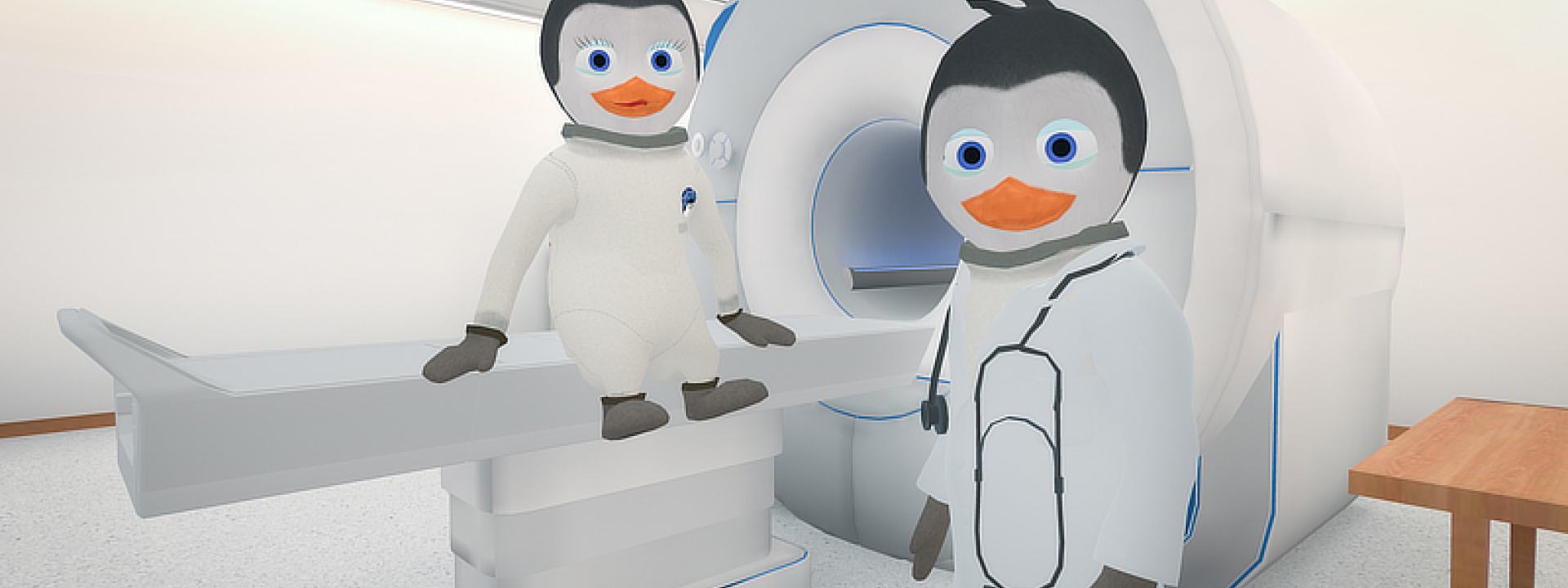

Pingunauten Trainer
Thanks to the great support of Child's Play we can continue the Pengunaut Trainer for three more years!

RESEARCH
We focus on fundamental as well as applied research in the field of Entertainment Computing. Our core expertise is grounded in computer science, multimedia technology and applied psychology. We investigate three main areas: Game Design & Development, the correlation between playing and learning, and transformative effects of digital technologies on emotional, cognitive, and behavioral responses in individuals. Our research focuses on serious games and game-based interventions for learning, prevention and health; embodied interaction in virtual reality; intelligent virtual agents, including playful teaching agents; emotional virtual characters and LLM-based conversational agents; and virtual patients for professional training. Further topics include participatory and user-centered design with children, teachers and families, motivation, emotion and engagement in playful learning environments, social and collaborative XR, and the evaluation of user experience through validated instruments, interaction data and physiological measures. We also conduct field and longitudinal XR studies in schools and clinics, often combining these research areas in interdisciplinary projects.
PROJECTS
The group’s approach aims both at academic excellence as well as applicability to commercial solutions. We are engaged in projects performed in collaboration with various partners and supporters. Working closely together with game developers, producers, and technology providers, they provide their network with fresh ideas and technical innovations through joint research projects as well as through the support of startups and excellence initiatives.
TEACHING
The courses taught by the Entertainment Computing Group cover a broad range from fundamentals of interactive applications and game development, including programming and media creation basics up to more advanced techniques taught at Master’s level. Additionally, students are supported in practicing what they have learned through a large number of research projects and seminars, often resulting in innovative interaction concepts and game prototypes. Providing a basic understanding of application and interaction design through the example of digital games is at the heart of this group’s teaching.