

DAAD Project
Establishment of the “Computer Simulation in Science and Engineering” Degree Program at Bethlehem University

Bethlehem University has set itself the goal of modernizing the educational landscape in Palestine and opening up new, forward-looking career opportunities for students. In close cooperation with the University of Duisburg-Essen, the Technical University of Darmstadt, and the University of Erlangen-Nuremberg-with the support of the Institute of Mechanics at the University of Duisburg-Essen-the bachelor’s degree program “ComputerSimulation in Science and Engineering” was therefore launched. This program combines theoretical and engineering fundamentals with state-of-the-art computer simulation methods. This prepares students for international careers, particularly in research, development, and the digital industry. A special focus is placed on supporting female students, who make up an above-average proportion of students in this technical field.
The project addresses several key challenges, including the limited availability of high-quality technical degree programs in Palestine, the limited job opportunities for graduates, and the need to promote career opportunities in digital and resource efficient sectors. Close collaboration with German universities ensures that students receive an excellent education that meets international standards. The project is funded by the Federal Foreign Office and administered by the DAAD (duration: May 2024 to December 2027).
Background & Rationale for the Program
Bethlehem University is a prestigious Catholicinstitution of higher education that has been committed to providing access to high-quality education for decades. It is distinguished by its openness to students of all faiths (21% Christian,79% Muslim) and places a strong emphasis on equal opportunities, particularly for women (78% ofstudents). Although the university maintains high academic standards, it has lacked a technology-oriented degree program until now.
The new bachelor’s program is intended to close this gap. The decision to focus on “Computer Simulation in Science and Engineering” was based on several factors:
- high demand for technical professionals with simulation skills
- ability to work remotely
- low infrastructure costs compared to traditional engineering programs
- international compatibility through standardized course content
Project Partners & International Collaborations
Implementing the project requires close collaboration between Bethlehem University (Prof.C. Sansour, Prof. A. Samara) and German partner universities-the University of Duisburg-Essen(project lead: Prof. J. Schröder), the TechnicalUniversity of Darmstadt (Prof. R. Müller, Prof. D.Schillinger), and the University of Erlangen-Nuremberg (Prof. J. Mergheim, Prof. P. Steinmann). These universities are providing their expertise and faculty to support the degree program during thecritical phases of implementation.
Establishing sustainable teaching operations at Bethlehem University is particularly important. This is achieved through a “train-the-trainer” program, in which German instructors train local specialists to enable independent teaching on site in the medium term. In addition, digital teaching methods are used to maximize flexibility and knowledge transfer.
Promotion & Empowerment Measures
There is a particular focus on supporting women pursuing technical careers. The high number offemale students in the program demonstrates that there is enormous potential here to specifically prepare women for the digital job market. To support this, several measures for female students have been proposed:
Awarding of Scholarships for Research Stays in Germany
Each year, up to ten outstanding female students are given the opportunity to spend three months writing their bachelor’s thesis at one of the German partner universities. During this time, they are mentored by experienced German researchers, gain in sights in to international research, and can build valuable professional networks for their future careers. This program not only promotes the participants’ academic development but also boosts their self-confidence and intercultural competence.
Special mentoring programs for female students
Through targeted mentoring programs, femalestudents receive individualized guidance and support. Experienced mentors are available to advise female students-both on academic matters and on questions regarding the organization of their studies. The goal is to provide female students with on going support and to streng then them in the long term in their personal and professional development.
Support for remote-work models to improve work-family balance
In a socially conservative environment, digital work models offer a great opportunity, especially for women. The degree program is specifically designed so that many of the jobs available to graduates can be performed remotely. Instruction is also offered in a hybrid format, allowing for flexible learning models. This approach enables women in particularto pursue a career without losing sight of their family responsibilities.
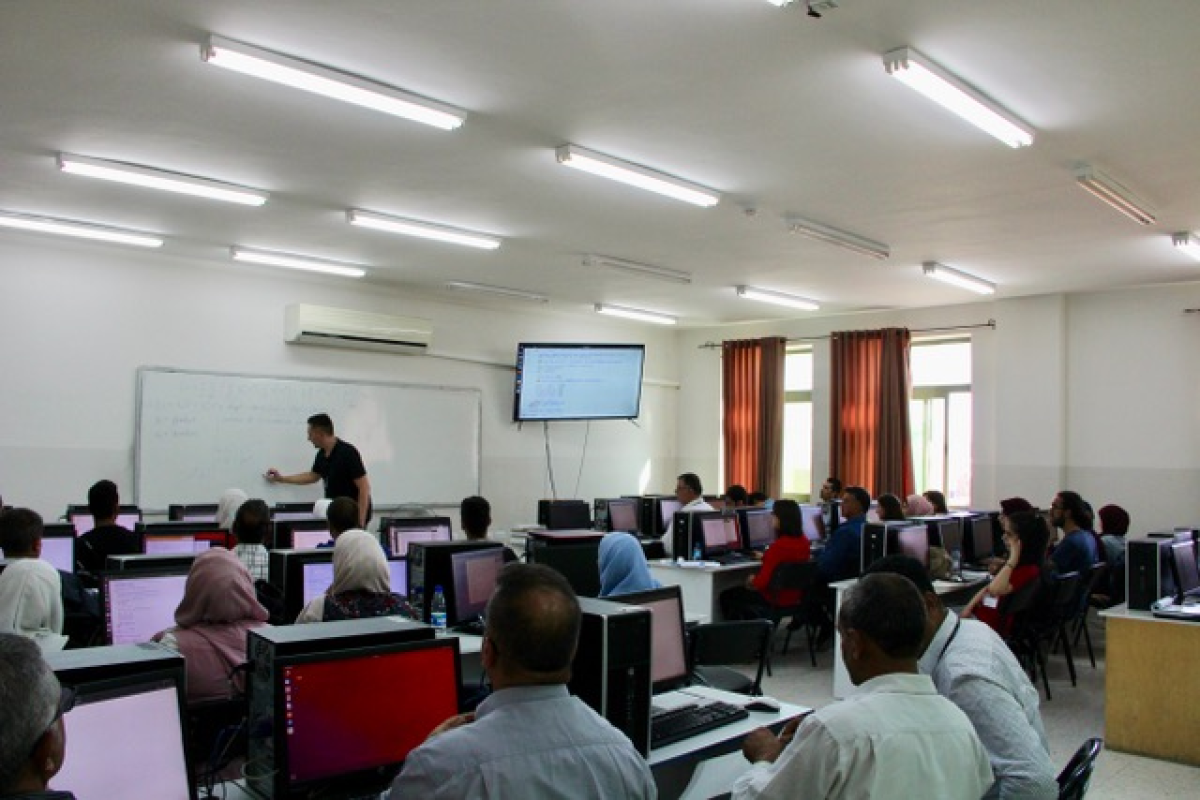


Course Content & Curriculum
The bachelor’s program has an interdisciplinary structure and combines content from mathematics,physics, computer science, and engineering. While the first two years focus on foundational knowledge, the third and fourth years emphasize specialized methods in simulation technology.
Courses include, among others:
- Fundamentals of Mechanics & Physics
- Programming & Algorithm Development
- Finite Element Methods (FEM) for Structural Mechanics
- Computational Fluid Dynamics (CFD) for Flow Simulation
- Tensor Analysis & Differential Geometry
- Simulation of Dynamic Systems
These courses provide students with a solid education that optimally prepares them for careers in industry and research.
Long-Term Prospects & Further Development
Implementing a new degree program in a region with limited resources is a challenging task. Among the greatest hurdles are:
- Recruiting and training local faculty
- Securing funding beyond the project’s duration
- Political uncertainties in the region
The long-term goal of the project is to sustainably integrate the bachelor’s degree program in to Palestine’s higher education landscape. In addition to the full transfer of teaching responsibilities to local staff, the following further developments are being pursued:
- Introduction of a master’s program in “Computational Mechanics”
- Development of new modules that address current research questions
- Expansion of cooperation with companies to improve career prospects for graduates
The “Computer Simulation in Science and Engineering” degree program makes a significant contribution to the modernization of higher education in Palestine. Close collaboration with German universities ensures that students receive an excellent education that optimally prepares them for the international job market. The focus on digital work models, the targeted support for women, and the sustainable integration of local academic staff make this project a unique and pioneering initiative in the region.
cooperated with


supported by

