
PhD project Greta Backhaus
PhD project Greta BackhausSystems Thinking in the context of tipping points using the example of lake ecosystem
Today’s societies are facing multiple complex problems that need both social and political solutions. Some of these problems, such as climate change or the loss of biodiversity, are biological phenomena that require Systems Thinking to understand, since biology in particular is characterized by multiple different systems (Momsen et al., 2022). A special property of some biological systems is the possible crossing of tipping points (Dakos et al., 2019), a phenomenon that is also increasingly discussed by the media in the context of climate change. However, Systems Thinking is also essential to understand tipping points as non-linear phenomena of complex systems (Mambrey et al., 2020). However, little attention has been paid to this phenomenon in research on Systems Thinking. Systems Thinking involves the ability to identify elements of a system, the relationships between those as well as the structure of the system and its boundaries, to recognize interactions, dynamics and complex interactions as well as emergence, and to make predictions about future system states (Lankers et al., 2023; Mambrey et al., 2020). It has been shown time and again that Systems Thinking is a hurdle for many learners and teachers (Sommer & Lücken, 2010), although Systems Thinking can be improved through specific intervention (Ben-Zvi Assaraf & Orion, 2005, 2010).
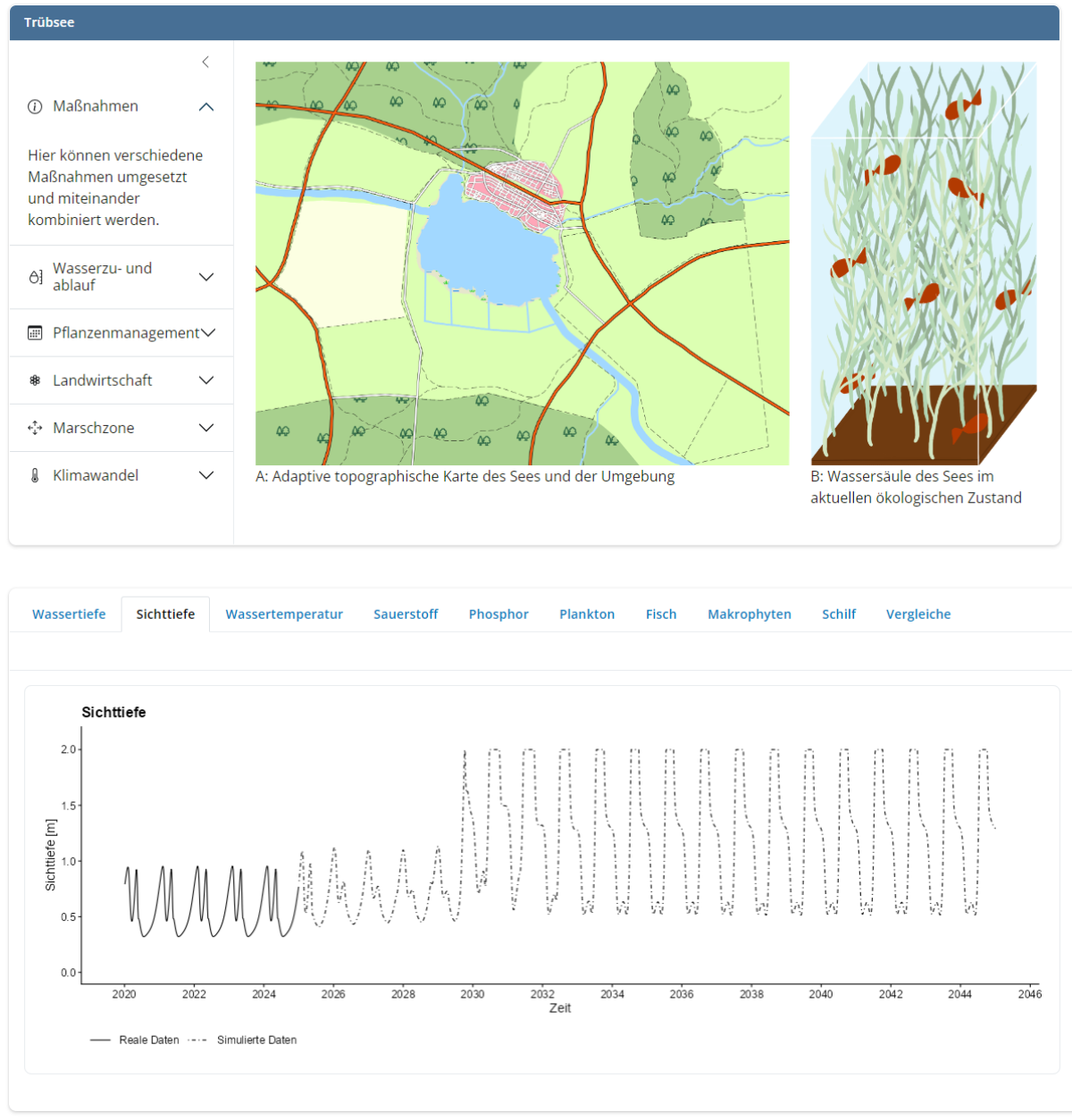
The project SysTip@Lake - Systems Thinking in Tipping Lake Ecosystem aims to investigate students' systemic thinking in relation to tipping points using the example of the lake ecosystem. For this purpose, the SeeSimulator, an interactive simulation based on the PCLake+ simulation model (Janssen et al., 2019), is being developed, which simulates two lakes (turbid and clear). The web-based app offers various intervention options. In this way the effectiveness of different measures (e. g. change in agricultural land use, change in the size of the marsh zone or plant management) can be investigated in relation to the ecological status of the lakes. The condition of the lakes can be assessed based on various measured values shown in diagrams. The various Systems Thinking skills of the test persons are assessed during interaction with the simulation by thinking aloud and creating a concept map (Tripto et al., 2013). A guided interview makes it possible to investigate the understanding of various system properties in more detail. Eye-tracking is used to understand and compare the usability of the SeeSimulator and the test persons' approach. The target group of the project are biology students as future multipliers of Systems Thinking as well as students of aquatic biology to be able to investigate the influence of knowledge about the ecosystem lake.
References
Ben-Zvi Assaraf, O. & Orion, N. (2005). Development of System Thinking Skills in the Context of Earth System Education. Journal of Research in Science Teaching, 42(5), 518–560. https://doi.org/10.1002/tea.20061
Ben-Zvi Assaraf, O. & Orion, N. (2010). System thinking skills at the elementary school level. Journal of Research in Science Teaching, 47(5), 540–563. https://doi.org/10.1002/tea.20351
Dakos, V., Matthews, B., Hendry, A. P., Levine, J., Loeuille, N., Norberg, J., Nosil, P., Scheffer, M., & Meester, L. de (2019). Ecosystem tipping points in an evolving world. Nature Ecology & Evolution, 3(3), 355–362. https://doi.org/10.1038/s41559-019-0797-2
Janssen, A. B., Teurlincx, S., Beusen, A. H., Huijbregts, M. A., Rost, J., Schipper, A. M., Seelen, L. M., Mooij, W. M., & Janse, J. H. (2019). PCLake+: A process-based ecological model to assess the trophic state of stratified and non-stratified freshwater lakes worldwide. Ecological Modelling, 396, 23–32. https://doi.org/10.1016/j.ecolmodel.2019.01.006
Lankers, A., Timm, J., & Schmiemann, P. (2023). Students’ systems thinking while modeling a dynamic ecological system. Frontiers in Education, 8, Article 1187237. https://doi.org/10.3389/feduc.2023.1187237
Mambrey, S., Timm, J., Landskron, J. J., & Schmiemann, P. (2020). The impact of system specifics on systems thinking. Journal of Research in Science Teaching, 57(10), 1632–1651. https://doi.org/10.1002/tea.21649
Momsen, J. L., Bray Speth, E., Wyse, S., & Long, T. M. (2022). Using Systems and Systems Thinking to Unify Biology Education. CBE Life Sciences Education, 21(2), 1-11. https://doi.org/10.1187/cbe.21-05-0118
Sommer, C. & Lücken, M. (2010). System competence – Are elementary students able to deal with a biological system? Nordic Studies in Science Education, 6(2), 125–143. https://doi.org/10.5617/nordina.255
Tripto, J., Ben-Zvi Assaraf, O., & Amit, M. (2013). Mapping What They Know: Concept Maps as an Effective Tool for Assessing Students’ Systems Thinking. American Journal of Operations Research, 03(01), 245–258. https://doi.org/10.4236/ajor.2013.31A022