

AK Giese Research
General research interests
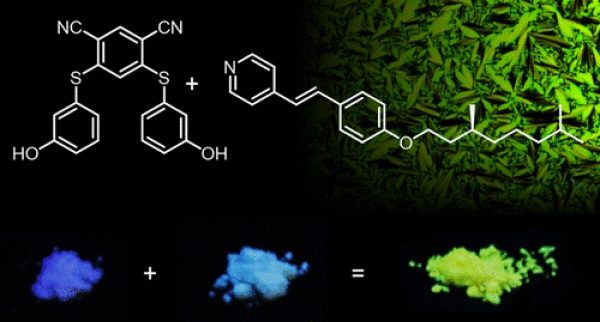
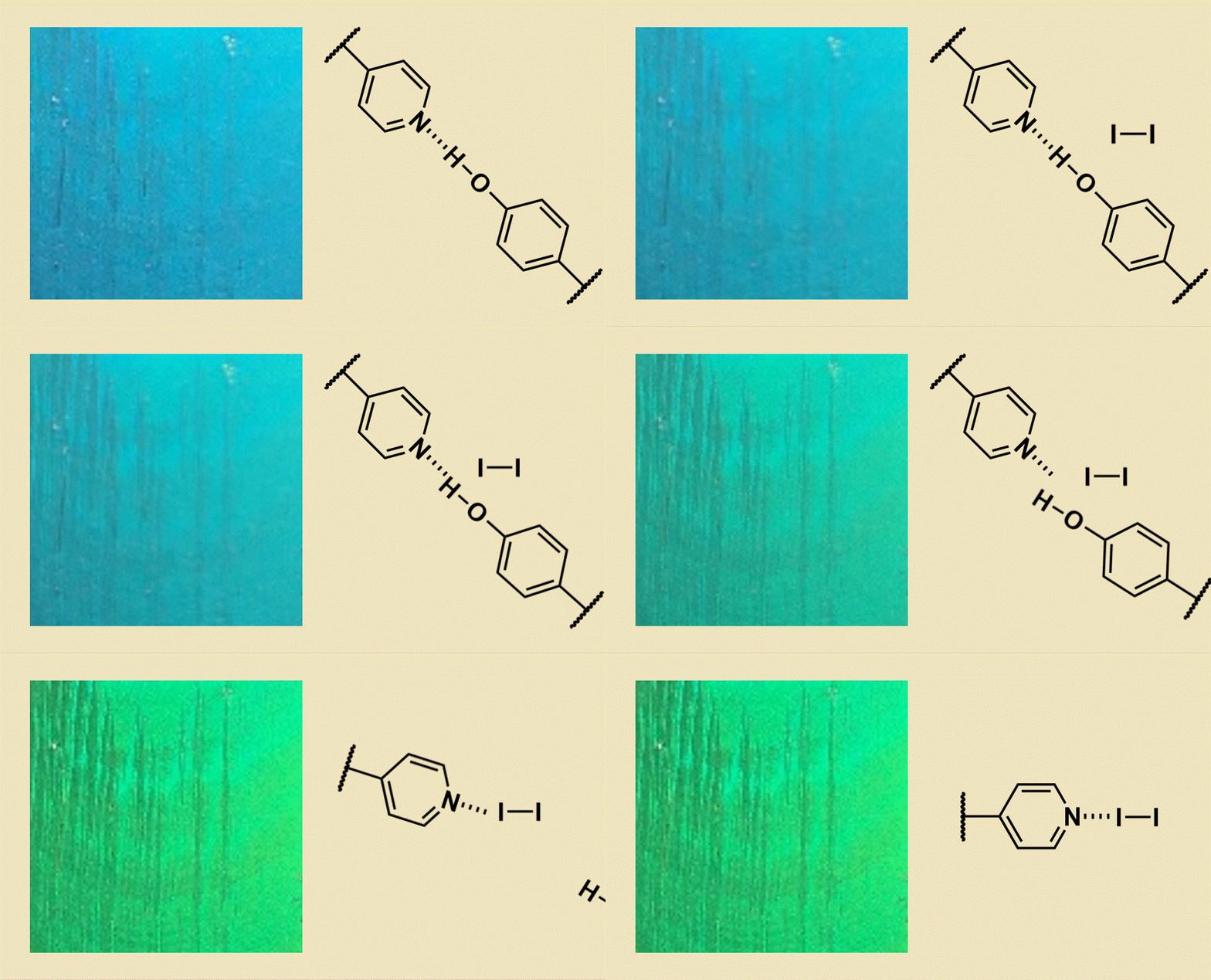
Our research group works in the field of supramolecular materials at the department of organic chemistry of the University of Duisburg-Essen. In the past five years we have gained strong expertise in synthesis and characterization of supramolecular liquid crystals (Introduction to liquid crystals), polymers and hybrid materials. Furthermore, we are interested in the design of photo-responsive and photonic materials as well as in fluorescent mesogens for sensing applications (see Figure 1). Supramolecular materials are obtained by molecular self-assembly of pre-tailored building blocks, held together by non-covalent forces such as hydrogen (HB) or halogen bonds (XB). The reversibility of these non-covalent interactions allows dynamic reorganization of the supramolecular structures as response to changes in the environment, which gives rise to the development of responsive materials. The properties of supramolecular materials result not only from the combination of the molecular building blocks, it also strongly depends on the supramolecular architecture of the assembly and the intermolecular forces between the individual building blocks. This complex interplay of non-covalent interactions makes the prediction of the properties of supramolecular materials challenging. In order to tackle the challenges in the design and synthesis of novel functional materials our group developed a modular supramolecular approach which enables systematic studies of the structure property relationships and at the same time provides a platform for tailor-made materials for various applications via simple self-assembly of the molecular entities. Therefore, hydrogen-/halogen-bond donors are combined with different acceptors to yield the functional assemblies.
Recent Publication
“A Modular Approach towards Functional Supramolecular Aggregates – Subtle Structural Differences Inducing Liquid Crystallinity” – M. Pfletscher, C. Wölper, J. S. Gutmann, M. Mezger, M. Giese,* Chem. Commun. 2016, 52, 8549-8552.
Fluorescent Materials
Organic materials with effective emission and multi-stimuli response are highly desirable for applications in optoelectronic devices, like displays or emissive diodes. In this context, the combination of fluorescence and liquid crystallinity yields a series of promising materials. A challenge on the design of such materials is fluorescence quenching due to higher ordered phases like liquid crystallinity or crystallinity. To overcome this quenching, chromophores with aggregation-induced emission can be used. Recently, we started to investigate fluorescent liquid crystalline materials obtained by two different approaches – a synthetic route and a supramolecular approach. The first route is based on AIE-active thioethers reported by Voskuhl and coworkers, which were decorated with alkyl-chains to promote liquid crystallinity. However, only one compound showed soft crystalline behavior with temperature-depending fluorescence. In contrast, the supramolecular approach yielded a series of hydrogen-bonded assemblies which showed temperature-depending fluorescence resulting from the order of the mesophase.
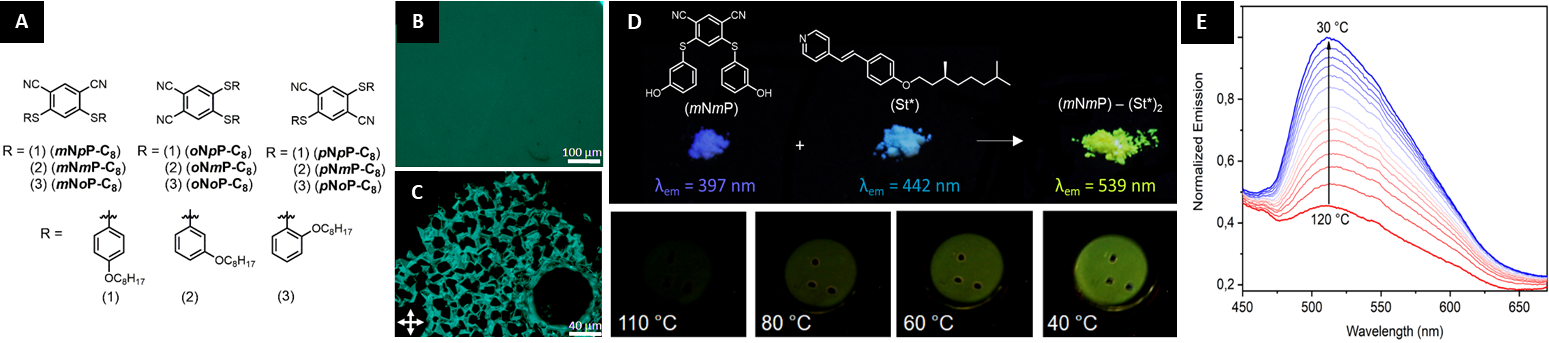 Figure 1: Molecular structures of the AIE-active compounds (A) and mesomorphic behavior under the POM (B, C) as well as the concept for hydrogen-bonded AIE-active mesogens (D) and their temperature-dependent fluorescence behavior (E).
Recent Publication
"Mesogens with Aggregation-Induced Emission Formed by Hydrogen Bonding" – M. Saccone, M. Blanke, C. G. Daniliuc, H. Rekola, J. Stelzer, A. Priimagi, J. Voskuhl,* M. Giese,* ACS Materials Lett. 2019, 1, 589-593.
"Structure–property relationships in aromatic thioethers featuring aggregation-induced emission: solid-state structures and theoretical analysis" – M. Saccone, S. Riebe, J. Stelzer, C. Wölper, C. G. Daniliuc, J. Voskuhl, M. Giese*, CrystEngComm 2019, 21, 3097-3105.
“Alkylated Aromatic Thioethers with Aggregation-Induced Emission Properties – Assembly and Photophysics” – S. Riebe, M. Saccone, J. Stelzer, A. Sowa, C. Wölper, K. Soloviova, C. Strassert, M. Giese,* J. Voskuhl,* Chem. Asian J. 2018, 14, 814-820.
Photoresponsive Materials
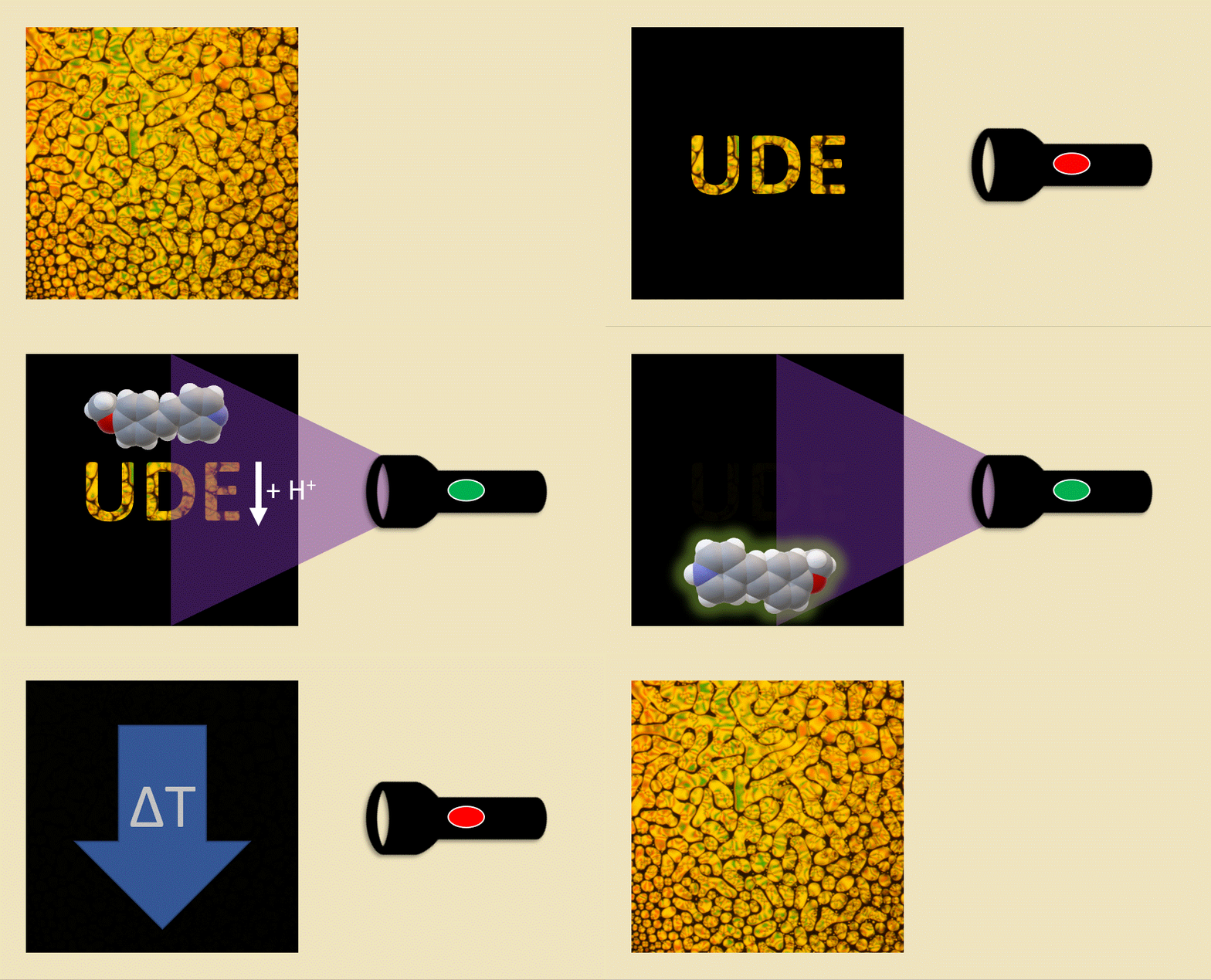
Many of our supramolecular assemblies are based on azobenzene derivatives, which provide an additional stimulus to gain control over the liquid crystalline and optical properties of the materials. In general, the photo-isomerization of azo-compounds yields a phase transition from the mesophase to the isotropic state. In addition, it allows us to delay the crystallization of the supramolecular assemblies. However, more interesting than the photo-controlled OFF-switching is to have a photo-trigger for introducing a new property. In a series of HBLCs based on hydroxy-benzoic acids and stilbazoles we observed a photo-activated fluorescence upon irradiation with 405 nm. The fluorescence results from the formation of a push-pull system at the stilbazole due to proton transfer. The emerging fluorescence is accompanied with a phase transition from the mesophase to the solid state and allows us to imprint patterns into the material. By heating the samples to 150°C for 1.5 h the image can be erased and after returning to the mesophase (at 90°C) a new pattern can be imprinted.
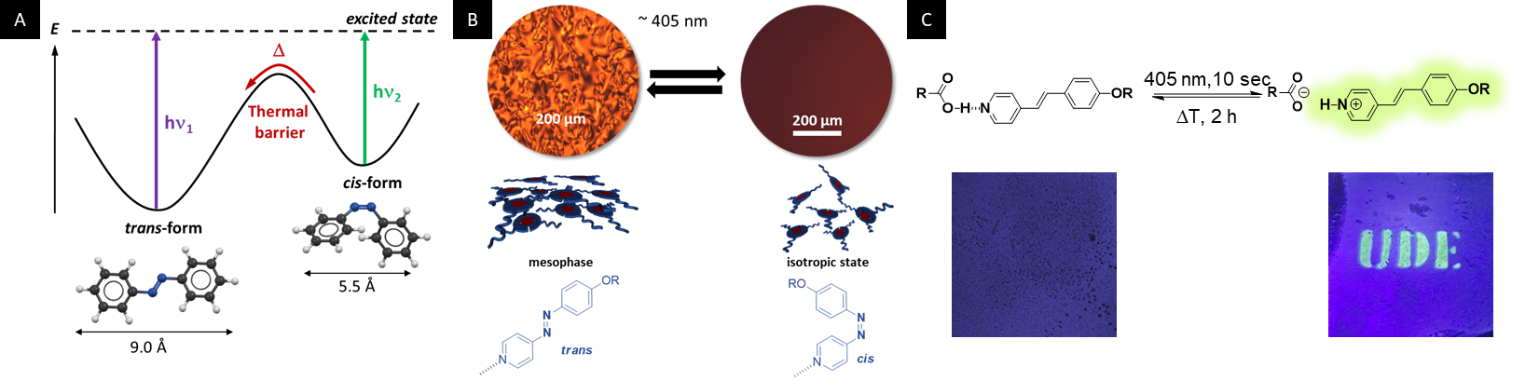
Figure 1: Visualization of the photo-induced trans-cis isomerization of azobenzenes (A) as well as POM images showing the nematic to isotropic phase transition upon irradiation with light (405 nm). (C) shows the photo-excitation of stilbazole resulting in a proton transfer and the ON-switching of fluorescence.
Recent Publication
"Photo-switchable Fluorescence in Hydrogen-bonded Liquid Crystals" – A. Kappelt, M. Giese,* Chem. Eur. J. 2020, accepted for publication, DOI: 10.1002/chem.202001696.
"Photo-switching and -cyclisation of hydrogen bonded liquid crystals based on resveratrol" – M. Blanke, J. Balszuweit, M. Saccone, C. Wölper, D. Doblas Jiménez, M. Mezger, J. Voskuhl,* M. Giese,* Chem. Commun. 2020, 56, 1105-1108.
"Photoresponsive Halogen-Bonded Liquid Crystals: The Role of Aromatic Fluorine Substitution" – M. Saccone, M. Spengler, M. Pfletscher, K. Kuntze, M. Virkki, C. Wölper, R. Gehrke, G. Jansen, P. Metrangolo, A. Priimagi, M. Giese*, Chem. Mater. 2019, 31, 2, 461-470.
Photonic Sensing
Chiral mesophases such as the chiral-nematic phase (also called cholesteric phase) are highly interesting with respect to photonic applications since they represent one-dimensional photonic crystals. Photonic crystals are materials with periodically changing refractive indices in one, two or three dimensions allowing them to selectively diffract certain wavelengths of light. For chiral-nematics, the reflected wavelength depends on the pitch (P) of the helical structure, the refractive index (navg) of the material and the angle of the incident light (sin(q)).
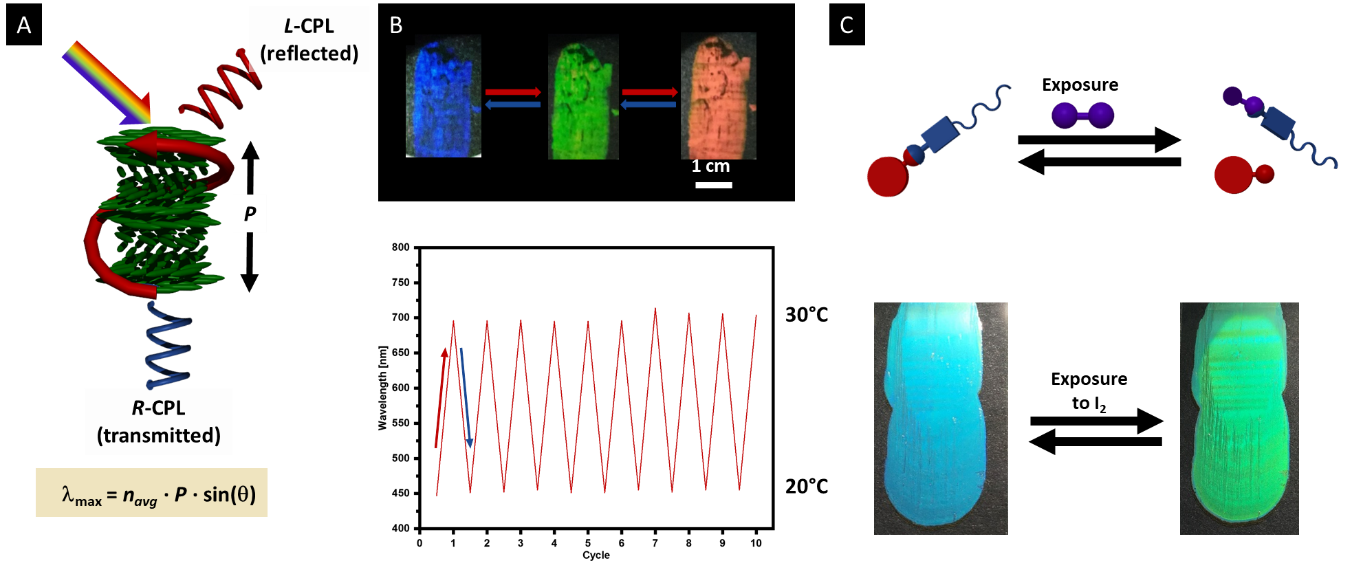
Figure 1: Schematic representation of the selective refraction of visible light at chiral-nematic structures (A) as well as representative figures of the temperature (B) and chemo-sensing (C).
The helical pitch corresponds to the repeating distance of a full 360° turn of the mesogens. When half of the pitch (P/2) of the chiral structure is in the region of the wavelength of visible light (Figure 1), the materials appear structurally coloured. Due to the chiral structure, the reflected light is circularly polarized with a handedness determined by the helical sense of the mesophase whereby a maximum of 50% of the incident light will be reflected. The light of the opposite handedness transmits through the film without loss of intensity. Since the structure of a chiral-nematic mesophase is flexible and can be affected by external stimuli it offers opportunities to use these dynamics for photonic sensing. In our group we use this structural flexibility for the sensing of temperature or biologically relevant gaseous analytes such as nitrous gases or carbon monoxide.
Recent Publication
"Cellulose nanocrystals in nanoarchitectonics – towards photonic functional materials" – M. Giese*, M. Spengler, Mol. Syst. Des. Eng. 2019, 4, 29-48.
Supramolecular Gels
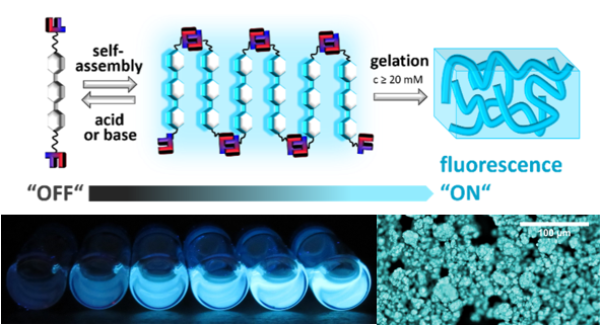
Supramolecular gels show great potential as soft smart materials, since their gel-sol phase transitions can be triggered by external stimuli. In this context, we prepared a series of dual-pH responsive and highly fluorescent DMSO gels by functionalizing aggregation-induced emission (AIE) active fluorophores with guanidiniocarbonyl pyrrole carboxylate (GCP) zwitterionic binding sites (see Fig. 1). In the gel state an intense fluorescence emission is observed, as the gelator molecules are fixed within a dense network of self-assembled fibres held together by H-bond assisted ion pairs between the GCP zwitterions. The phase transition to the sol state can be triggered by various stimuli (acid or base, temperature and mechanical stress) and goes along with a loss of fluorescence due to an increasing motional freedom of the monomers.
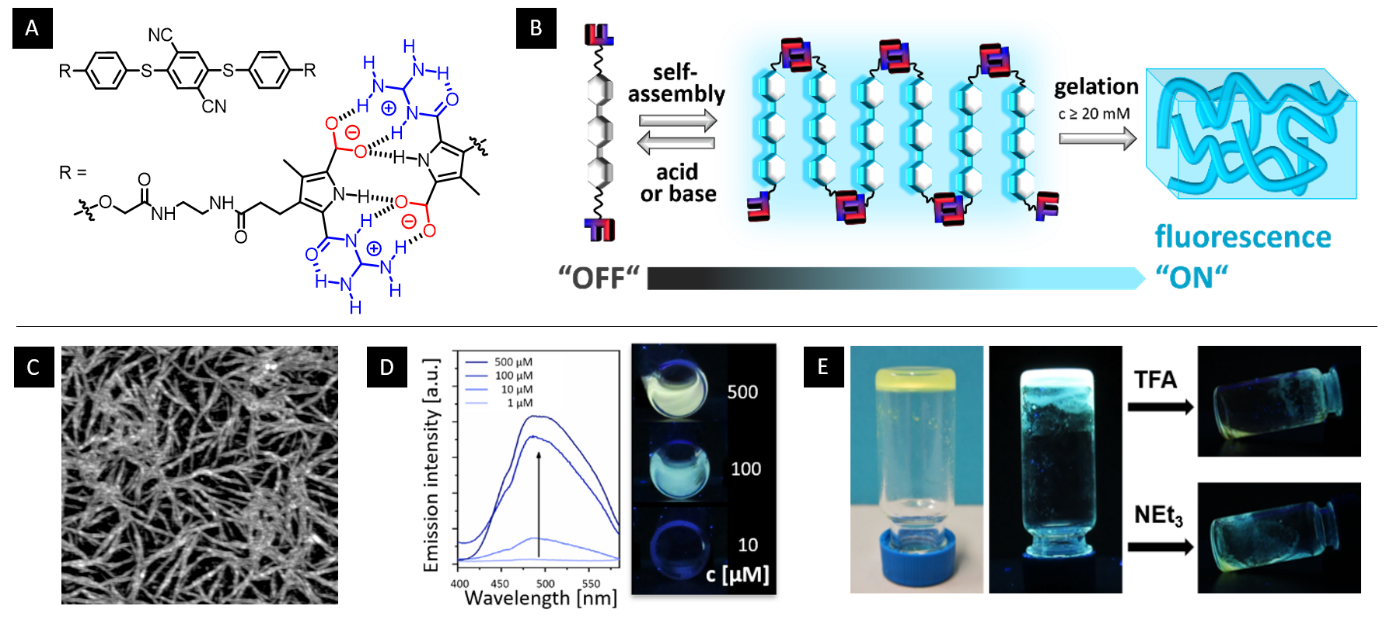
Figure 1: (A) Molecular structure of a bis-zwitterionic AIE-active gelator based on aromatic thioethers reported by Voskuhl and coworkers and dimerization of the zwitterionic binding site. (B) Schematic representation of the gelation process. (C) AFM image of the self-assembled fibrillar network. (D) Increase of emission intensity upon increasing concentrations. (E) DMSO gel under daylight and UV-light, and gel-sol transition triggered by the addition of acid and base.
As a next step we designed a modular construction kit for the preparation of more sophisticated supramolecular copolymers and multicomponent gels. In this project we several central core units (with useful properties, e.g. fluorescence, E/Z-isomerizability, water solubility) will be combined via orthogonal switchable supramolecular binding motifs (GCP zwitterions, metal-ligand binding sites, host-guest systems).
Recent Publication
M. Externbrink, S. Riebe, C. Schmuck, J. Voskuhl, Soft Matter 2018, 14, 6166-6170: “A Dual pH-Responsive Supramolecular Gelator with Aggregation-Induced Emission Properties”.
Hybrid Materials
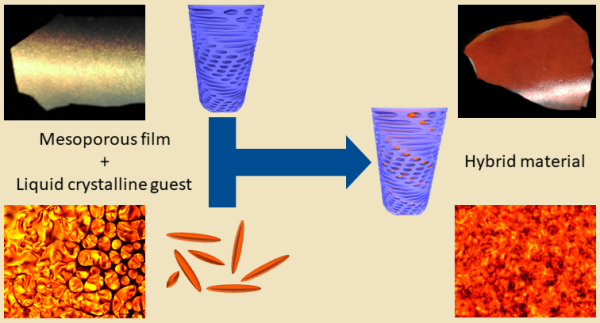
We are also interested in the self-assembly of liquid crystalline materials in confined spaces of mesoporous silica films. Therefore, our modular approach was adapted for the investigation of inorganic/organic hybrid materials. An interesting feature of the mesoporous silica films is that they are obtained by soft-templating with cellulose nanocrystals, which yield mesoporous materials with the chiral-nematic structure of the template imprinted in the nanostructure of the films. The nanostructure of the films represents a one-dimensional photonic crystal (for comparison see photonic sensing) and selectively reflects light of a specific wavelength and handedness. The color of this reflection depends on the periodicity (helical pitch) of the chiral-nematic structure, which cannot be changed due to the limited flexibility of silica. However, a second handle to manipulate the photonic properties of the mesoporous materials is given by the refractive index contrast between the host material (silica) and the guest (air) in the pores. Therefore, the infiltration of the pores with a guest which shows temperature-depending changes in the refractive index, such as liquid crystals, allows for the control of the photonic reflection by temperature. Our studies on the mesoporous silica films infiltrated by hydrogen-bonded liquid crystals show that the pores size controls the liquid crystalline behavior of the mesogens and that the mesogenic guests enable to change the photonic response of the nanostructured silica by temperature and UV-light (due to a photo-initiated phase transition, see Figure 1).
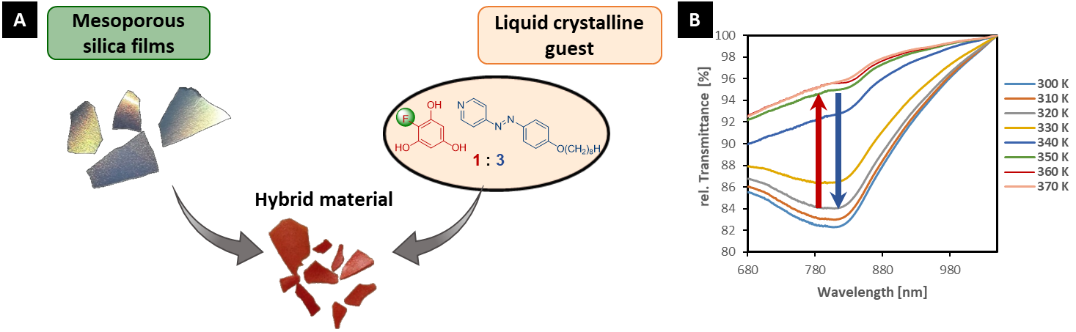
Figure 1: Schematic representation of the synthesis of the thermochromic hybrid materials (A) as well as their UV-Vis spectra of the hybrid material upon heating and cooling.
Recent Publication
“Hydrogen‐Bonded Liquid Crystals in Confined Spaces—Toward Photonic Hybrid Materials” – M. Spengler, R.Y. Dong, C.A. Michal, W.Y. Hamad, M. J. MacLachlan,* M. Giese,* Adv. Funct. Mater. 2018, 28, 1800207-1800207.
“Tuning the photonic properties of chiral nematic mesoporous organosilica with hydrogen-bonded liquid-crystalline assemblies” – M. Giese,* T. Krappitz, R.Y. Dong, C.A. Michal, W.Y. Hamad, B.O. Patrick, M. J. MacLachlan,* J. Mater. Chem. C 2015, 3, 1537-1545. (Hot Article)