
Summary of PITCH project
Innovating examinations, creating transfer and promoting equal opportunities in organic chemistry
Summary PITCH-Project
As part of the PITCH project, many participating departments at the University of Duisburg-Essen are taking a step towards a new – namely digital – examination culture (overview of participating departments). This project is funded by the Stiftung Innovationen in der Hochschullehre.
In the field of organic chemistry, there is currently a lack of suitable possibilities for digitally implementing typical task formats in teaching and examinations. A key part of organic chemistry is examining complex organic molecules, which are depicted in the form of structural formulae (see example in Fig. 1). In current teaching and examination practice, this is done with pencil and paper or with chalk on a board.
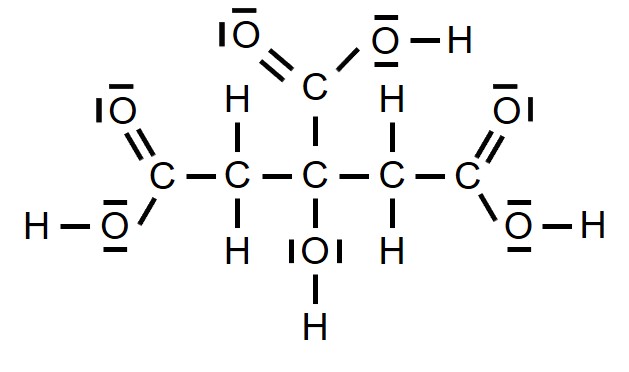
Figure 1: Structural formula of a citric acid molecule
Various programmes requiring a licence are available for digital depiction of such molecules. These are aimed at experts, however, and are designed for professional use. There are two main reasons why it is tricky to use them in teaching and examinations: (1) These programmes presuppose expertise among users and do not allow certain representations and classic beginner’s mistakes that are made in the course of learning processes. Learners therefore cannot depict molecules (incorrectly) in the way they would using pencil and paper; that means these mistakes cannot form part of the learning and assessable performance in the examination.
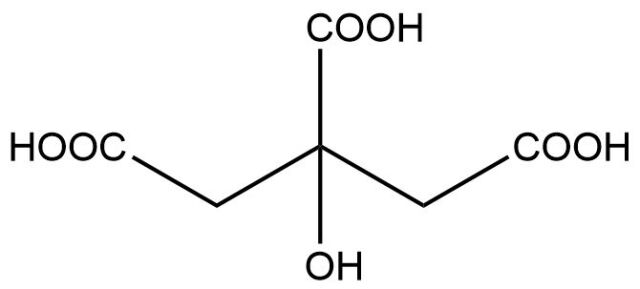
Figure 2: Representation of a citric acid molecule with a digital drawing programme
(2) The implementation of these professional programmes in learning platforms like Moodle is not provided for due to their target groups. Even if, as is the case at the University of Duisburg-Essen, there is a campus licence for such a programme, the possibilities for designing tasks with the help of these programmes are limited and, aside from the pure digitisation of the drawing, do not offer any added value in the sense of an integration of didactic support measures as required by innovative learning offerings. Rather, there is a risk that a cumbersome embedding in learning platforms like Moodle will lead to unnecessary cognitive load due to their operation, and that this impacts negatively on students’ learning success (extraneous processing, for an overview, see Mayer, 2009; Paas & Sweller, 2014).
Desirable support measures that represent an innovation and an additional learning opportunity compared to the current pencil-and-paper-based, in-person learning could take the form of additional digital learning solutions with immediate individual, error-specific or rule-based feedback (for an overview, see Johnson & Priest, 2014; Narciss, 2006, Shute 2008). With these, students can receive immediate feedback on their current skill level and can tackle further exercises flexibly as required. The immediate feedback on the task tackled is considered more favourable in motivational terms than, say, feedback received in person several days later. In addition, an in-person event does not generally permit individual feedback for all students on all their assignments.
For teachers, this kind of digital learning offering provides relief, because it saves them from correcting students’ exercises. In-person events can therefore focus on discussing classic difficulties or errors that occur frequently in tackling tasks and do not have to cover complete exercise sheets step by step in order to offer students a sample solution for comparing their own results.
If a digital learning solution like this functions seamlessly, then it can also be used for the purposes of examinations. Here, it can benefit both students and teachers because students don’t have to wait weeks for exam results and teachers are saved time-consuming correction work.
Crucial aspects for the success of a digital learning solution like this are: (1) that the technical implementation succeeds in such a way that the system is easy to use and does not lead to an unnecessary cognitive burden that hampers students’ learning processes – be it through cognitive overload or affective factors (like rejecting the learning offering); (2) the system must save teachers work – which can only be the case if there is automatic task generation and evaluation. If every task and the necessary error or rule-based feedback have to be generated manually, then the added burden will mean teachers will not use the system; and (3) the system must function reliably. If errors occur during use or the system is not available at times, this will lead to rejection on the part of teachers and students, and it will not be possible to use it in exams.
As part of the PITCH project, an editor that enables the display of structural formulae is integrated into the JACK® exercise and examination system. This creates the possibility of offering task formats characteristic of organic chemistry digitally, too. With the help of JACK®, rule-based feedback is provided that gives students hints about their mistakes. As part of the project, this feedback should be automated in such a way that it no longer has to be created individually for single tasks, but rather is available for specific types of tasks. Tasks created will be tested in the Moodle courses of the organic chemistry lectures and evaluated based on their learning effectiveness and their impact on cognitive and affective variables so that they can also be used in examinations once they have been sufficiently tested.
References
Johnson, Ch. I. & Priest, A. H. (2014). The Feedback Principle in Multimedia Learning (pp.449-463), in: Mayer, R. E. [ed.]. The Cambridge Handbook of Multimedia Learning – Second Edition, Cambridge University Press, New York.
Mayer, R. E. (2009). Multimedia learning (2nd ed.). Cambridge University Press. https://doi.org/10.1017/CBO9780511811678
Narciss, S. (2006). Informatives tutorielles Feedback. Entwicklungs- und Evaluationsprinzipien auf der Basis instruktionspsychologischer Erkenntnisse, Münster / New York / Munich / Berlin, Waxmann Verlag GmbH.
Paas, F., & Sweller, J. (2014). Implications of cognitive load theory for multimedia learning. In R. E. Mayer (ed.), The Cambridge handbook of multimedia learning (pp. 27–42). Cambridge University Press. https://doi.org/10.1017/CBO9781139547369.004
Shute, V. J. (2008). Focus on formative feedback. Review of educational Research, 78(1), 153-189. https://doi.org/10.3102/0034654307313795
Final Report
In order to digitally implement characteristic organic chemistry exercises, an open-source molecule editor (Kekule.js, Jiang et al., 2016) was implemented in the JACK learning and assessment environment (JACK, Striewe, 2016) in cooperation with colleagues from Bonn, Essen and Trier. This makes it possible to generate exercises in which molecules are represented as skeletal formulas (Brecher, 2008). For evaluation purposes, molecules are translated into a string code (InChI code, Heller et al., 2015). This can be compared with an example solution as well as alternative solutions and anticipated incorrect solution attempts. Students then receive feedback on their solution attempt. These tasks make it possible to represent and automatically evaluate individual and multiple molecules. Simple reaction equations can also be implemented with the tool.
In addition to checking only molecules, the program also checks whether molecules appear as reactants or products in the equation.
The newly developed tasks were tested with students during the introductory organic chemistry course and optimized over the course of the project. For the exercises, students are usually allowed three attempts at solving the problems before they receive a sample solution. In addition to the chemistry-specific tasks newly developed in the project, JACK also offers the option of implementing other, subject-specific task types (e.g., fill-in or multiple-choice). These were used as a supplement.
In addition to the feedback from students in the course, several studies were conducted to evaluate the digital tasks, examining the extent to which there are differences in the processing of digital and paper-based tasks. These studies have resulted in various publications (Schuessler, Rodemer et al., 2024; Schuessler, Striewe et al., 2024; Schüßler et al., 2025a; Schuessler et al., 2025b) and an application for a research project.
The PITCH project has resulted in an extensive collection of digital tasks, which is currently being prepared for release to interested parties. At the same time, an analysis of the students' responses to the tasks in the exercise mode is being carried out in order to be able to make statements about the effectiveness of the feedback provided. In addition, efforts are being made to continue the development of the digital tasks beyond the end of the project, with the aim of being able to reliably evaluate electron arrows and reaction sequences with several reaction steps in a reliable and automated manner in the future.
References
Brecher, J. (2008). Graphical representation standards for chemical structure diagrams (IUPAC Recommendations 2008). Pure and Applied Chemistry, 80(2), 277–410.
https://doi.org/10.1351/pac200880020277
Jiang, C., Jin, X., Dong, Y. & Chen, M. (2016). Kekule.js: An open source JavaScript chemoinformatics toolkit. Journal of chemical information and modeling, 56(6), 1132–1138.
https://doi.org/10.1021/acs.jcim.6b00167
Schüßler, K., Rodemer, M., Giese, M., & Walpuski, M. (2024). Organic Chemistry and the Challenge of Representations: Student Difficulties with Different Representation Forms When Switching from Paper–Pencil to Digital Format, Journal of Chemical Education (11), 4566-4579.
https://pubs.acs.org/doi/full/10.1021/acs.jchemed.4c00303
Schüßler, K., Striewe, M., Pueschner, D., Luetzen, A., Goedicke, M., Giese, M., & Walpuski., M. (2024). Developing and Evaluating an E-Learning and E-Assessment Tool for Organic Chemistry in Higher Education. Front. Educ, 9.
https://doi.org/10.3389/feduc.2024.1355078
Schüßler, K., Giese, M. & Walpuski, M. (2025a). Erste Schritte auf dem Weg zu einer digitalen Lern- und Prüfungsumgebung für die organische Chemie [First steps towards a digital learning and assessment environment for organic chemistry]. In N. Auferkorte-Michaelis, M. Bonnes, P. Hintze & J. Liebscher (Hrsg.), Prüfungen digital gestalten: Technische und didaktische Konzepte für die Hochschullehre [Designing exams digitally: Technical and didactic concepts for university teaching]. Barbara Budrich.
Schuessler, K., Giese, M. & Walpuski, M. (2025b). Note-taking moderates the relationship between invested mental effort and solving chirality tasks. Chemistry Education Research and Practice.
https://doi.org/10.1039/D5RP00256G
Striewe, M. (2016). An architecture for modular grading and feedback generation for complex exercises. Science of Computer Programming, 129, 35–47.
https://doi.org/10.1016/j.scico.2016.02.009