

What we are doing
Our current research is part of the DFG-funded Collaborative Research Center (SFB/TRR 247) and is dedicated to "Heterogeneous Oxidation Catalysis in the Liquid Phase". In other words, we are working on accelerating the production of liquid chemicals on the surfaces of solid-state materials. We are investigating fundamental optimization processes that enable rational design and improvement of abundant and low-cost oxides as an alternative to expensive metals for their potential use as catalytic materials to produce environmentally friendly chemical fuels.
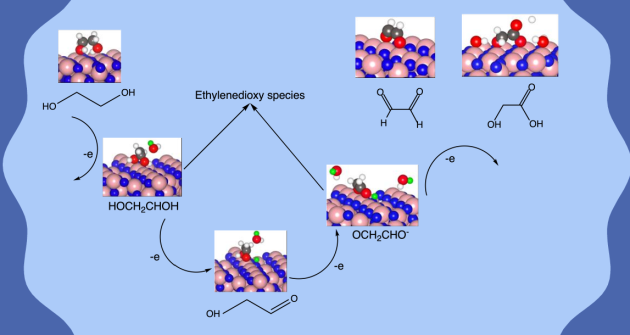
Fig. 1: Oxidation of Ethylene glycol
We are conducting ab initio simulations to help bringing the understanding of oxides liquid phase oxidation catalysis, on which most industrial processes are based, to the same level as that of the already well-established gas phase catalysis on metals. We work in an interdisciplinary environment, and we are providing computational expertise to various experimental projects within the SFB/TRR 247 and beyond, to shed light on important and fundamental aspects of heterogeneous liquid phase catalysis on oxide surfaces. This includes electro-, thermal- and photo-catalysis.
Also, we are involved in many collaborations with physicists and chemists outside the CRC 247 consortium, in Germany as well as in the rest world. Mostly via joint experimental and theoretical studies we investigate together transition metal dichalcogenides, perovskites and Heuslers materials for catalysis, energy and environmental research. A strong focus is devoted to scientists from Africa with the aim of bridging computational sciences and experimental research that miss the most on the continent.

Group Leader: PD. Dr. habil. Stephane Kenmoe
Stephane Kenmoe is the driving force behind The Central African School on Electronic Structure Methods and Applications (CASESMA), a yearly capacity building event taking place in Central Africa during a week or two. Since 2018, 7 editions have been organized in Dschang Cameroon (2018, 2019, 2025 and 2026), Kinshasa (2022), Brazzaville (2023 and 2024). The school is open to early career scientists from central Africa and beyond and focuses various aspects of computational condensed matter. These include many body techniques (DFT, molecular dynamic simulations, light-matter interaction) to simulate condensed phases of matter (liquid, solids, interfaces or catalytic systems).
While early career participants come mainly from middle Africa, lecturers come from all over the world. Up till date CASESMA has witnessed the participation of more than 400 early career participants from Cameroon, Congo Republic, Democratic republic of Congo, Gabon, Central African Republic, Chad, Burundi, Nigeria and Sudan. Lecturers from Germany, Italy, France, UK and Sweden have contributed to the success of CASESMA. The school goes beyond the one- or two-weeks training. It has paved the way for collaboration between participants and various research groups at the international level.
Are you interested in joining the next CASESMA ? Please contact us at: stephane.kenmoe@uni-due.de