
PhD project Carolyn Erben
PhD project Carolyn ErbenThe ideas and interests of students regarding the watercourse ecosystem
Contact: Carolyn Erben
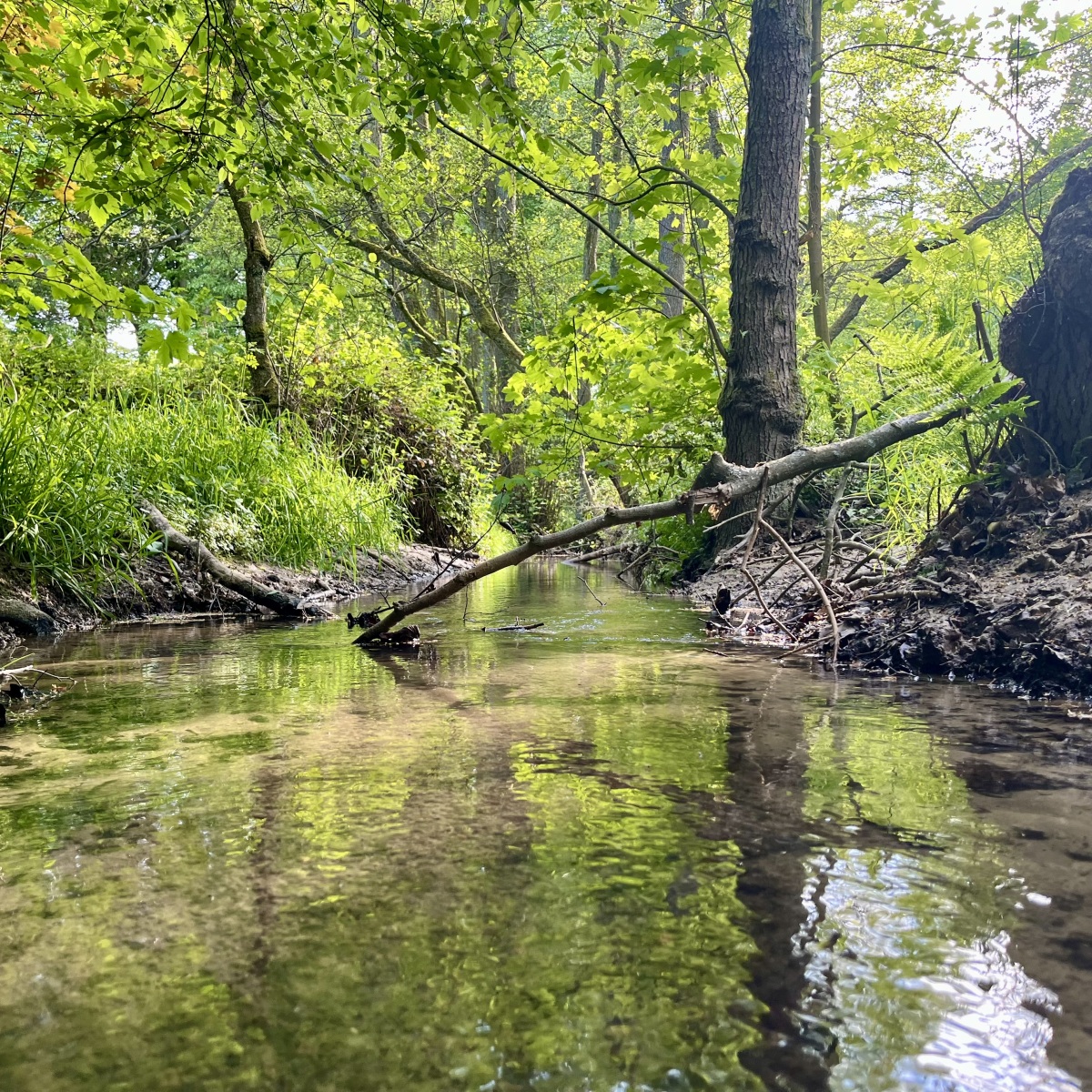
Watercourses are important ecosystems that are widely used by humans for various purposes, such as providing drinking water, supporting food production, and serving as local recreational areas. However, more than half of Germany's watercourses (52.7%) are in an unsatisfactory to poor ecological state (BMUV/UBA, 2022). To improve the condition of our watercourses, we need to raise awareness of aquatic ecosystems, as well as implement comprehensive water monitoring and protection measures. Citizen science (CS)-projects in the environmental sector can help to raise awareness of watercourse ecosystems by combining science communication with the experience of nature in action-oriented projects (Moormann & Sturm, 2021, p. 379). In the Citizen Science-project 'DNA macht Schule' ('DNA goes school'), pupils use molecular genetic methods, such as environmental DNA metabarcoding, to explore river ecosystems and learn about new research methods.
In order to be able to create evidence-based learning materials for the project, it is necessary to analyse the initial prerequisites of the students. In particular, the prior knowledge, interest and attitudes of learners are considered to be prerequisites for effective learning and should therefore be taken into account when creating learning materials (e.g. Renninger & Hidi, 2017; Schrenk et al., 2019; Graf, 2007). However, at present, there are few to no empirical findings regarding prior knowledge, interest and attitudes towards the river ecosystem and river analyses (Ladrera et al. 2020).
As part of the study, a design-based research (DBR) approach (Reinmann, 2005) will be used to record the prior knowledge, interests and attitudes of primary and secondary school pupils. Subsequently, the learning materials will be developed iteratively. The design-based research approach aims to promote sustainable innovation in teaching and learning processes through 'systematic design, implementation, review and redesign' (Reinmann, 2005, p. 61). This iterative process will be repeated to produce material that is as conducive to learning as possible, and to generate empirical data on the effectiveness of CS-projects in terms of students' knowledge, interest and attitudes towards the river ecosystem.
References
Bundesministerium für Umwelt, Naturschutz, nukleare Sicherheit und Verbraucherschutz [BMUV] / Umweltbundesamt [UBA] (2022). Die Wasserrahmenrichtlinie - Gewässer in Deutschland 2021. Fortschritte und Herausforderungen.
Graf, D. (2007). Die Theorie des geplanten Verhaltens. In D. Krüger & H. Vogt (Hrsg.) (2007), Theorien in der biologiedidaktischen Forschung. Ein Handbuch für Lehramtsstudenten und Doktoranden (S. 33-34). Springer.
Ladrera, R., Rodríguez-Lozano, P., Verkaik, I., Prat, N. & Díez, J. R. (2010). What do students know about rivers and their managemenz? Analysis by educational stages and territories. Sustainability, 12(20), 8719.
Moormann, A. & Sturm, U. (2021). Naturerfahrung durch Citizen Science-Projekte. In U. Gebhard, A. Lude, A. Möller & A. Moormann (Hrsg.), Naturerfahrung und Bildung (S. 379-393). Springer VS.
Reinmann, G. (2005). Innovation ohne Forschung? Ein Plädoyer für Design-Based Research-Ansatz in der Lehr-Lernforschung. Unterrichtswissenschaft, 33(1), 52-69.
Renninger, K. A, & Hidi, S. E. (2017). The power of interest for motivation and engagement. Routledge.
Schrenk, M., Gropengießer, H., Groß, J., Hammann, M., Weitzel, H. & Zabel, J. (2019). Schülervorstellungen im Biologieunterricht. In J. Groß, M. Hammann, P. Schmiemann & J. Zabel (Hrsg.), Biologiedidaktische Forschung: Erträge für die Praxis (S. 3-20). Springer Spektrum.