

LIISim and LIFSim
LIISim is a modular signal processing toolbox developed and maintained by our Chair at the University of Duisburg-Essen. This tool is designed to assist the scientific community with time-resolved laser-induced incandescence (LII) measurements, which are used for in situ analysis of gas-borne soot and inorganic nanoparticles in reactive media like flames or gas-phase synthesis.
LIISim enables precise determination of particle cooling curves and particle sizes by measuring the temporal decay of particle incandescence at multiple wavelengths after laser-induced heating.
The software facilitates the complex process of evaluating LII data, starting with importing raw signals from oscilloscopes, processing these signals to calibrated forms, applying spectroscopy and heat transfer models, and finally visualizing, comparing, and extracting the data.
The software’s modular architecture allows users to customize and extend its capabilities. It includes various spectroscopic and heat-transfer models, enabling accurate simulations of particle behavior during and after laser heating. This flexibility is crucial for adapting to different experimental setups and conditions.
A significant advantage of LIISim is its support for a common file format, which simplifies data exchange and comparison between research groups. This standardization can lead to the establishment of a public measurement database, enhancing collaborative efforts and inter-laboratory comparisons. By providing open-source access under the GNU General Public License (GPL), LIISim encourages validation, improvement, and further development by the global research community.
LIISim is equipped with a graphical user interface (GUI) that allows dynamic evaluation of data. Users can configure and combine processing steps flexibly, visualize the results in real-time, and analyze experimental data with ease. The software’s multi-threading capability ensures efficient processing, making it suitable for handling large datasets.
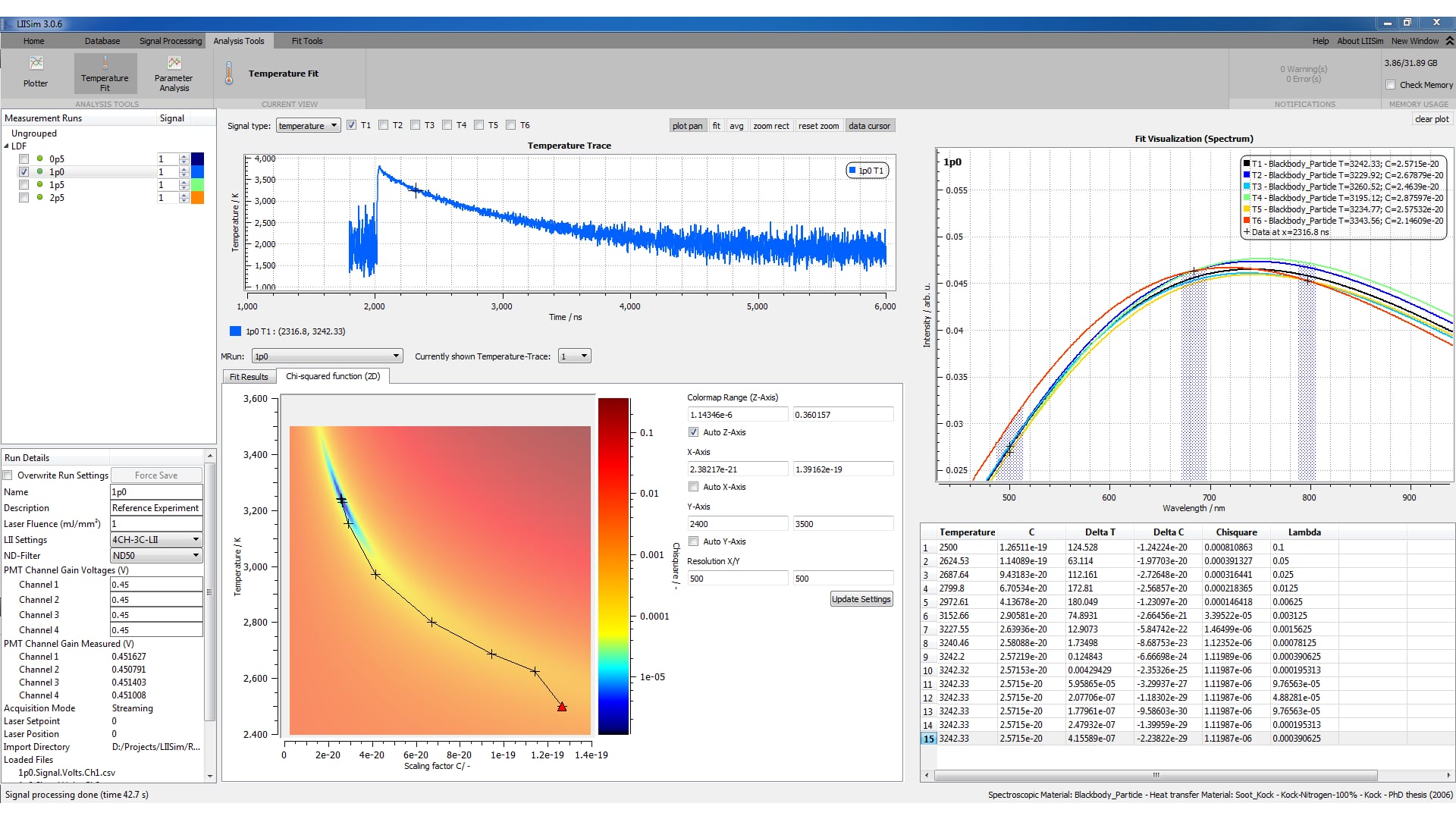
Fig1. Graphical User Interface (GUI)
The source code and executable files are available on GitHub, promoting transparency and accessibility.
In summary, LIISim is a comprehensive tool that enhances the accuracy and efficiency of with time-resolved LII measurements. Its open-source nature, combined with robust features for data processing and analysis, makes it an invaluable resource for researchers in the field of combustion and nanoparticle diagnostics.
LIFSim 4.0 is a sophisticated software developed and maintained by our Chair at the University of Duisburg-Essen. This innovative tool is designed to simulate and fit laser-induced fluorescence (LIF) multi-line spectra in reactive media such as flames or gas-phase synthesis processes. By providing detailed simulations of absorption, LIF excitation, and LIF emission spectra for molecules such as NO, SiO, OH, and O2, LIFSim 4.0 aids researchers in measuring concentration and temperature fields, offering critical insights into reaction intermediates distribution and temperature fieds-
The software's modular structure allows for extensive customization and expansion, enabling users to include additional species as needed. LIFSim 4.0 calculates line positions, line broadening, and collisional quenching effects based on spectroscopic data from the literature, ensuring accurate and reliable simulations. This capability is crucial for deriving detection schemes that offer high selectivity and quantitative information, even under varying conditions of temperature, pressure, and bath-gas composition.
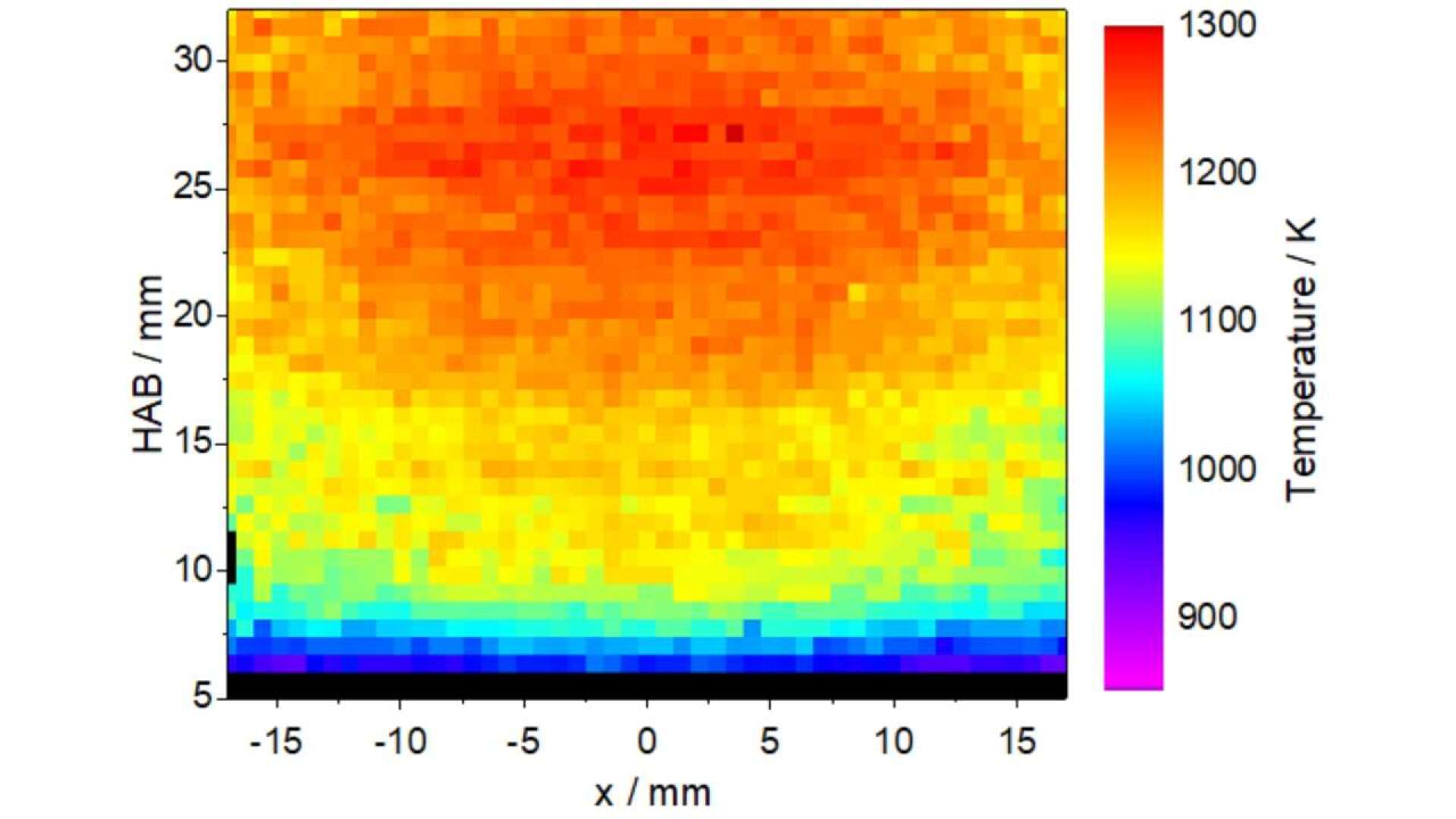
Fig 2. Temperature field of the H2/O2 premixed laminar flame
LIFSim 4.0 also includes powerful spectral analysis tools that facilitate the interrogation and examination of sensitive spectral regions. These tools are particularly useful for deriving temperature information from multi-line LIF measurements. The software's library features optimized fitting functions designed to enhance and accelerate the post-processing of LIF images taken at different excitation wavelengths. This enables precise temperature imaging and effective separation of the target LIF signal from background interference, such as broad-band fluorescence or scattering.
In addition to its robust simulation capabilities, LIFSim 4.0 is available as open-source software on GitHub under the AGPL-3.0 license. This openness encourages collaboration and continuous improvement by the diagnostics community. The software supports parallel computing, allowing for the simultaneous processing of spectra from different pixel positions, thereby significantly reducing computation time.
LIFSim 4.0 has been developed with the goal of providing a versatile and reliable tool for the diagnostics community, facilitating advanced research and development in the field of laser-induced fluorescence. By making this powerful tool accessible to a broader audience, our Chair aims to foster a collaborative environment that drives innovation and excellence in spectroscopic diagnostics.