

Research
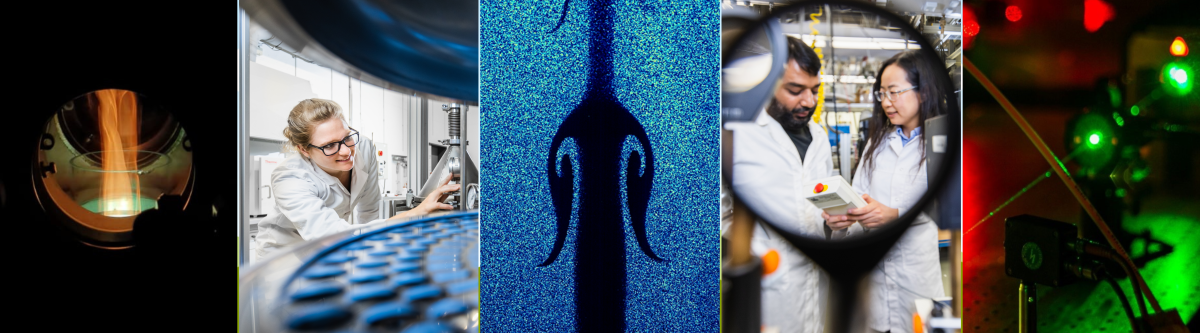
Reactive fluids – key processes in nature and technology
Reactive fluids play a central role in numerous natural and technical processes. At high temperatures in particular, ultra-fast chemical reactions interact in complex ways with flow processes. A detailed understanding of these phenomena is crucial for developing sustainable and efficient technologies.
At the chair of Prof. Christof Schulz, an interdisciplinary team of around 45 employees is dedicated to researching, controlling and utilising such processes. The focus is on investigating combustion processes and the synthesis of nanomaterials in the gas phase. Under the leadership of Prof. Hartmut Wiggers, the Nanoparticles working group develops tailor-made materials in flames, plasmas and wall-heated reactors, with a particular focus on applications in energy technology. The underlying mechanisms of nanoparticle synthesis and the processes of material and energy conversion are investigated using state-of-the-art laser-based measurement techniques. These allow contactless measurement of concentrations, temperatures, droplet and particle sizes, and velocities. The Applied Spectroscopy working group led by Dr. Niklas Jüngst and Dr. Torsten Endres develops novel spectroscopic methods, which are optimised and used for optical analyses in the Imaging working group led by Prof. Sebastian Kaiser. In addition, Dr. Mustapha Fikri and his team from the Kinetics working group are investigating the dynamics and mechanisms of combustion, ignition and particle formation. To this end, shock wave apparatus is used in combination with optical and mass spectrometric methods to precisely analyse ultra-fast processes at high temperatures.
Experimental facilities and scientific methods
EMPI-RF (Institute for Energy and Material Processes – Reactive Fluids) has extensive experimental facilities at its disposal, including molecular beam methods for investigating the elementary steps of nanoparticle formation, shock wave tubes for analysing ultrafast reactions, and spectroscopic and imaging measurement techniques with the highest spatial and temporal resolution. The fundamental understanding gained in this way flows directly into the development and optimisation of technical processes, for example in optically accessible engine test benches or pilot-scale nanoparticle production facilities.
Basic research and industrial applications
The research topics combine publicly funded basic research with practice-oriented collaborations, particularly in the areas of material synthesis, technical combustion in piston engines and gas turbines, petrochemistry, and the development of innovative measurement techniques.
Study and teaching
Students benefit from a comprehensive teaching programme that covers reactive flows in combustion technology and material synthesis as well as the kinetics of gas-phase processes at high temperatures. The core teaching content includes reactive flows, combustion engines, laser optical measurement techniques in reactive flows and nanoparticle formation processes.
Cooperation and interdisciplinary research
The team of engineers, chemists and physicists works closely with other working groups at EMPI (Institute for Energy and Material Processes). Particularly intensive cooperation exists with Prof. Andreas Kempf and Prof. Khadijeh Mohri at the EMPI Fluid Dynamics department for modelling reactive flow processes and with Prof. Doris Segets at the EMPI Particle Technology department for processing nanomaterials into functional layers for energy technology applications.