

Reactors for nanoparticle synthesis
Spray-flame reactor
An industrially scalable one-step method for synthesizing narrow-size distributed, multi-component oxides is much desired. Spray-flame synthesis (SFS) is at the forefront of such a method because of its high flexibility combined with low-cost precursor, solvents, and equipment demand. It consists of a pilot and a two-fluid spray flame, latter producing the desired materials. An elaborate process design of SFS incorporates solution preparation of the precursors followed by atomization and combustion of the same, resulting in a homogeneous multicomponent, precisely controlled particles. Moreover, in many cases, being a single-step process, it in turn eliminates the need for post-processing of the as-synthesized material. A SFS can be an open or closed system, depending on the purpose.
As a continuous synthetic technique, important material characteristics such as phase composition, particle size distribution, surface area, stoichiometric ratio, etc. can be adjusted and kept constant throughout the reaction. The initial metal precursors are cheap and readily available nitrates. On the other hand, solvents can be anything from ethanol to non-polar toluene. Depending on the nature of the desired materials, the precursors, solvents, and fuels (e.g. methane, oxygen flame), reactor pressure etc., can be tuned.
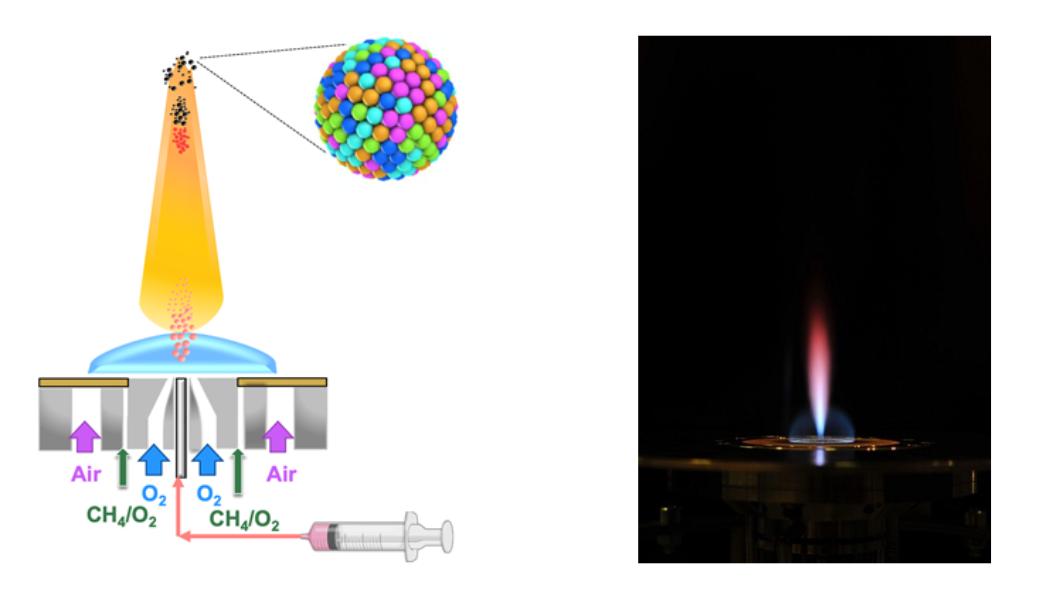
Figure 1: schematic setup of a spray-flame reactor (left) and photograph of our lab-scale system (right).
In our lab, we have pressure-regulated, closed reactors with a pilot flame of methane and oxygen. Furthermore, oxygen is used to turn the precursor solution into a spray of droplets followed by combustion with the help of pilot flame. Pilot flame and later spray flame are generally stabilized with compressed gas fed through a sintered matrix. The produced particles are collected downstream. Together with colleagues from the DFG-funded priority program SPP 1980, we have developed the SpraySyn2 burner for detailed experimental studies and simulation of the combustion and article formation processes. The closed reactor system enables precise control of fuel ratio, reactor pressure, quench gas mass flow, precursor feeding rate, etc., which helps to design nanoparticles’ properties such as particle size, shape, surface properties, etc. Naturally, in our lab, we have spray-flame reactors that can be easily modified to meet the requirement to produce the target material. Moreover, SFS’ burner can be modified so that a solid precursor can be used with an appropriate atomizer.
Literature:
F. Schneider, S. Suleiman, J. Menser, E. Borukhovich, I. Wlokas, A. Kempf, H. Wiggers, C. Schulz, SpraySyn – A standardized burner configuration for nanoparticle synthesis in spray flames, Rev. Sci. Instrum. 90 (2019) 085108, DOI: 10.1063/1.5090232
Hot-wall Reactor
Hot wall reactors, also called free-space-reactor or tube-furnace, are a class of reactors well suited to continuously produce nanomaterials under very controlled conditions. Typically, a gaseous precursor is introduced into the reactor tube, which is electrically heated to temperatures from 600-1800°C. Exposed to high temperatures, the precursor (e.g. SiH4) will decompose, forming condensable species (e.g. Si) which can nucleate and grow to the desired nanomaterial, called chemical vapor synthesis (CVS).
A notable advantage of this technique is its good scalability, usually via parallelization and numbering up. The EMPI-RF lab hosts different size hot wall reactors, the biggest can produce materials at a rate of up to 1 kg/hour. For a nanomaterial of a well-defined size and composition, this is an enormous capability, not matched by many research institutes worldwide.

Figure 2: Picture of our biggest hot-wall reactor and gas supply.
Hot-wall reactors are of specific interest regarding the synthesis of non-oxidic materials and compounds. Currently the hot-wall reactors are mainly used to produce silicon-based materials for applications in Lithium-ion batteries. Besides pure silicon, sub stoichiometric silicon nitride (SiNx) and amorphous silicon carbide (a-SiCx) are two materials produced and investigated as active materials for anodes. They are very promising due to their high lithiation capacity (increasing the energy that can be stored in a battery), while providing significantly longer lifetimes than pure silicon.
Literature:
H. Wiggers, R. Starke, P. Roth, Silicon Particle Formation by pyrolysis of Silane in a Hot Wall Gasphase Reactor, Chem. Eng. Technol., 24(3) (2001) 261–264. doi.org/10.1002/1521-4125(200103)24:3<261::AID-CEAT261>3.0.CO;2-K