

Biomechanics of Arterial Walls under Supraphysiological Loading Conditions
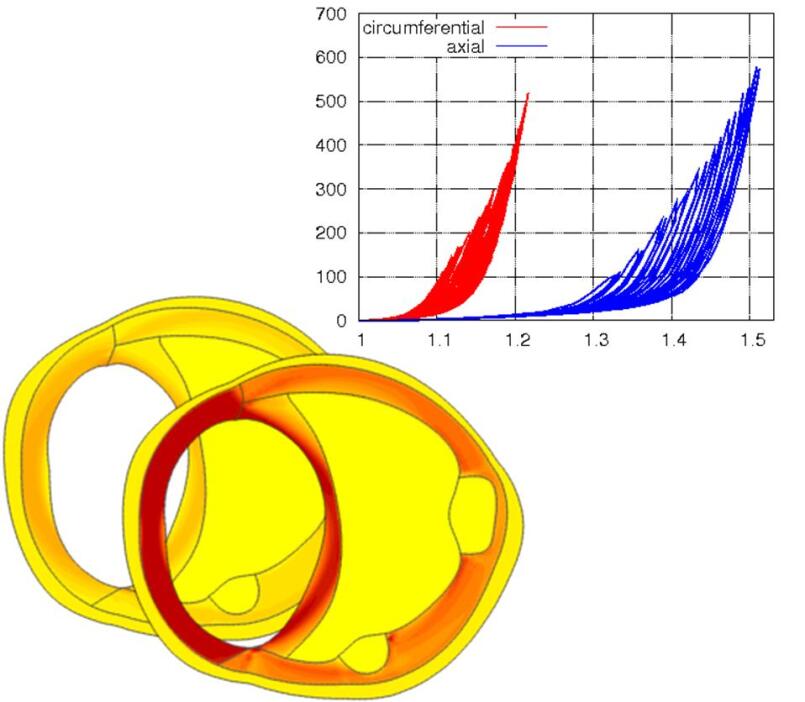
Damage behavior in arterial walls
DFG (Deutsche Forschungsgemeinschaft) project BA 2823/5-1, in cooperation with FWF (Austrian Science Fund) under the D-A-CH agreement
Associated people
D. Balzani (TU Dresden), T. Schmidt, in cooperation with G. A. Holzapfel (TU Graz)
Abstract
This research project deals with the analysis and the modeling of traumatic degenerations of overstretched arterial walls that occur in therapeutical interventions. The data base for the qualitative and quantitative description of arterial tissues is obtained from biaxial extension tests performed on the tissue components of individual arterial layers loaded far beyond the physiological domain. Such tests enable the analysis of the macroscopic mechanical response of the tissues. In addition, structural analysis techniques such as Fourier transfer infrared spectroscopy and scanning electron microscopy are used to study damage on the smaller length scale. The macroscopic response of the fiber-reinforced tissues is described by a formulation based on micro-mechanical models characterizing the individual tissue components. These models take into account alterations of stochastic distributions of fiber properties as a consequence of the tissue overstretch. In order to obtain a quantitative prediction of the material response the model parameters are adjusted to the performed experiments based on least-square minimization. Finally, we validate the models by comparing finite element calculations with experiments performed on whole arterial wall segments.

References
Balzani, D., Brinkhues, S. & Holzapfel, G. (2012), "Constitutive Framework for the Modeling of Damage in Collagenous Soft Tissues with Application to Arterial Walls", Computer Methods in Applied Mechanics and Engineering. Vol. 213--216, pp. 139-151.
Balzani, D., Neff, P., Schröder, J. & Holzapfel, G. (2006), "A Polyconvex Framework for Soft Biological Tissues. Adjustment to Experimental Data", International Journal of Solids and Structures. Vol. 43(20), pp. 6052-6070.