Drying rivers – how water bodies can change in the face of climate change
ZWU strengthens German-South African cooperation
Temporary watercourses have played only a minor role in Germany to date. However, climate change is increasingly leading to smaller and medium-sized rivers that previously carried water all year round now carrying little or no water at all in certain seasons. This will have far-reaching consequences for aquatic ecosystems and their use. In Germany, systems for assessing the ecological status of temporary watercourses are still in their infancy. In addition to ecological factors such as habitat changes and rising water temperatures, water quality, the effects of chemical pollution and changes in important hydrological parameters play a decisive role. In semi-arid and arid regions, these conditions have long been a reality, and accordingly, there is extensive experience and knowledge of temporary watercourses, especially in South Africa.
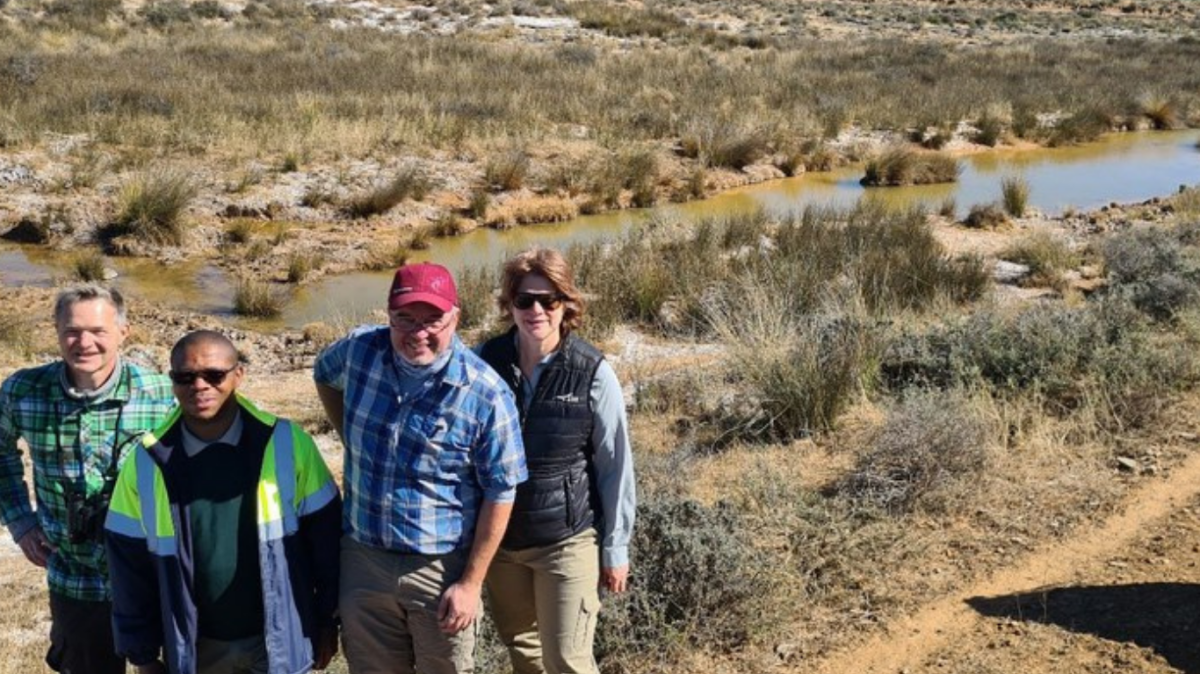
Dr Marinda Avenant and her team at the Centre for Environmental Management (CEM) at the University of the Free State (UFS) have outstanding expertise in the field of temporary watercourses. To benefit from this knowledge, learn more about the local aquatic systems and plan joint research projects, Dr H. Börnick and Dr D. Jungmann (both from Dresden University of Technology) and Dr A. Lorenz (University of Duisburg-Essen, member of the ZWU) visited the CEM in Bloemfontein from 14 to 24 July 2025.
During the field visit, the team met with farmers (Khoisan Karoo Conservancy), water suppliers (South African Department of Water Affairs) and scientists (Sol Plaatje University in Kimberley) to highlight the importance of interdisciplinary cooperation between hydrology, ecology and chemistry, while also addressing nature conservation and resource use.
This comprehensive strategy is essential for an accurate assessment of ecological conditions and plays an important role in the protection and sustainable management of these sensitive ecosystems.
All programme elements were excellently prepared in terms of content, exceptionally well organised and generously supported by the CEM.
Contact:
Dr. Armin Lorenz
Faculty of Biology
Aquatic Ecology
Universitätsstr. 5
D-45141 Essen
Room S05T03B21
Tel: +49.201.18.32442
Fax: +49.201.18.32179
armin.lorenz@uni-due.de