

Transmission electron microscopy
What is a transmission electron microscope?
Transmission electron microscopy (TEM) is a versatile characterization method featuring highest spatial and energetic resolution. Samples need to be electron transparent i.e. their thickness must be below 100 nm. The Jeol JEM-2200FS is capable of conventional TEM as well as scanning TEM (STEM). In the STEM mode the spherical aberration of the electromagnetic lens system is corrected utilizing a CEOS double hexapole corrector enabling a resolution limit of one Angström. At the same time and resolution analytical methods like electron energy loss spectroscopy and energy dispersive x-ray spectroscopy are available.
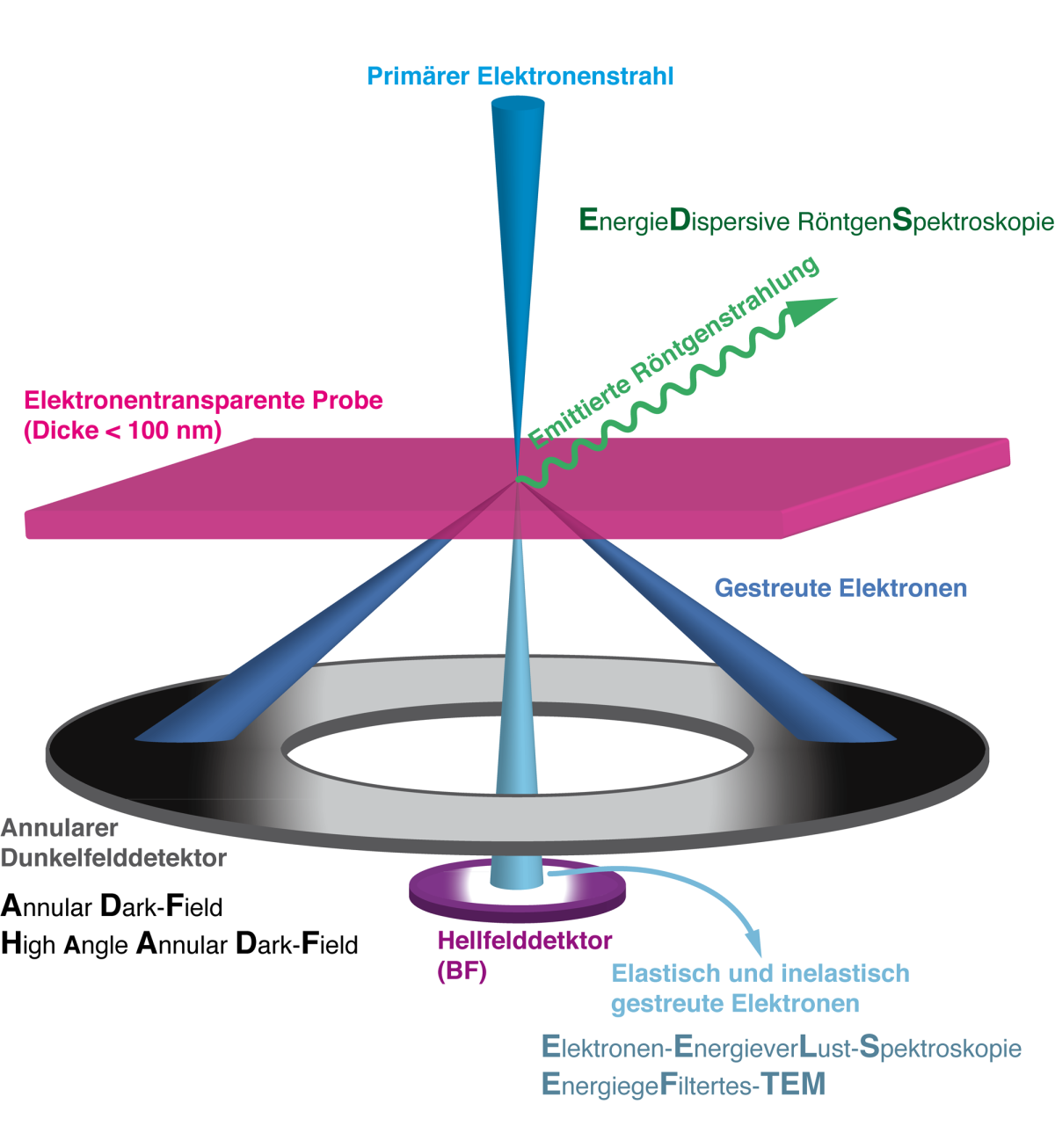
In figure 1 the interaction of sample and electron beam is sketched.

More InformationElectron diffraction
Electron diffraction reveals the crystal structure and symmetry of the sample material. In the selective area diffraction (SAD) mode the lateral resolution is limited by the size of the selection-aperture going down to ~ 250 nm. For higher lateral resolution convergent beam electron diffraction (CBED) is also possible reaching a resolution of a few nanometers.
More Information
High resolution imaging

HRTEM
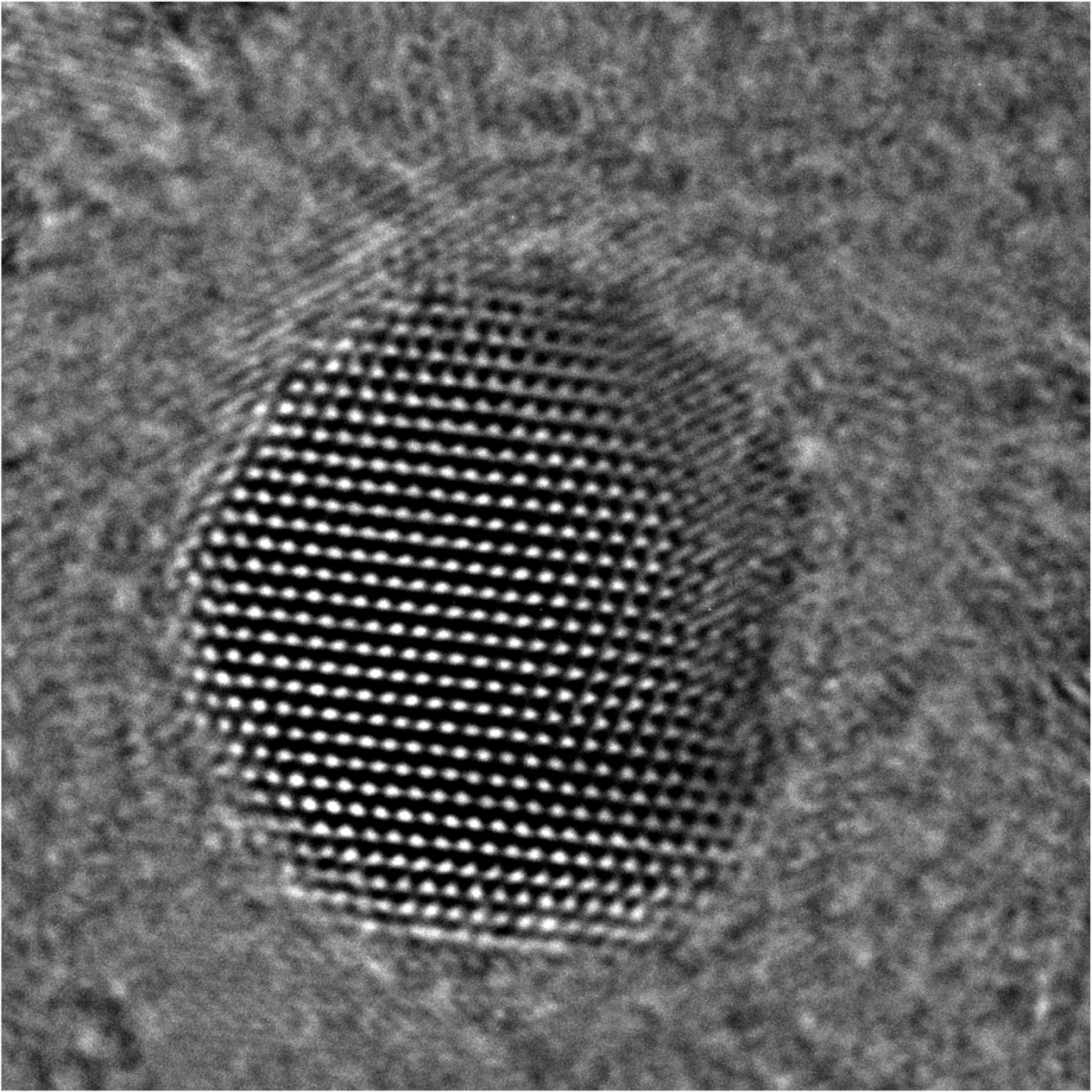
In TEM mode the sample is illuminated with a parallel beam of electrons. Depending on the sample quality imaging of atomic structures is possible ( see figures 2 and 3). At the ICAN the best achievable point resolution in TEM mode is 0.14 nm. Quantitative analysis of the exit wave is also possible using focal series reconstruction.
Figure 3: HRTEM image and fourier transform of a thin gold-film in [100] orientation.
HRSTEM
In STEM mode (scanning) the electron beam will be focussed to a spot with approximately one Angström in diameter (the electron probe). This probe is than scanned across the sample in a raster fashion while the transmitted electrons can be captured using a wide variety of different detectors. With the help of the electron optical corrector the resolution in STEM mode reaches 0.1 nm. One benefit of high-angle annular dark-field (HAADF) images in the STEM mode is the proportionality of the image intensity to the atomic number Z. Therefore a direct interpretation of the elemental distribution is possible like for example contrast changes for Strontium and Titanium in figure 4 showing SrTiO3.
Figure 4: HRTEM image of a gold nano-particle with 6 nm diameter.
More InformationTomography
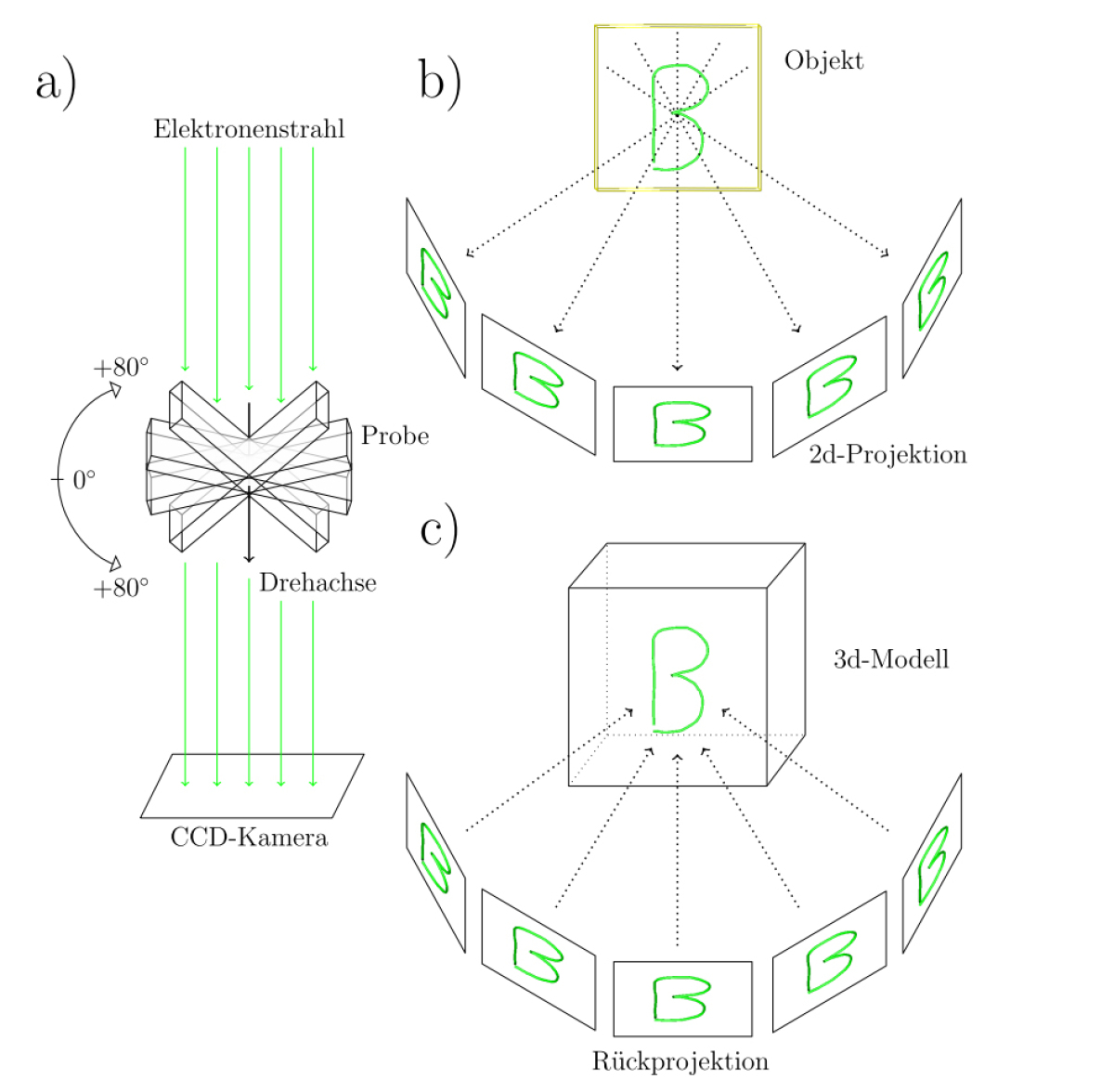
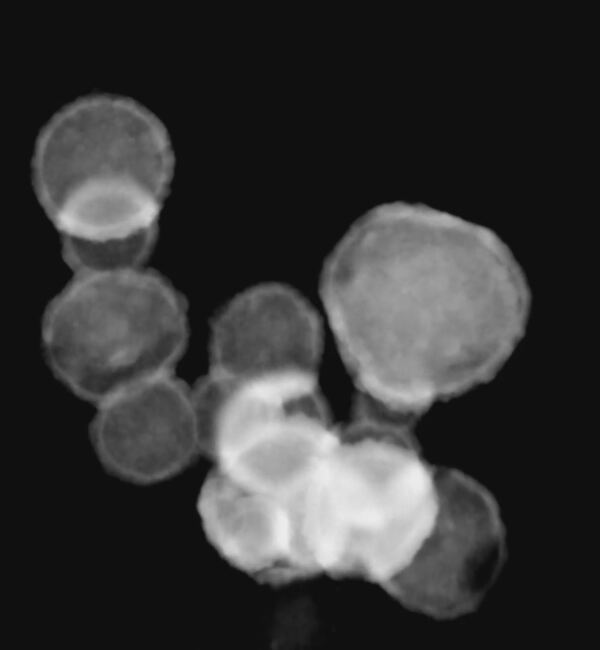
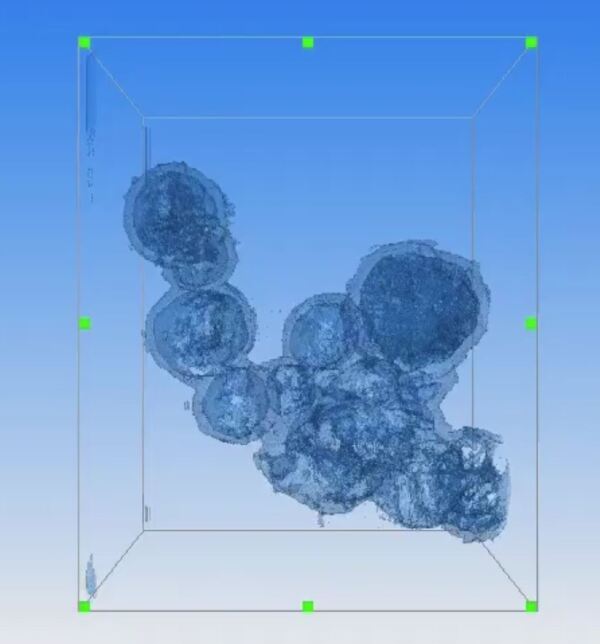
For a characterization of the 3-d structure it is necessary to acquire a tomographic tilt series at first, i.e. image the sample at different angles of projection. Typically a such a tilt series is acquired with steps of one degree from +80° to -80° angle between sample and incoming electron beam (see figure 5). At the ICAN a special tomography needle holder is also available allowing for a 360° rotation reducing artefacts (missing wedge) in the reconstruction. An exemplary tilt series of core-shell nano-particles is seen in figure 6. Different methods like weighted back projection or simultaneous iterative reconstruction are then used to create a three-dimensional model of the sample structure figure 7).
More InformationEnergy Dispersive X-ray spectroscopy
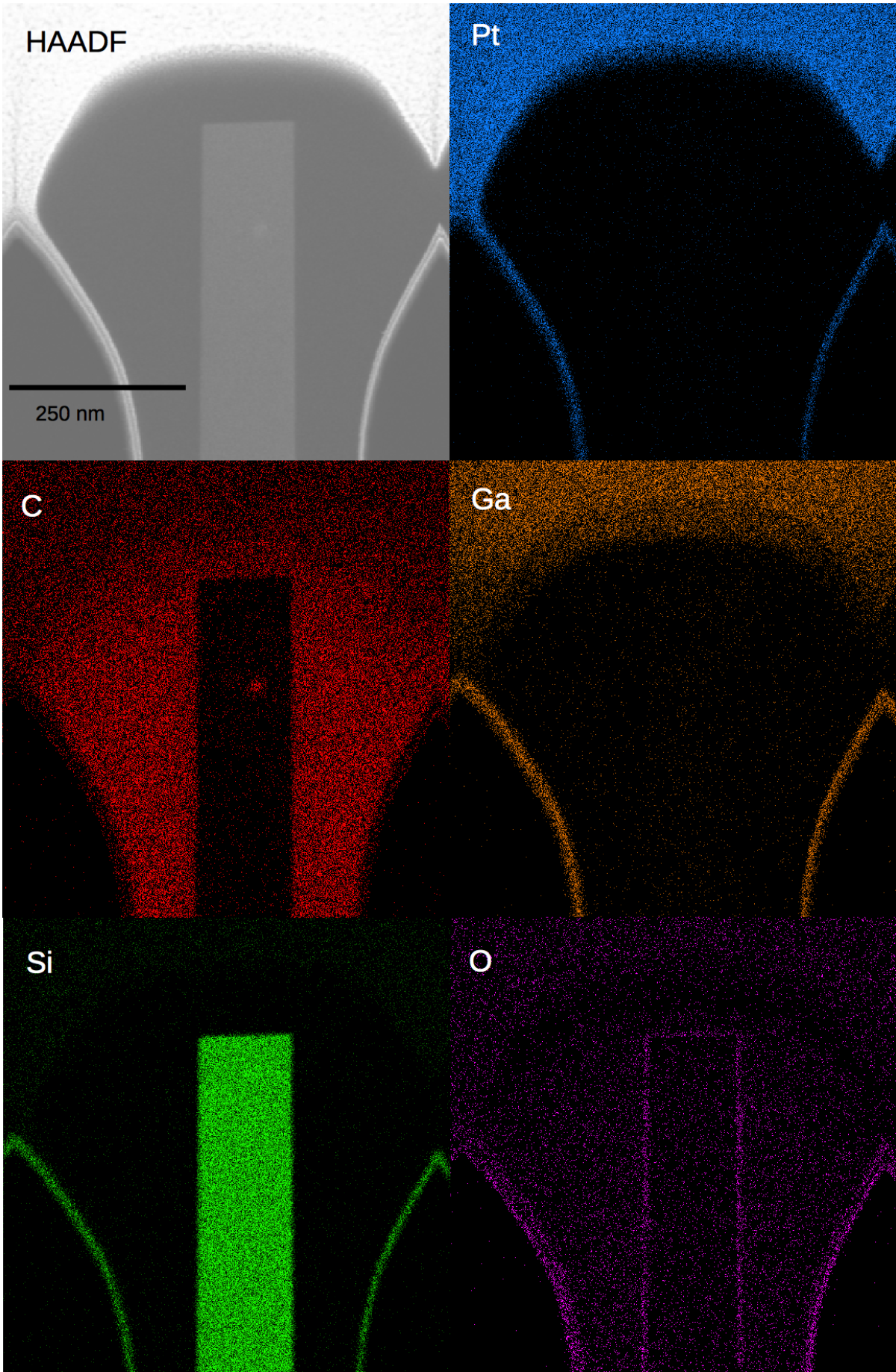
Resulting from inelastic interaction electrons of the sample material may be excited to higher energy shells or even removed from their original atomic core. By this means holes are created in the shell-structure which than get re-populated by electrons from higher shells losing their excess energy in the form of x-rays. The emitted x-rays are element-specific enabling a quantitative chemical analysis with high spatial resolution. An exemplary elemental map is shown in figure 8.
More InformationElectron Energy Loss Spectroscopy
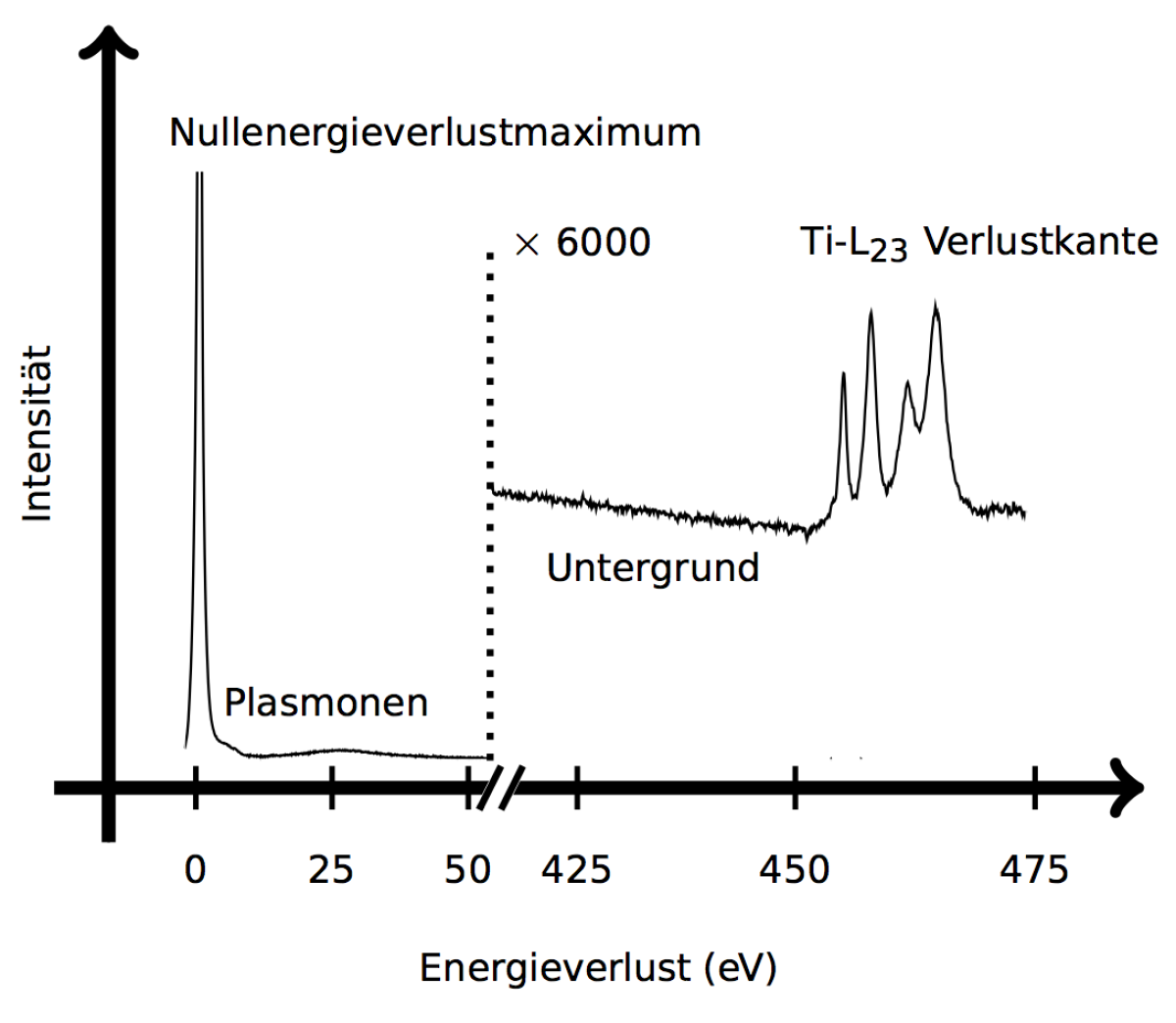
After interaction with the shell electrons, the primary electrons lost a specific amount of energy themselves. This loss of energy is again element specific and depends on the energy difference of the excitation. Using an electromagnetic prism the energy loss of the primary electrons may be analyzed revealing not only elemental composition but also chemical bonding in the nanometer regime. In figure 10 the Ti-L23 edge is shown. The number and separation of the four peaks allows the identification of the number of oxygen atoms the titanium is bond to.
Your contact for the TEM:
ICAN - Interdisciplinary Center for Analytics on the Nanoscale
47057 Duisburg
Functions
-
Wissenschaftliche/r Mitarbeiter/in, Center for Nanointegration Duisburg-Essen

Current lectures
No current lectures.
Past lectures (max. 10)
No past lectures.
The following publications are listed in the online university bibliography of the University of Duisburg-Essen. Further information may also be found on the person's personal web pages.
-
Designing 3D-Printed TiO2/BiFeO3-Hybrid Materials for Enhanced Photocatalytic Degradation of Acyclovir via Visible LightIn: ACS Applied Materials & Interfaces, Vol. 18, 2026, Nr. 19, pp. 27412 – 27425
-
Mechanistic Understanding of Laser-Induced Defect Engineering of Anisotropic Cobalt Oxide Spinel Platelets in WaterIn: ChemCatChem, Vol. 18, 2026, Nr. 1, e01054DOI (Open Access)
-
Structural Characterization of Carbon-Doped and Carbon-Coated TiO₂ Core–Shell NanoparticlesIn: Advanced Materials Interfaces, Vol. 13, 2026, Nr. 2, e00770DOI (Open Access)
-
Effects of Dynamic Surface Transformation on the Activity and Stability of Mixed Co-Mn Cubic Spinel Oxides in the Oxygen Evolution Reaction in Alkaline MediaIn: Advanced Energy Materials, Vol. 15, 2025, Nr. 8, 2403096DOI (Open Access)
-
Insight into the Correlation of Shape and Magnetism of Hematite NanospindlesIn: Journal of Physical Chemistry C: Nanomaterials and Interfaces, Vol. 129, 2025, Nr. 48, pp. 21508 – 21519
-
Scanning Transmission Electron Microscopy Analysis of the Si(111)–AlN–GaN Nanowire Interface Grown by Polarity- and Site-Controlled Growth MethodIn: Physica Status Solidi (A) - Applications and Materials Science, Vol. 222, 2025, Nr. 4, 2400562DOI (Open Access)
-
Unveiling Surface Species Formed on Ni-Fe Spinel Oxides During the Oxygen Evolution Reaction at the Atomic ScaleIn: Advanced Science, Vol. 12, 2025, Nr. 25, 2501967DOI (Open Access)
-
Correlating atomic-scale structural and compositional details of Ca-doped LaCO₃ perovskite nanoparticles with activity and stability towards the oxygen evolution reactionIn: Journal of Catalysis, Vol. 438, 2024, 115697DOI (Open Access)
-
Graphene self-folding : Evolution of free-standing few-layer graphene in plasma synthesisIn: Carbon, Vol. 218, 2024, 118732DOI (Open Access)
-
Integrated In Situ Fabrication of CuO Nanorod-Decorated Polymer Membranes for the Catalytic Flow-Through Reduction of p-NitrophenolIn: ACS Applied Materials & Interfaces, Vol. 16, 2024, Nr. 14, pp. 17517 – 17530
-
Poly(4-Vinylpyridine)-Based Cubosomes : Synthesis, Assembly, and Loading CapabilitiesIn: Small Science, Vol. 4, 2024, Nr. 12, 2400274DOI (Open Access)
-
Tunable Syngas Formation at Industrially Relevant Current Densities via CO₂ Electroreduction and Hydrogen Evolution over Ni and Fe-derived Catalysts obtained via One-Step Pyrolysis of Polybenzoxazine Based CompositesIn: Small, Vol. 20, 2024, Nr. 23, 2305958DOI (Open Access)
-
Atomic-Scale Insights into Morphological, Structural, and Compositional Evolution of CoOOH during Oxygen Evolution ReactionIn: ACS Catalysis, Vol. 13, 2023, Nr. 2, pp. 1400 – 1411
-
Cobalt nickel boride as electrocatalyst for the oxidation of alcohols in alkaline mediaIn: JPhys Energy, Vol. 5, 2023, Nr. 2, 024005DOI (Open Access)
-
Differentiating between Acidic and Basic Surface Hydroxyls on Metal Oxides by Fluoride Substitution : A Case Study on Blue TiO₂ from Laser Defect EngineeringIn: Angewandte Chemie International Edition, Vol. 62, 2023, Nr. 12, e202213968DOI (Open Access)
-
Linking Composition, Structure and Thickness of CoOOH layers to Oxygen Evolution Reaction Activity by Correlative MicroscopyIn: Angewandte Chemie International Edition, Vol. 62, 2023, Nr. 28, e202305982DOI (Open Access)
-
Machine Hammer Peening and Its Effect on the Surface Integrity of Arc-Sprayed WC-W₂C-FeCMnSi CoatingsIn: Coatings, Vol. 13, 2023, Nr. 9, 1563DOI (Open Access)
-
Multicompartment Nanostructures as Templates for Multimetallic Hybrid MaterialsIn: Small Science, Vol. 3, 2023, Nr. 9, 2300071DOI (Open Access)
-
3D atomic-scale imaging of mixed Co-Fe spinel oxide nanoparticles during oxygen evolution reactionIn: Nature Communications, Vol. 13, 2022, Nr. 1, 179DOI (Open Access)
-
Beneficial Effects of Low Iron Contents on Cobalt‐Containing Spinel Catalysts in the Gas Phase 2‐Propanol OxidationIn: ChemCatChem, Vol. 14, 2022, Nr. 18, e202200472DOI (Open Access)
-
Comparison of EUV Photomask Metrology Between CD-AFM and TEMIn: Nanomanufacturing and Metrology, Vol. 5, 2022, pp. 91 – 100DOI (Open Access)
-
Correction: Comparison of EUV Photomask Metrology Between CD-AFM and TEM (Nanomanufacturing and Metrology, (2022), 5, 2, (91-100), 10.1007/s41871-022-00124-y)In: Nanomanufacturing and Metrology, Vol. 5, 2022, Nr. 4, pp. 440DOI (Open Access)
-
Formic Acid-Assisted Selective Hydrogenolysis of 5-Hydroxymethylfurfural to 2,5-Dimethylfuran over Bifunctional Pd Nanoparticles Supported on N-Doped Mesoporous CarbonIn: Angewandte Chemie International Edition, Vol. 60, 2021, Nr. 12, pp. 6807 – 6815DOI (Open Access)
-
Influence of Nanoparticle Processing on the Thermoelectric Properties of (BiₓSb₁−X)₂Te₃ Ternary AlloysIn: ChemistryOpen, Vol. 10, 2021, Nr. 2, pp. 189 – 198DOI (Open Access)
-
Room temperature synthesized solid solution AuFe nanoparticles and their transformation into Au/Fe Janus nanocrystalsIn: Nanoscale, Vol. 13, 2021, Nr. 23, pp. 10402 – 10413DOI (Open Access)
-
The Effect of Water on the 2-Propanol Oxidation Activity of Co-Substituted LaFe₁−CoₓO₃ PerovskitesIn: Chemistry - A European Journal, Vol. 27, 2021, Nr. 68: Special Issue: Contemporary Challenges in Catalysis, pp. 17127 – 17144DOI (Open Access)
-
Cover Feature: Spray‐Flame‐Prepared LaCo1–xFexO3 Perovskite Nanoparticles as Active OER Catalysts : Influence of Fe Content and Low‐Temperature Heating (ChemElectroChem 12/2020)In: ChemElectroChem, Vol. 7, 2020, Nr. 12, pp. 2495 – 2495DOI (Open Access)
-
One-step synthesis of carbon-supported electrocatalystsIn: Beilstein Journal of Nanotechnology, Vol. 11, 2020, pp. 1419 – 1431DOI (Open Access)
-
Particle Size Distributions for Cellulose Nanocrystals Measured by Transmission Electron Microscopy : An Interlaboratory ComparisonIn: Analytical Chemistry, Vol. 92, 2020, Nr. 19, pp. 13434 – 13442DOI, Online Full Text (Open Access)
-
Spray-Flame-Prepared LaCo₁–ₓFeₓO₃ Perovskite Nanoparticles as Active OER Catalysts : Influence of Fe Content and Low-Temperature HeatingIn: ChemElectroChem, Vol. 7, 2020, Nr. 12, pp. 2564 – 2574DOI (Open Access)
-
Terpolymer Multicompartment Nanofibers as Templates for Hybrid Pt Double HelicesIn: ACS Applied Materials & Interfaces, Vol. 12, 2020, Nr. 35, pp. 39586 – 39594
-
Vesicular Polymer Hexosomes Exhibit Topological DefectsIn: Journal of the American Chemical Society: JACS, Vol. 142, 2020, Nr. 25, pp. 10989 – 10995
-
Characterization and reactivity of charcoal from high temperature pyrolysis (800–1600 °C)In: Fuel, Vol. 235, 2019, pp. 1544 – 1554DOI (Open Access)
-
The effect of feedstock origin and temperature on the structure and reactivity of char from pyrolysis at 1300–2800 °CIn: Fuel, Vol. 235, 2019, pp. 306 – 316DOI (Open Access)
-
Magnetite-Gold nanohybrids as ideal all-in-one platforms for theranosticsIn: Scientific Reports, Vol. 8, 2018, pp. 11295DOI, Online Full Text (Open Access)
-
Adjusting the catalytic properties of cobalt ferrite nanoparticles by pulsed laser fragmentation in water with defined energy doseIn: Scientific Reports, Vol. 7, 2017, Nr. 1, pp. 13161DOI, Online Full Text (Open Access)
-
Ammonia decomposition and synthesis over multinary magnesioferrites : promotional effect of Ga on Fe catalysts for the decomposition reactionIn: ChemCatChem, Vol. 9, 2017, Nr. 4, pp. 659 – 671
-
Synthesis of Sb2Se3 and Bi2Se3 Nanoparticles in Ionic Liquids at Low Temperatures and Solid State Structure of [C4C1Im]3[BiCl6]In: Zeitschrift für Anorganische und Allgemeine Chemie (ZAAC), Vol. 643, 2017, Nr. 1, Special Issue: Reactions in Ionic Liquids, pp. 60 – 68DOI, Online Full Text (Open Access)
-
Structural anomaly in the high-entropy alloy ZrNbTiTaHfIn: Intermetallics, Vol. 68, 2016, pp. 11 – 15
-
The role of metastable LPSO building block clusters in phase transformations of an Mg-Y-Zn alloyIn: Acta Materialia, Vol. 112, 2016, pp. 171 – 183
-
Comprehensive model of metadislocation movement in Al₁₃Co₄In: Scripta Materialia, Vol. 98, 2015, pp. 24 – 27
-
Development and characterisation of a new line width reference materialIn: Measurement Science and Technology, Vol. 26, 2015, Nr. 11, 115006
-
Plastic deformation properties of Zr-Nb-Ti-Ta-Hf high-entropy alloysIn: Philosophical Magazine, Vol. 95, 2015, Nr. 11, pp. 1221 – 1232DOI, Online Full Text (Open Access)
-
Hexagonal High-entropy AlloysIn: Materials Research Letters, Vol. 3, 2014, Nr. 1, pp. 1 – 6DOI (Open Access)
-
On the stability of metadislocations with 16 associated phason planesIn: Intermetallics, Vol. 53, 2014, pp. 187 – 191
-
Periodic cation segregation in Cs0.44[Nb2.54W2.46O14] Quantified by High-Resolution Scanning Transmission Electron MicroscopyIn: Microscopy and Microanalysis, Vol. 20, 2014, Nr. 5, pp. 1453 – 1462
-
Self-assembly of biaxial discorectangular lead carbonate nanosheets into stacked ribbons studied by SAXS and HAADF-STEM tomographic tilt seriesIn: Soft Matter, Vol. 10, 2014, Nr. 47, pp. 9511 – 9522DOI (Open Access)
-
Studies of local structural distortions in strained ultrathin BaTiOIn: Microscopy and Microanalysis, Vol. 20, 2014, Nr. 3, pp. 740 – 747
-
From conformal overgrowth to lateral growth of indium arsenide nano structures on silicon substrates by MOVPEIn: Journal of Crystal Growth, Vol. 370, 2013, pp. 141 – 145
-
Orientation of well-dispersed multiwalled carbon nanotubes in melt-spun polymer fibers and its impact on the formation of the semicrystalline polymer structure : A combined wide-angle X-ray scattering and electron tomography studyIn: Macromolecules, Vol. 46, 2013, Nr. 14, pp. 5604 – 5613
-
Reference nano-dimensional metrology by scanning transmission electron microscopyIn: Measurement Science and Technology, Vol. 24, 2013, Nr. 8, 085001
-
Spatial resolution and radiation damage in quantitative high-resolution STEM-EEL spectroscopy in oxidesIn: Micron, Vol. 43, 2012, Nr. 4, pp. 532 – 537
-
Inorganic WS2 nanotubes revealed atom by atom using ultra-high-resolution transmission electron microscopyIn: Applied Physics A: Materials Science and Processing, Vol. 96, 2009, Nr. 2, pp. 343 – 348
-
Intermixing and charge neutrality at DyScO3/SrTiO3 interfacesIn: Acta Materialia, Vol. 57, 2009, Nr. 11, pp. 3192 – 3198
-
StripeSTEM, a technique for the isochronous acquisition of high angle annular dark-field images and monolayer resolved electron energy loss spectraIn: Ultramicroscopy, Vol. 109, 2009, Nr. 12, pp. 1447 – 1452
-
The influence of Se doping upon the phase change characteristics of GeSbIn: Solid State Sciences, Vol. 11, 2009, Nr. 3, pp. 683 – 687
-
Complex inorganic nanomaterials by block terpolymer templatingIn: ACS National Meeting / American Chemical Society. Washington: American Chemical Society (ACS), Vol. 258, 2019, Nr. 727
-
The ultramicrotome as a tool for the preparation of ultra-thin samples for TEM investigations2021
(ICAN Notes)DOI, Online Full Text (Open Access) -
The matrix effect - A challenge for quantitative secondary ion mass spectrometry2020
(ICAN Notes)DOI, Online Full Text (Open Access) -
Neue Erkenntnisse zur Keimbildung bei GJS
Österreichische Gießereitagung ; Gurten, 27.-28. April 2017,Gurten, Österreich, 2017