

Perturbed Angular Correlation of γ-rays (CERN)
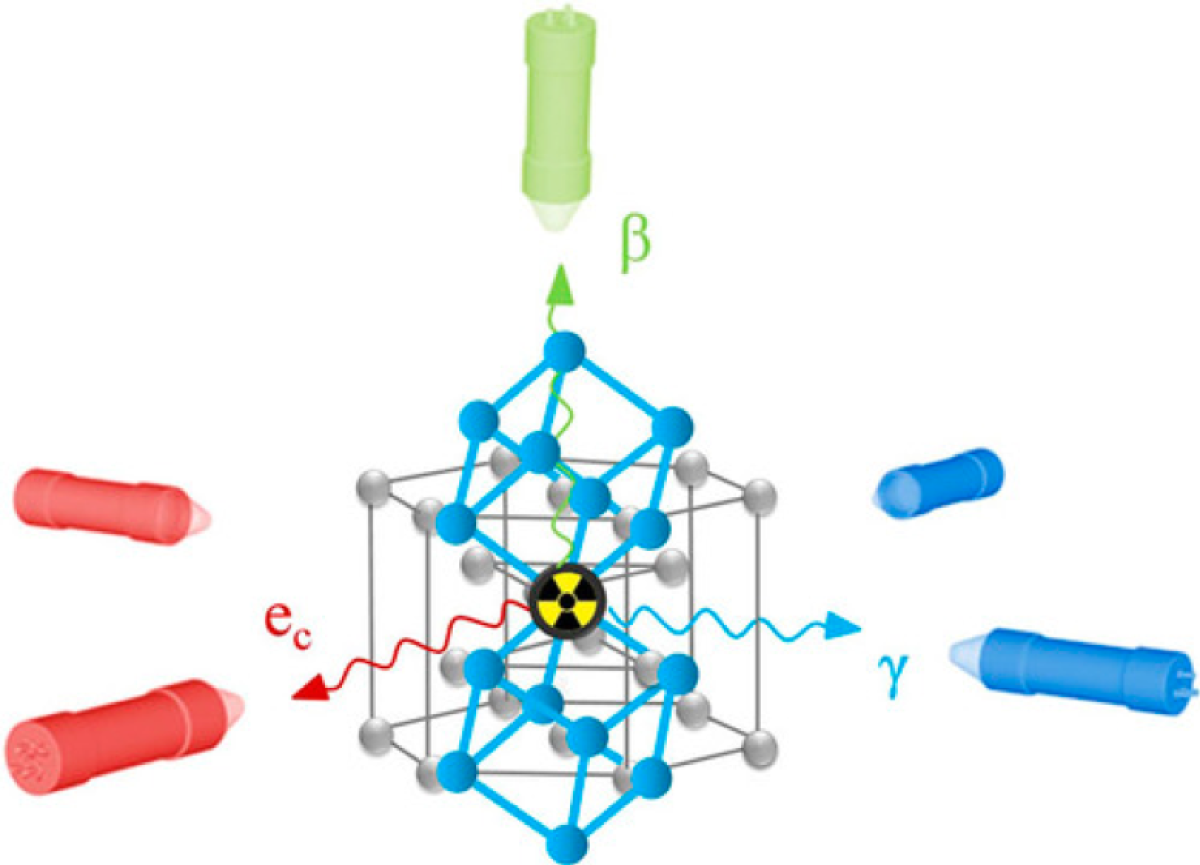
The method of Perturbed Angular Correlation (PAC) of γ-rays is a sensitive nuclear spectroscopic technique for investigating the local environment of atomic nuclei in condensed matter. It is based on the analysis of the time-dependent angular correlation between successive γ quanta emitted in a nuclear decay involving a γ-γ cascade.
The key physical basis lies in the fact that the intermediate nuclear state between the two γ emissions has a finite lifetime τ (typically in the range of 10⁻⁹ to 10⁻⁶ s) and, during this time, interacts with its local electromagnetic environment (electric or magnetic fields). These interactions lead to a perturbation of the original angular correlation of the γ radiation, hence the name Perturbed Angular Correlation.
PAC spectroscopy enables the determination of local structural and electronic properties that are often inaccessible to other techniques. It is particularly sensitive to electric field gradients (EFG), magnetic hyperfine fields, and dynamic processes.