
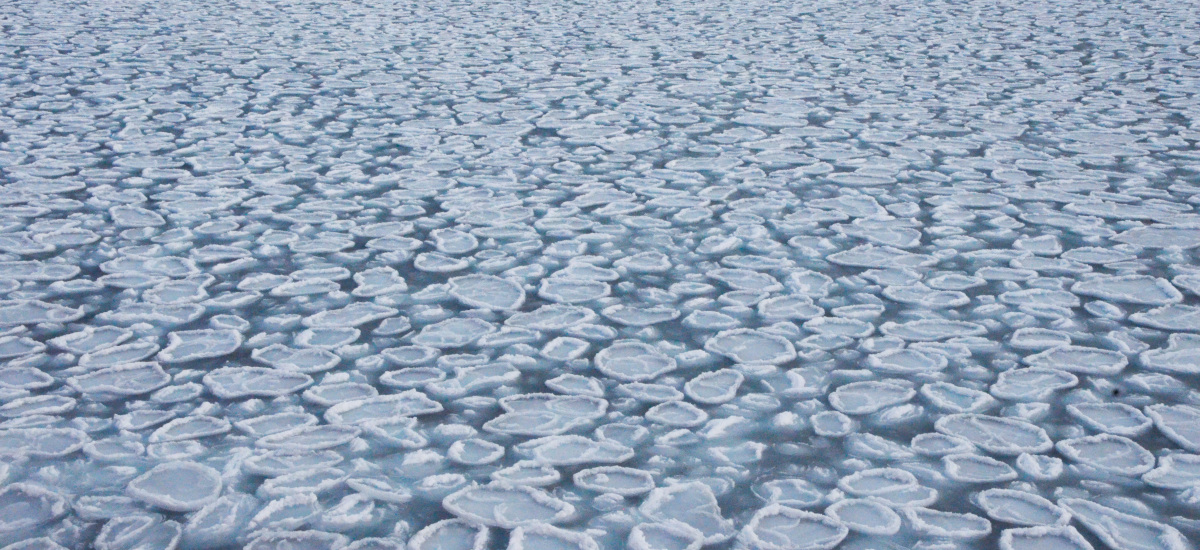
6. Mechanics of concrete and sea ice
The mechanical behaviour of construction materials determines how well they perform in service. Alongside the classical standardised test procedures, the institute carries out detailed fracture-mechanics analyses to build a more precise picture of the fracture process itself. Our focus falls on newly produced cements and, above all, on recycled materials. Sea ice has strikingly similar mechanical properties to concrete. We therefore bring the methods of civil engineering and fracture mechanics to sea-ice research, in order to understand local sea-ice behaviour in relation to environmental influences such as wind, temperature and ocean currents, and so supply sea-ice models with the experimental parameters they need.

Expeditions to the Antarcti marginal ice zone
So far we have joined two expeditions into the Antarctic marginal ice zone aboard the South African research vessel SA Agulhas II. On these voyages we took ice samples from floes, from so-called pancake ice and from the consolidated ice. Each sample was tested on board immediately after extraction for a range of properties, among them compressive strength, salinity and temperature. These measurements will feed into improved numerical simulations of sea-ice behaviour.
Read moreSelection of literature on the topic
F. Paul, T. Mielke and D.C. Lupascu
Experimental setup to determine rheological properties of frazil ice
Rheologische Messungen an Baustoffen 2020, Page 75-84 (2020)