
3. Halide perovskite for photovoltaic applications
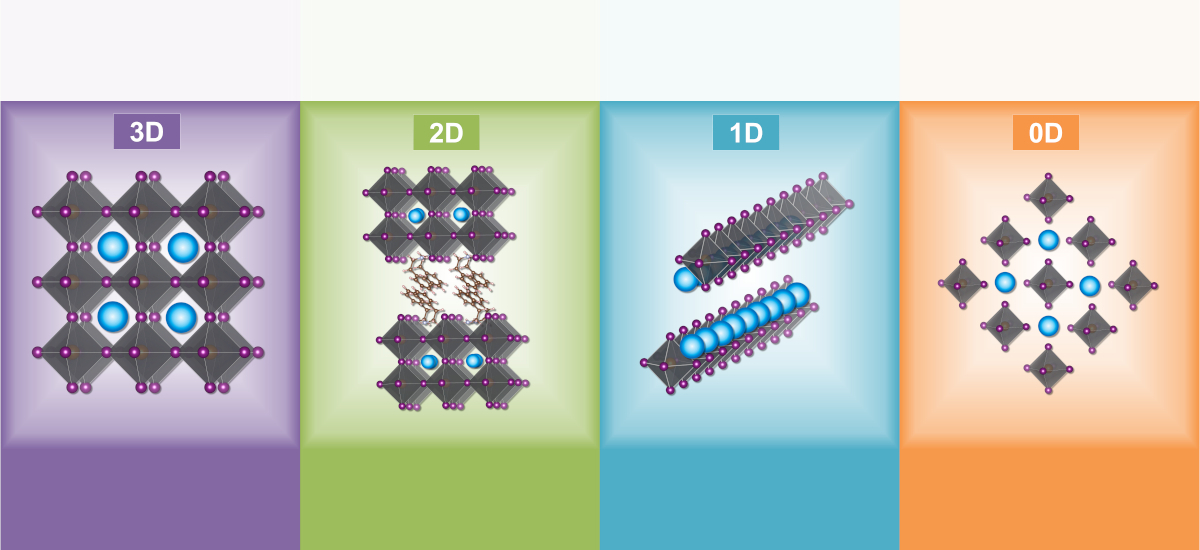

3D Perovskite (Aziridinium-based halide)
Research on Aziridinium Lead Iodide (AzrPbI3) has transitioned from purely theoretical predictions in 2018 to successful experimental synthesis in recent years. It is recognized as one of the few organic cations, alongside methylammonium (MA) and formamidinium (FA), capable of sustaining a symmetry 3D perovskite framework. AzrPbI3 has a suitable band gap (~1.5 eV) which is close to ideal band gap for single junction solar cell and the determined band position of AzrPbI3 is consistent with the literature values for other perovskites.
Our group's latest study benchmarks aziridinium lead iodide (AzrPbI3) against the industry-standard methylammonium lead iodide (MAPbI3), showing that AzrPbI3 resists moisture, air, and UV-light degradation far better than MAPbI3, though it remains more vulnerable to heat. The work highlights aziridinium cation engineering as a promising new route toward more durable perovskite solar materials.
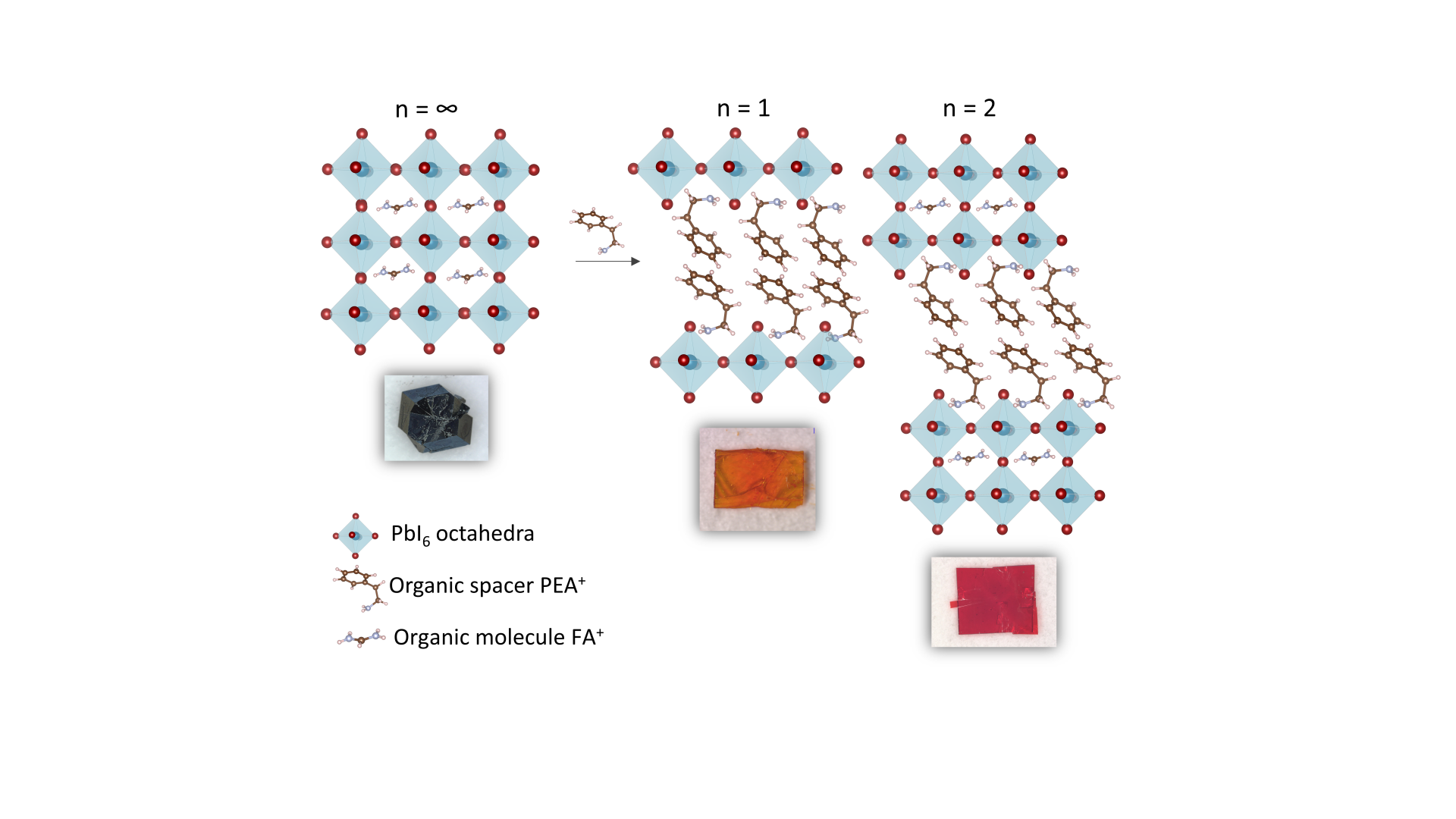
2D Ruddlesden-Popper perovskites
Two-dimensional Ruddlesden-Popper perovskites are layered derivatives of 3D metal halide perovskites with general formula (A´)2(A)n-1BnX3n+1. In this formula A´ is a bulky organic spacer, A is a monovalent organic cation such as Methylammonium (MA+) or Formamidinium (FA+), B is a divalent metal cation (Pb2+), and X is a halide anion (I-, Br-, or Cl-). The parameter “n” determines the number of corner-sharing BX6 octahedral layers. Alternating organic layers and octahedral layers form a natural quantum well architecture, in which the organic spacers act as insulating barrier layers while n defines the thickness of the quantum well. The choice of organic spacer is a key design handle: it controls interlayer distance, octahedral tilting and distortion, lattice rigidity, and hydrophobicity, and through these the optical, electronic and stability properties of the material. In our group, we have synthesized RP perovskite single crystals incorporating a range of functional organic spacers. We study how the spacer chemistry tunes structure and optoelectronic behaviour, with the aim of developing stable and efficient materials for photovoltaic applications.

Lead-free azetidinium-based system
The azetidinium cation is a key building block for synthesizing new photovoltaic materials, largely due to its small effective radius. As Pb toxicity poses a serious environmental threat, developing Pb-free alternatives is essential. Our group has successfully synthesized seven new low-dimensional, Pb-free light absorbers based on azetidinium cation. These materials are strong candidates for applications in tandem solar cells and indoor photovoltaics. In addition, this research helps clarify the factors that improve the stability and photoconductivity of Pb-free materials for future photovoltaic applications.