
1. Recycling of concrete
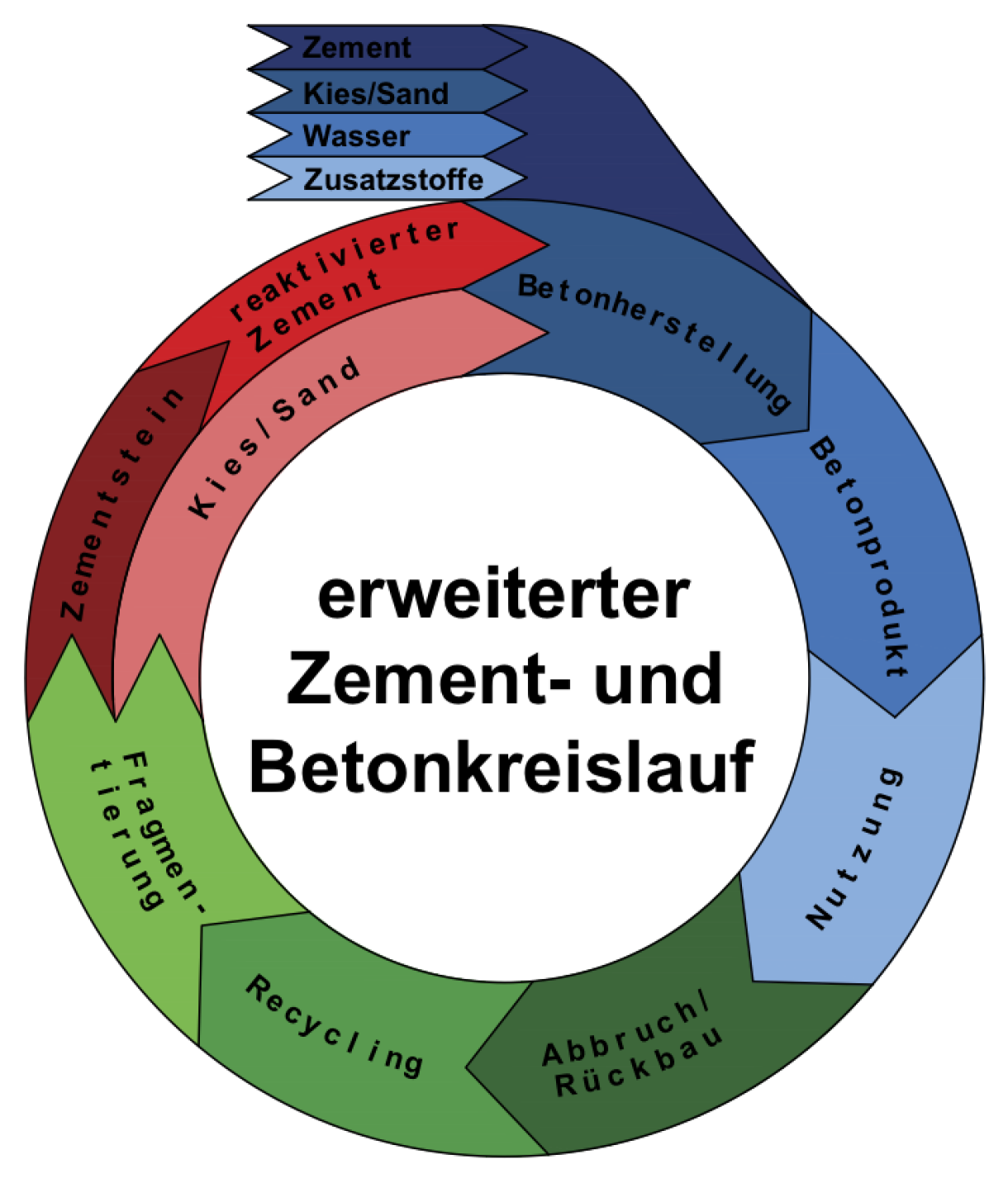
Concrete production is one of the largest industrial sources of CO₂ emissions worldwide. Approximately 60–70 % of these emissions are attributable to the production of cement clinker, the principal component of the binder in concrete. In light of growing resource scarcity and ecological challenges, the recycling of old concrete, and in particular the recovery of its cementitious fraction, is gaining increasing importance.
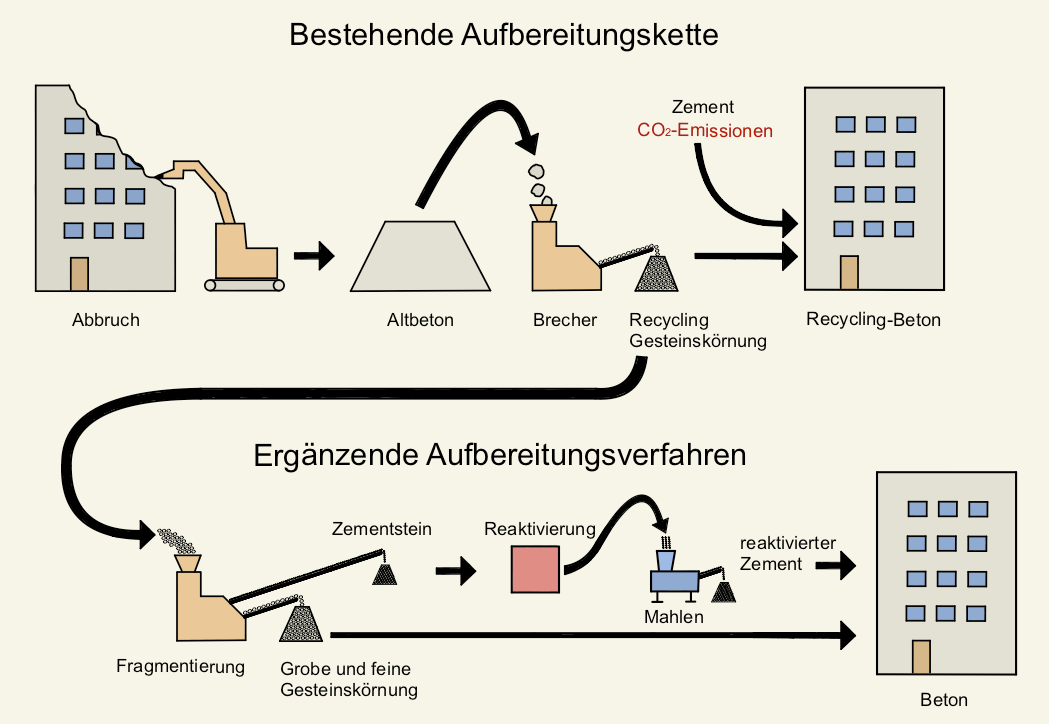
While conventional concrete recycling processes primarily aim at the reuse of aggregate, more recent research approaches focus on the separation, processing, and thermal reactivation of the hardened cement paste contained in old concrete.
The greatest challenge in recycling therefore lies in mechanically and chemically separating the cement paste from the aggregate so that the binder material can subsequently be restored to a reactive state through suitable thermal or thermochemical processes.
By combining mechanical separation with energy-optimized thermal reactivation, not only can resource efficiency be significantly enhanced, but the ecological footprint of cement production can also be substantially reduced.
Contacts: Prof. Doru C. Lupascu, Dr. Tommy Mielke
Durability of Concrete
As a traditional building material, concrete is primarily investigated with regard to its durability. For instance, the effect of aging on the internal and external deterioration of high-performance concrete under frost and deicing-salt exposure is a research topic in its own right. In addition, work is underway on detecting internal damage through acoustic emission analysis, as well as on investigations into fiber-reinforced self-compacting concrete.