

Simulation of residual stresses in arterial walls
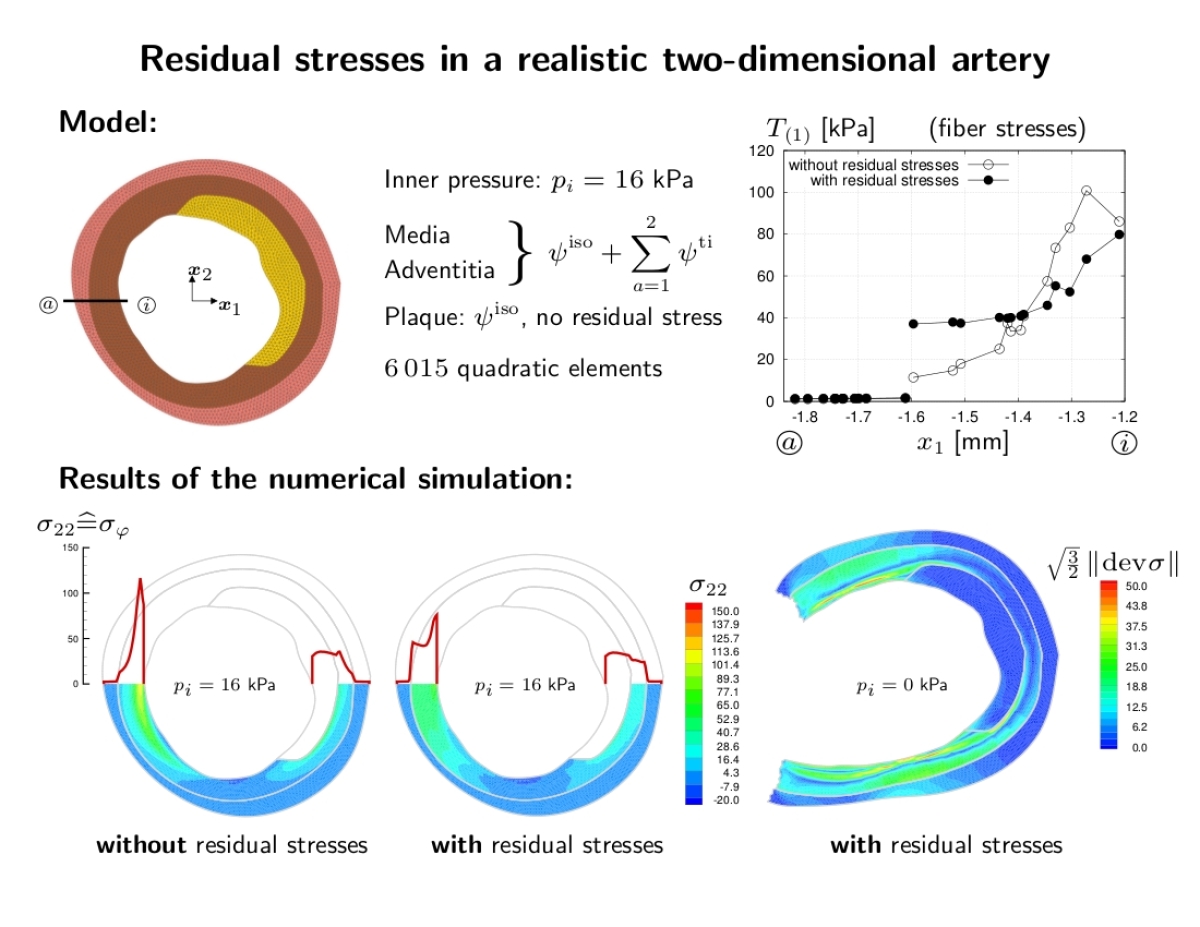
Opening of the artery as a result of the existence of residual stresses
DFG (Deutsche Forschungsgemeinschaft) project SCHR 570/16-1
Associated people
J. Schröder, S. Brinkhues, M. von Hoegen
Abstract
In a variety of investigations of the mechanical behavior of arteries it is assumed, that an unloaded artery exhibits an internal zero-stress state. This assumption does not reflect the real behavior, which can be observed in experiments: when an axial section is cutted in longitudinal direction, the artery springs open. This ``cutted'' configuration is often assumed to be stress-free. In various works dealing with the numerical simulation of arterial walls, it is accounted for residual stresses by closing an opened, unstressed artery by an initial bending to form a load-free, but internally stressed configuration. However, such configuration is not available for real purposes. In this research project we propose a novel approach for the incorporation of residual stresses in human arteries. In contrast to the approach described above, we focus directly on the gradients of appropriate stresses in radial direction. Motivated by the arrangement of the embedded fibers, the gradients of the fiber stresses in radial direction are considered and smoothed by dint of residual stresses. This approach is applicable for arbitrary two- or three-dimensional arterial geometries and thus an appropriate solution for such complex physiological problems.

References