MAMDIWAS Workpackages
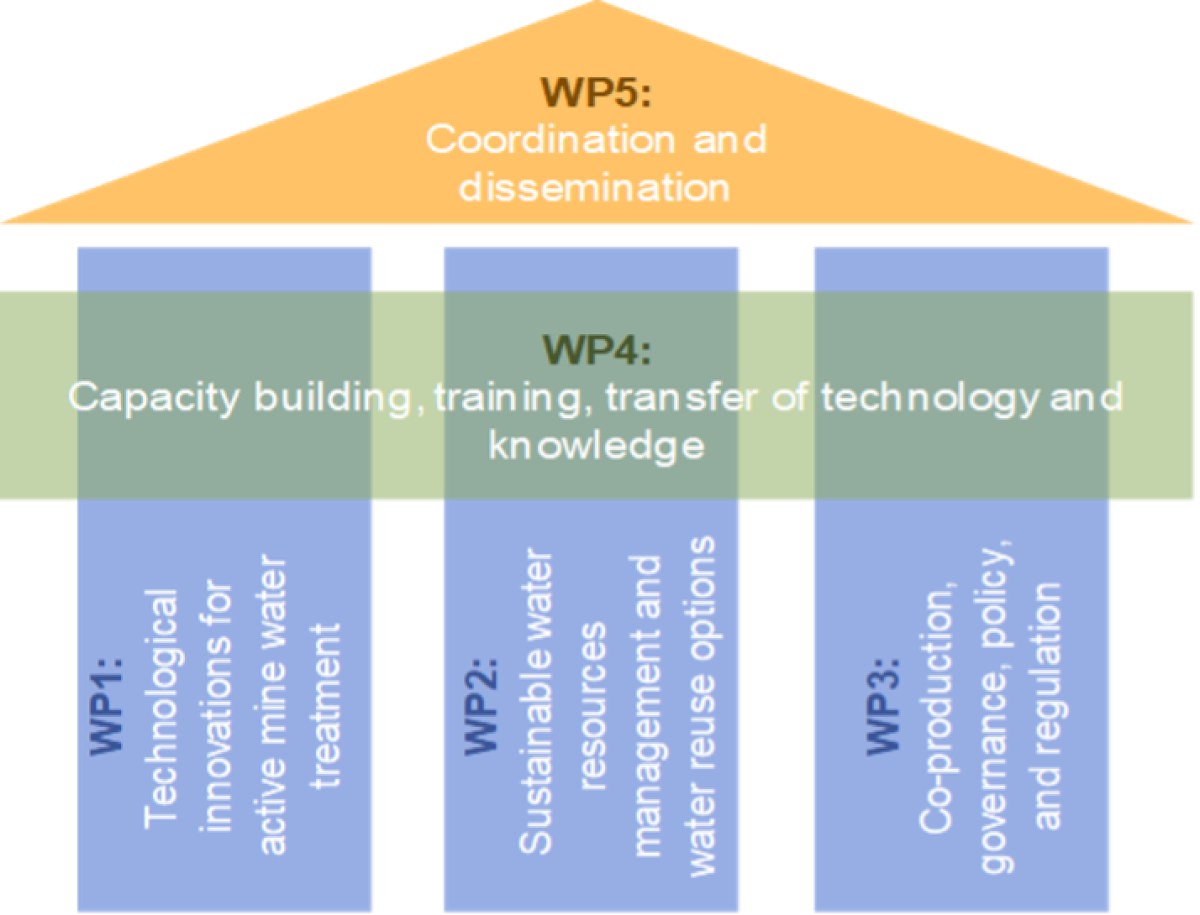
Lead partners: UDE / ZWU& UNISAWP1: Technological innovations for active mine water treatment
The main objective of WP 1 is to develop cost-effective, energy-saving technologies for treating mining influenced water that reduce sludge and produce valuable by-products and reusable water. This involves enhancing the cascade concept, optimizing acid mine drainage pre-treatment, and using new membrane-based technologies, such as capillary nanofiltration in closed cycle systems, combined with sludge precipitation.
Lead partners: IWW & SUNWP2: Sustainable water resources management and reuse options
The main objectives of WP 2 are to implement an integrated water resources management approach for the Vaal River catchment, assess baseline water quality and quantity to identify water pollutants and their environmental impacts, and determine water reuse options (e.g., drinking, irrigation, hydroponics, industrial) and local community acceptance.
Lead partners: WI & UNISAWP3: Co-production, governance, policy, and regulation
The objective of WP3 is to analyze the operating environment, conduct stakeholder mapping, develop recommendations for governance policy, and regulation and develop a post-mining development strategy that focuses on reclaimed water interventions for community enhancement.
Lead partners: UDE / ZWUWP4: Capacity building, training, transfer of technology and knowledge
WP 4 focuses on capacity building and technology transfer in South Africa, training academic and industrial professionals in water treatment and membrane technologies. It aims to meet local community needs, promote sustainable development, encourage entrepreneurship, and guide business setup. Key objectives include strengthening academia-industry networks for collaboration and knowledge exchange, developing a skilled workforce, and advancing membrane technology applications in South Africa.
Lead partners: UDE / ZWUWP5: Coordination and dissemination
WP 5 is designed to ensure the effective management, evaluation, and communication of MAMDIWAS. Its primary objective is to establish a robust monitoring and evaluation framework to track progress and outcomes, ensuring the effectiveness and efficiency of the demonstration activities.