

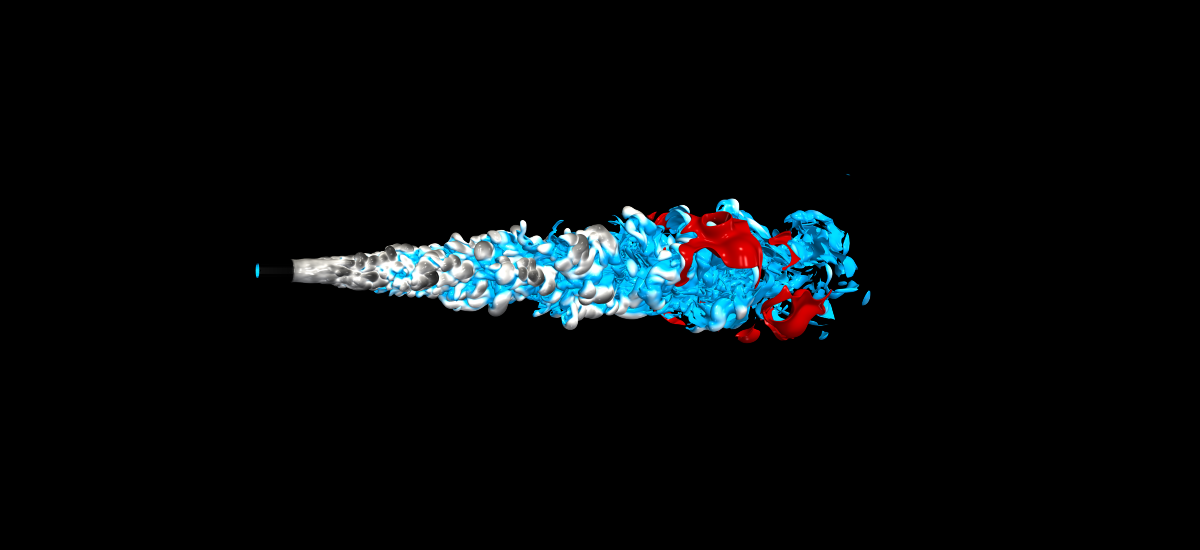
Our team, led by Prof. Dr.-Ing. Andreas Kempf, Apl. Prof. Dr. Khadijeh Mohri, and Dr.-Ing. Irenäus Wlokas, develops and tests methods for the simulation, measurement, and optimization of reactive flows, flames, and detonations in facilities such as chemical reactors, gas turbine combustion chambers, hydrogen systems, piston engines, and iron direct reduction plants. Our methods shorten development times, minimize pollutants, and offer deep insights into processes and physics, enabling the development of cost-efficient, flexible, and safe facilities with significantly reduced emissions.
News
15-10-2026

New Publication
Role of early particle formation in modeling gas-phase chemistry of Fe-doped flames
The first absolute FeO concentration maps in Fe-doped flames, showing that early particle formation matters for flame chemistry modelling.
14.09.2026

New Publication
Towards predicting Deflagration-to-Detonation Transition in smooth channels
A new hetero-monodisperse population balance model efficiently captures hetero-aggregate formation and growth while significantly reducing computational cost for CFD simulations.
06.07.2026

Paper Published
New Simulation Framework Improves Prediction of Iron Oxide Nanoparticle Formation in Spray Flames
The formation of iron oxide nanoparticles in turbulent spray flames using a novel simulation framework.
16.07.2026
Paper Published
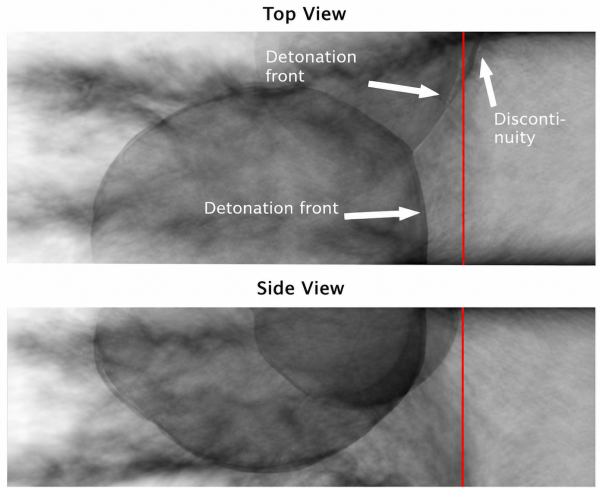
Towards predicting Deflagration-to-Detonation Transition in smooth channels
Present a modelling strategy that constitutes significant progress in modelling DDT.
14.07.2026

Paper Published
The Role of Oxide Layer Thickness in Turbulent Iron Combustion
A carrier-phase DNS study," has now been published in Proceedings of the Combustion Institute.
14.09.2026

Conference Presentation
New Model for Hetero-Aggregate Formation
At IAC 2026, our team presented a new Monte Carlo model for efficient simulation of hetero-aggregate formation and growth.
16.07.2026

Conference Paper Accepted
International Shock Wave Symposium
Henrik Thomas investigates shock-wave focusing and ignition in hydrogen-air mixtures within three-wall corner geometries.
28.09.2026

Bachelor Thesis
A parametric modelling of the UDE optical engine
Devanesh Bala Chandran developed a fully parametric CAD model of the UDE optical engine. The model gives our hydrogen engine simulations a flexible and traceable geometric basis.
28-09-2026
Bachelor Thesis
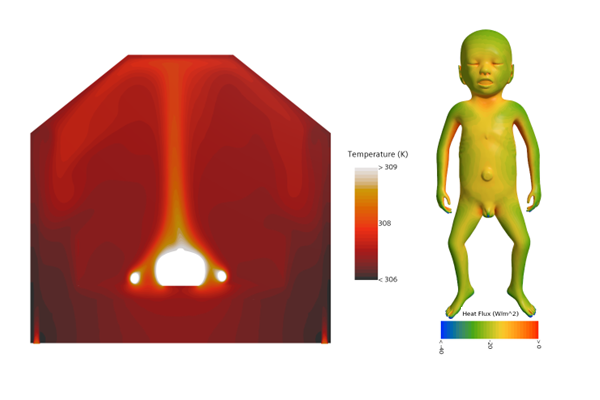
Numerical Modeling of Conduction, Convection, & Radiation
Presenting a comprehensive CFD framework modeling conduction, convection, and surface-to-surface radiation in neonatal incubators.
30-09-2026
Master thesis
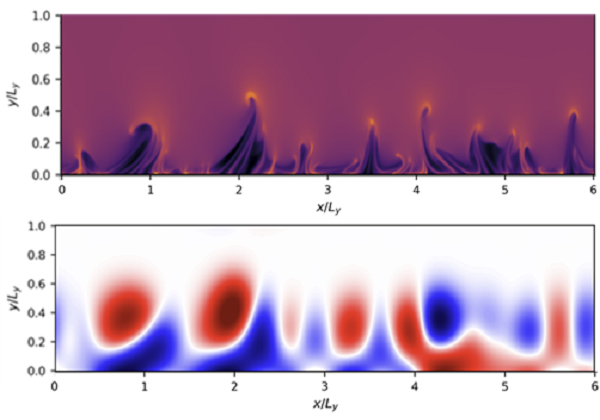
Electrode Geometry in Ion Transport and Electrohydrodynamic Flow
Using numerical simulations based on the coupled Poisson–Nernst–Planck and Navier–Stokes
Links at the UDE:
- Faculty of Engineering
- Institute for Energy and Materials Processes
- Center for NanoIntegration, CENIDE
- NanoEnergieTechnikZentrum, NETZ
- Center for Energy Research, CER.UDE
- Center for Computational Sciences and Simulation, CCSS
- SFB 445
- Institute of Energy and Environmental Technology e.V. (IUTA)
- Forschergruppe 2284