

Flugzeit-Sekundärionen-Massenspektrometrie (TOF-SIMS)
Was kann ein Flugzeit-Sekundärionen-Massenspektrometer?
Die Abkürzung TOF-SIMS ist ein Akronym für die Kombination der Sekundärionenmassenspektrometrie (SIMS) mit einem Flugzeit (TOF) -Massenanalysator.
Die zu untersuchende Probe wird mit einem primären Ionenstrahl mit einer kinetischen Energie von einigen keV beschossen. Die Ionen kollidieren mit der Oberfläche, geben dabei ihre Energie ab und erzeugen eine Stoßkaskade. Diese führt zum herauslösen einzelner Oberflächenatome und -moleküle, bzw. von Clustern und Fragmenten. Einige dieser Sekundärpartikel liegen als Ionen vor und können nach ihrer Masse getrennt analysiert werden.
Für die Massentrennung wird das Flugzeit- (Time-of-Flight) Prinzip verwendet. Partikel unterschiedlicher Masse erreichen bei gleicher Beschleunigungsspannung eine unterschiedliche Geschwindigkeit. Die beschleunigten Partikel legen im Analysator eine bestimmte Strecke zurück und erreichen den Detektor zu unterschiedlichen Zeiten, je leichter der Partikel desto schneller ist er. Da Zeiten mit sehr hoher Genauigkeit messbar sind, erreicht man mit dieser Methode eine sehr hohe spektrale Massenauflösung und man bekommt ein sehr genaues Abbild der Probenoberfläche und ihrer Zusammensetzung. Der Ablauf ist in dem Film in Abbildung 1 dargestellt.
Mit dieser Methoden erreicht man eine Ortsauflösung < 100 nm, mit einer Oberflächenempfindlichkeit auf die ersten 1-2 Lagen der Probe. Tiefenprofile mit einer Tiefengenauigkeit von < 1nm und einer Messgeschwindigkeit von bis zu 10µm/h sind erreichbar.
Mit der Integrierten fokussierten Ionenstrahl Quelle (FIB) ist es möglich sauber Querschnittsflächen von hochporösen Oberflächen und Schichtstrukturen mit stark unterschiedlicher Ionen-Ätzrate zu erzeugen und diese Querschnitte dann zu untersuchen. Die Erzeugung eines solchen Krater ist in dem Film in Abbildung 2 gezeigt. Der Krater hat eine Größe von etwa 30µmx15µm bei einer Tiefe von ca. 20µm. Dauer etwa 6h.
Wir verwenden am ICAN das TOF.SIMS 5 von Ion-TOF.
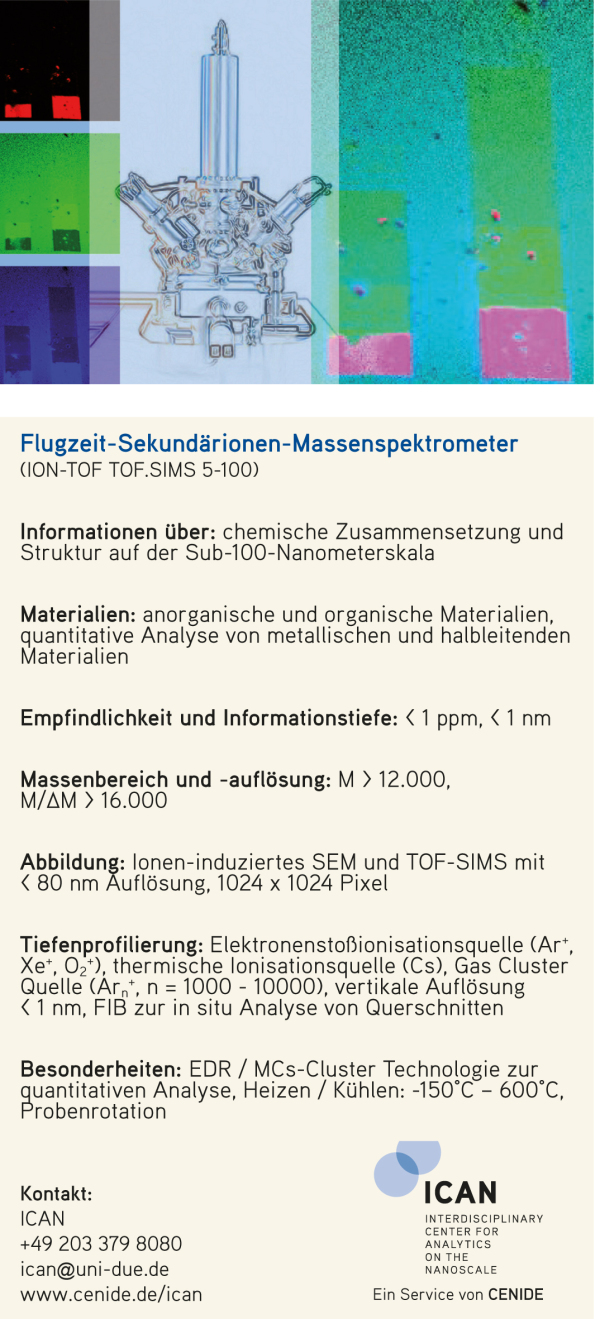
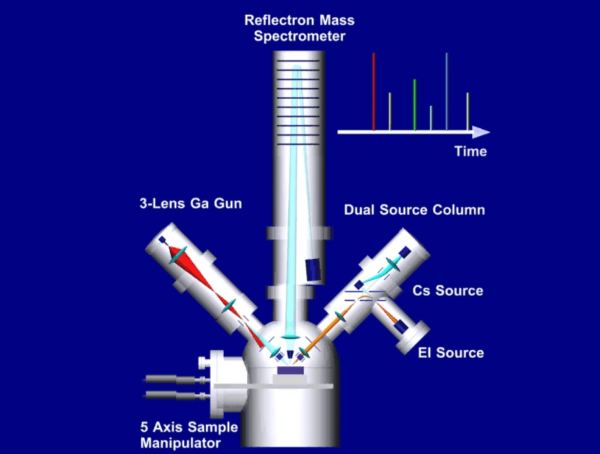
Abbildung 1: Darstellung des Time-of-Flight Prinzips. Animation bereitgestellt von der Ion-TOF GmbH.
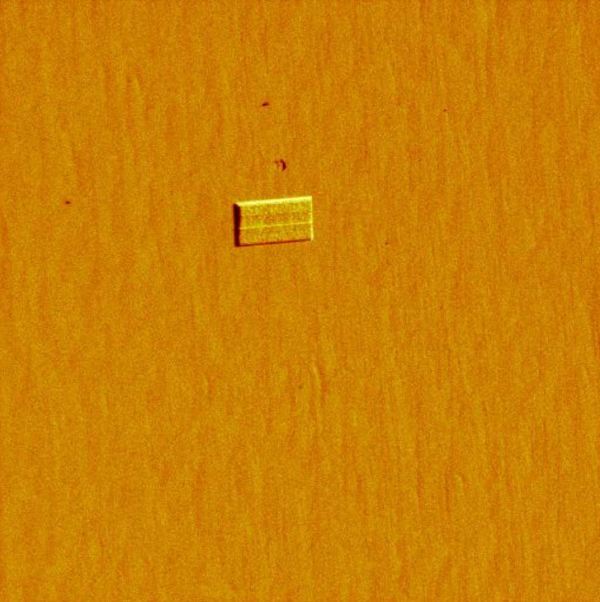
Abbildung 2: Sekundärelektronenbilder der Erzeugung eines FIB-Kraters in dotiertem Diamant zur Untersuchung der freigelegten Querschnittsfläche. Größe des Kraters etwa 30µm x 15µm x 20µm. Dauer etwa 6h.
Depth profiling
Abbildung 3 zeigt das Massenspektrum einer Europium dotierten Aluminiumoxidschicht auf Silizium auf linearer und logarithmischer Skala. Da bei dieser Technik Unterschiede in der Flugzeit gemessen werden kommt der Umrechnung dieser Zeit-Skala in eine Masse-Skala große Bedeutung zu. Dies führt dazu, dass oft die Auswertung der Daten erheblich mehr Zeit in Anspruch nimmt als ihre Erzeugung.
In der logarithmischen Auftragung wird die enorme Sensititvät der Technik deutlich. Es ist möglich Dotier-Konzentrationen bis in den ppm-Bereich zu vermessen.
Abbildung 4 zeigt den Intensitätsverlauf des Aluminium- und Europiumsignals in Abhängigkeit von der Sputterzeit. Zwischen der Aufnahme von 2 Massenspektrum wurde die Oberfläche mit schnellen Sauerstoffmolekülen beschossen um tieferliegende Atomlagen freizulegen. Auf diese Weise erzeugt man ein Tiefenprofil des Materials. In diesem Beispiel sieht man, dass die Europiumkonzentration in die Tiefe hin zunimmt, an der Grenzfläche zum Silizium ein Maximum besitzt und dann ins Silizium hin wieder abfällt.
Das der Übergang vom Al2O3 zum Silizium nicht beliebig scharf ist hat verschiedene Gründe. In diesem Fall war die große Rauheit der Al2O3 Oberfläche hierfür maßgeblich verantwortlich. Die untersuchte Aluminiumoxdischicht war etwa 8 µm dick.
TOF-Sims ist keine Technik um direkt mit einer Messung totale Konzentration zu bestimmen. Der Grund dafür ist der, dass die Abtragsraten und Ioniesierungswahrscheinlichkeit eines bestimmten Elementes/Moleküls stark von der Matrix abhängt, in der es sich befindet.
Zum Beispiel würde eine bestimmte Dotiermenge an Bor in Slizium eine deutlich andere Signalintensität geben, als die gleiche Menge Bor in Diamant. Daher benötigt man idealerweise für jede Messung eine Referenzprobe, mit gleicher Matrix, bei der die Konzentration des Dotierstoffs bekannt ist.
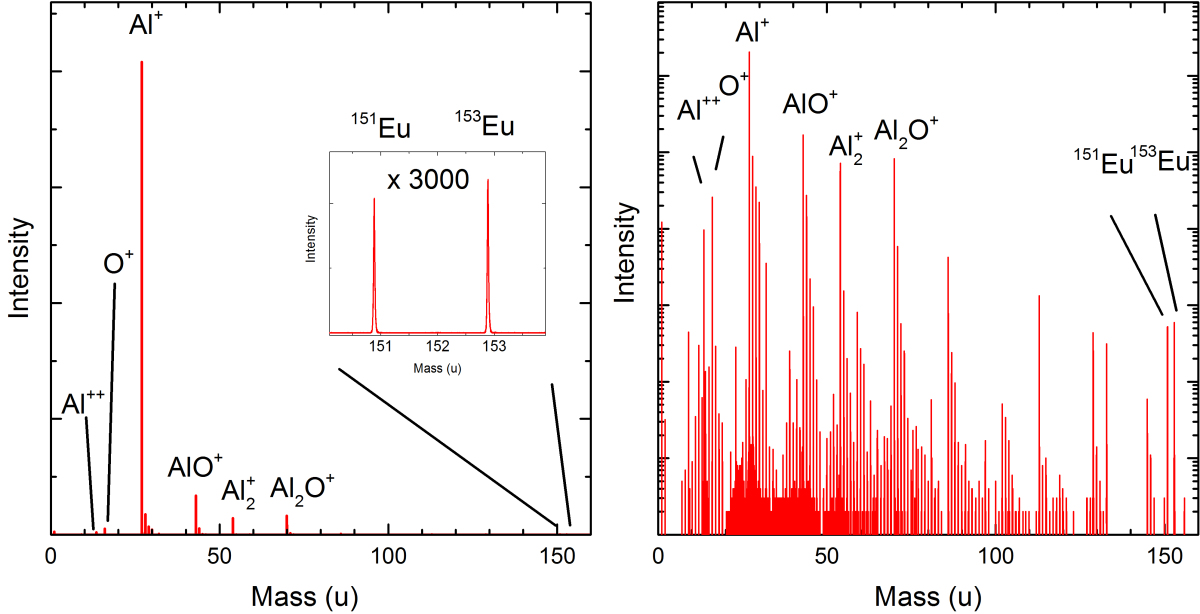
Abbildung 3: Massenspektrum von Europium dotierten Aluminiumoxid auf linearer und logarithmischer Skala.
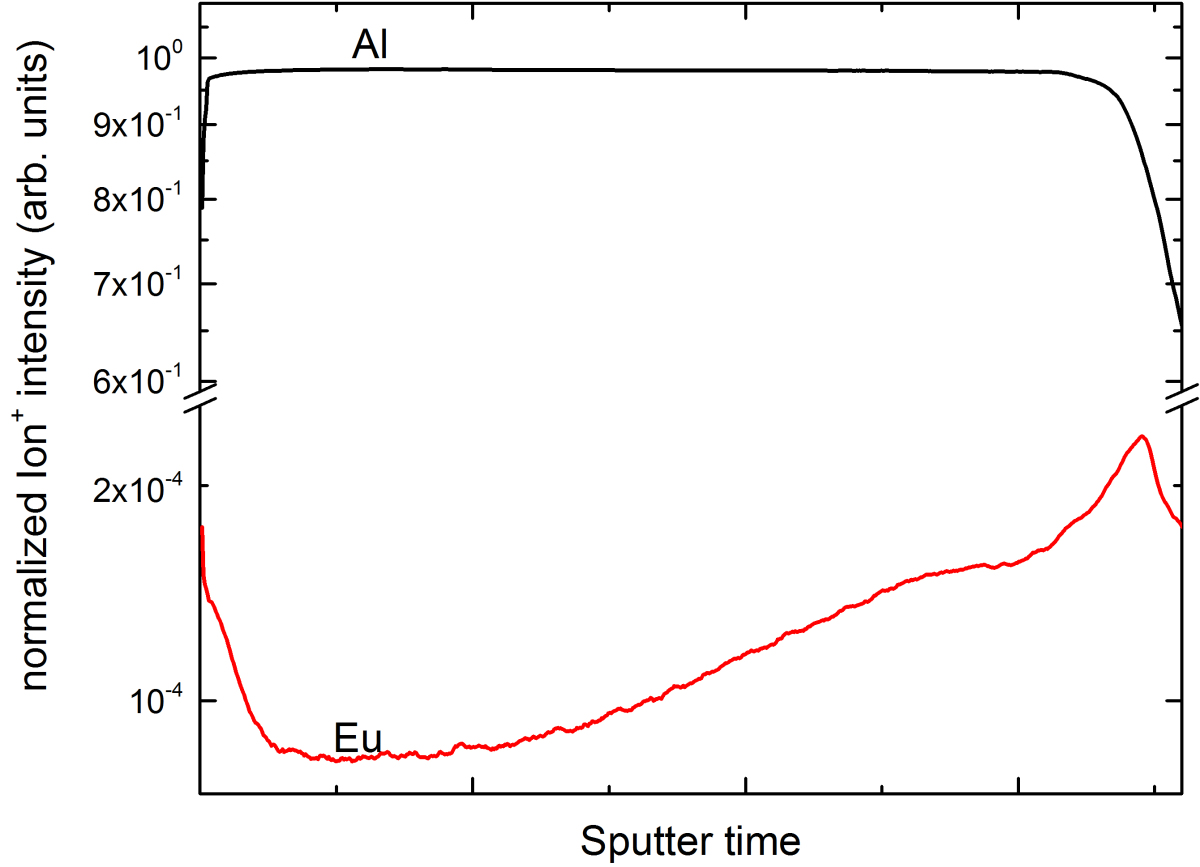
Abbildung 4: Verlauf der Intensität des Al+ und des Eu+ Signals in Abhänigkeit von der Ionenätzzeit (geätzt wurde mit Sauerstoff). Die Schichtdicke der Al2O3 Schicht betrug ca. 8 µm.
Ihr Ansprechpartner für das TOF-SIMS:
ICAN - Interdisciplinary Center for Analytics on the Nanoscale
47057 Duisburg
Funktionen
-
Wissenschaftliche/r Mitarbeiter/in, Center for Nanointegration Duisburg-Essen
-
apl. Professor/in, Physikalische Chemie

Aktuelle Veranstaltungen
Keine aktuellen Veranstaltungen.
Vergangene Veranstaltungen (max. 10)
-
WiSe 2025
-
WiSe 2024
-
WiSe 2023
-
WiSe 2022
-
WiSe 2021
Die folgenden Publikationen sind in der Online-Universitätsbibliographie der Universität Duisburg-Essen verzeichnet. Weitere Informationen finden Sie gegebenenfalls auch auf den persönlichen Webseiten der Person.
-
Laser-Induced Iron Doping of Spinel Thin Film Electrocatalyst : Impact of Pulsed Laser Processing on Surface Cobalt Oxide Doping and Oxygen Evolution Reaction ActivityIn: ChemCatChem, Jg. 18, 2026, Nr. 2, e01233DOI (Open Access)
-
Diffusion of Eu, Ce and Lu in orthopyroxeneIn: Geochimica et Cosmochimica Acta, Jg. 410, 2025, S. 85 – 100DOI (Open Access)
-
Interaction of 2-propanol with predominantly SrO- and TiO2-terminated SrTiO3(100) surfaces studied by vibrational sum frequency spectroscopyIn: Catalysis Science and Technology, Jg. 13, 2023, Nr. 17, S. 4988 – 4995DOI (Open Access)
-
N-Doped porous carbons obtained from chitosan and spent coffee as electrocatalysts with tuneable oxygen reduction reaction selectivity for H₂O₂ generationIn: RSC Advances, Jg. 13, 2023, Nr. 33, S. 22777 – 22788DOI (Open Access)
-
Beneficial Effects of Low Iron Contents on Cobalt‐Containing Spinel Catalysts in the Gas Phase 2‐Propanol OxidationIn: ChemCatChem, Jg. 14, 2022, Nr. 18, e202200472DOI (Open Access)
-
Auf Spurensuche im Nanokosmos : Katalyseforschung im Interdisciplinary Center for Analytics on the NanoscaleIn: Unikate: Berichte aus Forschung und Lehre, 2021, Nr. 57: Katalyse : Alles andere als oberflächlich, S. 139 – 148DOI, Online Volltext (Open Access)
-
Segregation-Enhanced Epitaxy of Borophene on Ir(111) by Thermal Decomposition of BorazineIn: ACS Nano, Jg. 15, 2021, Nr. 4, S. 7421 – 7429
-
The Effect of Water on the 2-Propanol Oxidation Activity of Co-Substituted LaFe₁−CoₓO₃ PerovskitesIn: Chemistry - A European Journal, Jg. 27, 2021, Nr. 68: Special Issue: Contemporary Challenges in Catalysis, S. 17127 – 17144DOI (Open Access)
-
Experimental evidence for the separation of thermally excited bipolar charge carries within a p-n junction : A new approach to thermoelectric materials and generatorsIn: Journal of Applied Physics, Jg. 125, 2019, Nr. 18, 184502
-
Lead diffusion in CaTiO₃ : A combined study using Rutherford backscattering and TOF-SIMS for depth profiling to reveal the role of lattice strain in diffusion processesIn: American Mineralogist, Jg. 104, 2019, Nr. 4, S. 557 – 568
-
UV-light assisted patterned metallization of textile fabricsIn: Applied Surface Science, Jg. 436, 2018, S. 1093 – 1103
-
Adjusting the catalytic properties of cobalt ferrite nanoparticles by pulsed laser fragmentation in water with defined energy doseIn: Scientific Reports, Jg. 7, 2017, Nr. 1, S. 13161DOI, Online Volltext (Open Access)
-
Gradual modification of ITO particle's crystal structure and optical properties by pulsed UV laser irradiation in a free liquid jetIn: Dalton Transactions, Jg. 46, 2017, Nr. 18, S. 6039 – 6048
-
Laser-Induced Functionalization of Organo/Carbon Interfaces for Selective Adsorption of Au Nanoparticles in Microsized DomainsIn: Langmuir, Jg. 33, 2017, Nr. 35, S. 8686 – 8692
-
Laser-induced surface activation of biocomposites for electroless metallizationIn: Surface and Coatings Technology, Jg. 311, 2017, S. 104 – 112
-
Resonant laser processing of nanoparticulate Au/TiO2 films on glass supports : Photothermal modification of a photocatalytic nanomaterialIn: Surface Science, Jg. 650, 2016, S. 57 – 63
-
Surface-enhanced Raman spectroscopy on laser-engineered ruthenium dye-functionalized nanoporous goldIn: Applied Surface Science, Jg. 374, 2016, S. 19 – 22
-
Photothermally induced bromination of carbon/polymer bipolar plate materials for fuel cell applicationsIn: Applied Surface Science, Jg. 336, 2015, S. 85 – 88
-
Poly(N,N-dimethylaminoethyl methacrylate) Brushes : pH-Dependent Switching Kinetics of a Surface-Grafted Thermoresponsive PolyelectrolyteIn: Langmuir, Jg. 31, 2015, Nr. 49, S. 13426 – 13432
-
Resonant photothermal laser processing of hybrid gold/titania nanoparticle filmsIn: Applied Surface Science, Jg. 336, 2015, S. 48 – 52
-
Chemical functionalization of carbon/polymer bipolar plate materials via oxygen plasma activation and subsequent silanizationIn: Surface and Coatings Technology, Jg. 240, 2014, S. 255 – 260
-
Photothermal Laser Fabrication of Micro- and Nanostructured Chemical Templates for Directed Protein ImmobilizationIn: Langmuir, Jg. 30, 2014, Nr. 49, S. 14841 – 14848
-
Photothermal laser microsintering of nanoporous goldIn: Langmuir, Jg. 30, 2014, Nr. 24, S. 7190 – 7197
-
Fabrication of chemical templates via selective laser-induced desorption of hexadecanethiol self-assembled monolayersIn: Applied Surface Science, Jg. 278, Laser materials processing for micro and nano applications, E-MRS 2012 Symposium V, 2013, S. 57 – 61
-
Fabrication of periodic surface topographies via sequential photothermal laser microsintering of silicon nanoparticle filmsIn: Applied Surface Science, Jg. 278, 2013, S. 278 – 283
-
Femtosecond-laser processing of nitrobiphenylthiol self-assembled monolayersIn: Applied Surface Science, Jg. 278: Laser materials processing for micro and nano applications, E-MRS 2012 Symposium V, 2013, S. 43 – 46
-
Hofmeister Effect of Sodium Halides on the Switching Energetics of Thermoresponsive Polymer BrushesIn: Macromolecular Rapid Communications, Jg. 34, 2013, Nr. 5, S. 417 – 422
-
Laser-doping of crystalline silicon substrates using doped silicon nanoparticlesIn: Thin Solid Films, Jg. 548, 2013, S. 437 – 442
-
Sintering of thin titanium dioxide nanoparticle films via photothermal processing with ultraviolet continuous-wave lasersIn: Applied Surface Science, Jg. 278, Laser materials processing for micro and nano applications, E-MRS 2012 Symposium V, 2013, S. 336 – 340
-
VerNETZungen : Integrierte Nanopartikel-Synthese und -Verarbeitung im NanoEnergieTechnikZentrumIn: Unikate: Berichte aus Forschung und Lehre, 2013, Nr. 43: NanoEnergie – Materialentwicklung für eine nachhaltige Energieversorgung, S. 26 – 41DOI, Online Volltext (Open Access)
-
Photothermal laser processing of thin silicon nanoparticle films : On the impact of oxide formation on film morphologyIn: Applied Physics A: Materials Science and Processing, Jg. 106, 2012, Nr. 4, S. 853 – 861
-
Substrate-mediated effects in photothermal patterning of alkanethiol self-assembled monolayers with microfocused continuous-wave lasersIn: Beilstein Journal of Nanotechnology, Jg. 3, 2012, Nr. 1, S. 65 – 74DOI (Open Access)
-
Probing the intrinsic switching kinetics of ultrathin thermoresponsive polymer brushesIn: Angewandte Chemie International Edition, Jg. 50, 2011, Nr. 19, S. 4513 – 4516
-
Micro- and nanopatterning of functional organic monolayers on oxide-free silicon by laser-induced photothermal desorptionIn: Small, Jg. 6, 2010, Nr. 17, S. 1918 – 1926
-
Nonlinear femtosecond laser processing of alkylsiloxane monolayers on surface-oxidized silicon substratesIn: Journal of Vacuum Science and Technology A: Vacuum, Surfaces, and Films, Jg. 28, 2010, Nr. 4, S. 814 – 817
-
Photothermal micro- and nanopatterning of organic/silicon interfacesIn: Langmuir, Jg. 26, 2010, Nr. 9, S. 6826 – 6831
-
Photothermally induced bromination and decomposition of alkylsiloxane monolayers on surface-oxidized silicon substratesIn: Journal of Vacuum Science and Technology A: Vacuum, Surfaces, and Films, Jg. 28, 2010, Nr. 4, S. 834 – 837
-
Self-assembled organic monolayers as high-resolution resists in rapid nonlinear processing with single femtosecond laser pulsesIn: Applied Physics A: Materials Science and Processing, Jg. 101, 2010, Nr. 3, S. 461 – 466
-
Sub-wavelength patterning of organic monolayers via nonlinear processing with continuous-wave lasersIn: New Journal of Physics (NJP), Jg. 12, 2010, S. 125017DOI, Online Volltext (Open Access)
-
Temporal stability of photothermally fabricated micropatterns in supported phospholipid multilayersIn: Journal of Vacuum Science and Technology A: Vacuum, Surfaces, and Films, Jg. 28, 2010, Nr. 4, S. 953 – 957
-
Direct Laser Patterning of Soft Matter: Photothermal Processing of Supported Phospholipid Multilayers with Nanoscale PrecisionIn: Small, Jg. 5, 2009, Nr. 18, S. 2099 – 2104
-
Laser-induced local dehydroxylation on surface-oxidized silicon substrates: mechanistic aspects and prospects in nanofabricationIn: Applied Physics A: Materials Science and Processing, Jg. 94, 2009, Nr. 1, S. 95 – 103
-
Photothermally induced microchemical functionalization of organic monolayersIn: ChemPhysChem, Jg. 10, 2009, Nr. 12, S. 2000 – 2003
-
Surface-initiated polymerization on laser-patterned templates : morphological scaling of nanoconfined polymer brushesIn: Langmuir, Jg. 25, 2009, Nr. 20, S. 12393 – 12398
-
Subwavelength patterning of alkylsiloxane monolayers via nonlinear processing with single femtosecond laser pulsesIn: Applied Physics Letters (APL), Jg. 92, 2008, S. 223111
-
Oriented growth of osteoblast-like cells on two-dimensionally structured films of functionalized calcium phosphate nanoparticles on a silicon substrateIn: Advanced Engineering Materials, Jg. 9, 2007, S. 1077 – 1081
-
Self-assembled organic templates for the selective adsorption of gold nanoparticles into confined domains
24th European Conference on Surface Science (ECOSS-24) ; 4-8 September 2006, Paris, France,In: Surface Science, Jg. 601, 2007, Nr. 18, S. 3916 – 3920 -
1D Nanofabrication with a Micrometer-Sized Laser SpotIn: Nano Letters, Jg. 6, 2006, Nr. 10, S. 2358 – 2361
-
Direct laser patterning of octadecylsiloxane monolayers on surface-oxidized silicon substrates : Indications for a photothermal excitation mechanismIn: Surface Science, Jg. 600, 2006, Nr. 18, S. 4034 – 4038
-
Laser-assisted decomposition of alkylsiloxane monolayers at ambient conditions : rapid patterning below the diffraction limitIn: Applied Physics A: Materials Science and Processing, Jg. 82, 2006, Nr. 4, S. 689 – 695
-
Laser-assisted fabrication of submicron-structured hydrophilic/ hydrophobic templates for the directed self-assembly of alkylsiloxane monolayers into confined domainsIn: Applied Physics A: Materials Science and Processing, Jg. 82, 2006, Nr. 1, S. 15 – 18
-
Preparation of two-dimensionally patterned layers of functionalised calcium phosphatenanoparticles by laser direct writingIn: Journal of Materials Chemistry, Jg. 16, 2006, Nr. 19, S. 1798 – 1802
-
Characterization of the telomere complex, TERF1 and TERF2 genes in muntjac species with fusion karyotypesIn: Experimental Cell Research, Jg. 306, 2005, Nr. 1, S. 64 – 74
-
Preparation of stacked organosiloxane bilayers on hydrophilic and hydrophobic silicon substrates by spin coatingIn: Thin Solid Films, Jg. 488, 2005, Nr. 1-2, S. 124 – 131
-
Characterization of ancestral chromosome fusion points in the Indian muntjac deerIn: Chromosoma, Jg. 112, 2004, Nr. 5, S. 213 – 220
-
Imaging surface topographical changes during plastic deformation of a metal with chemical wave patternsIn: Surface Science, Jg. 548, 2004, Nr. 1-3, S. 163 – 169
-
Preparation of Submicron-Structured Alkylsiloxane Monolayers Using Prepatterned Silicon Substrates by Laser Direct WritingIn: Langmuir, Jg. 20, 2004, Nr. 9, S. 3525 – 3527
-
An AFM study of the growth kinetics of the self-assembled octadecylsiloxane monolayer on oxidized silicon
7th International Conference on Nanometer-Scale Science and Technology and the 21st European Conference on Surface Science (NANO-7 / ECOSS-21) ; 24-28 June 2002, Malmö, Sweden,In: Surface Science, Jg. 532-535, 2003, S. 963 – 969 -
Mutations in the polyglutamine binding protein 1 gene cause X-linked mental retardationIn: Nature Genetics, Jg. 35, 2003, Nr. 4, S. 313 – 315DOI (Open Access)
-
Two-dimensional aggregation of species with weak and strong bonding interactions : Modeling the growth of self-assembled Alkylsiloxane monolayersIn: Langmuir, Jg. 19, 2003, Nr. 17, S. 6590 – 6593
-
Reaction of sulfur dioxide with Ag(110)–p(2x1)-O : a LEED, TPRS, and STM investigationIn: Surface Science, Jg. 504, 2002, S. 223 – 234
-
Pattern formation in restricted geometries : The NO+CO reaction on Pt(100)In: The Journal of Chemical Physics (JCP), Jg. 112, 2000, Nr. 15, S. 6795 – 6803DOI (Open Access)
-
Nonlinear processing and multiphoton ablation of self-assembled monolayers for application as ultrathin resists and in biochemical sensorsIn: Optically Induced Nanostructures: Biomedical and Technical Applications / König, Karsten; Ostendorf, Andreas (Hrsg.). Berlin [u.a.]: de Gruyter, 2015, S. 117 – 139
-
Laser Patterning of Silanized Carbon/Polymer Bipolar Plates with Tailored Wettability for Fuel Cell ApplicationsIn: Laser Surface Modification and Adhesion / Mittal, K. L.; Bahners, Thomas (Hrsg.). Hoboken, New Jersey: John Wiley and Sons, Inc, 2014, S. 263 – 287
-
Micro-patterning of self-assembled organic monolayers by using tunable ultrafast laser pulsesIn: Frontiers in ultrafast optics: biomedical, scientific, and industrial applications XIV / SPIE photonics west , 2 - 5 February 2014, San Francisco, California, United States. Bellingham, Wash.: SPIE, 2014
-
Sub-wavelength patterning of self-assembled organic monolayers via non-collinear optical parametric amplifierIn: ICALEO 2013 - 32nd International Congress on Applications of Lasers and Electro-Optics / 32nd International Congress on Applications of Lasers and Electro-Optics, ICALEO 2013, Miami, FL, United States, 6 October 2013 through 10 October 2013, 2013, S. 893 – 897
-
Fabrication, laser structuring and field emission properties of carbon nanowallsIn: 25th International Vacuum Nanoelectronics Conference (IVNC 2012) / International Vacuum Nanoelectronics Conference, Jeju, South Korea, 9 - 13 July 2012. Piscataway, NJ: IEEE, 2012, S. 354 – 355
-
Electron emission of laser-structured carbon nanowalls on Si and stainless steel substratesIn: 24th International Vacuum Nanoelectronics Conference (IVNC), 2011 / International Vacuum Nanoelectronics Conference, 18 - 22 July 2011, Historische Stadthalle Wuppertal, Germany / Klümper, Andreas (Hrsg.). Piscataway: IEEE, 2011, S. 139 – 140
-
Preparation of organic monolayers on uniform and patterned silicon substratesIn: Physical chemistry of interfaces and nanomaterials II: 6 - 8 August 2003, San Diego, California, USA II / Optical Science and Technology, SPIE's 48th Annual Meeting, 2003, 06.-08.08.2003, San Diego, California, United States / Lian, Tianquan; Dai, Hai-Lung (Hrsg.). Bellingham [u.a.]: SPIE, 2003, S. 9 – 23
-
Photothermal laser processing of thin silicon nanoparticle films : prospects in photovoltaic applications
1st International Conference on Materials for Energy, 4. - 8. Juli 2010 Karlsruhe, Germany,Karlsruhe, 2010