

Multilingual Participation in the Labor Market: Use and Value of Heritage Languages in the Workplace (MAriE)
| Multilingual Participation in the Labor Market: Use and Value of Heritage Languages in the Workplace (MAriE) | ||
|
The "MAriE project" (“Multilingual Participation in the Labor Market: Use and Value of Heritage Languages in the Workplace”) examines how (heritage) languages are used in the workplace and what value is attributed to them. Questions regarding the utility or value of heritage languages (as well as foreign languages) in the labor market are studied in various disciplines in different ways, and the results are sometimes interpreted very differently. In economic research, it is widely accepted that proficiency in languages other than the majority language generally has no positive impact on employment status or wages (with the exception of English proficiency). In sociolinguistic studies, the use of heritage languages in the workplace is viewed in a more nuanced or ambivalent manner. Various studies point to exploitative effects (also known as the commodification of language) associated with the language skills of multilingual speakers. To date, there have been no systematic studies in Germany on the use and value of heritage languages that examine the situation of multilingual workers in a labor market that is increasingly shaped by migration. In the context of dynamic migration and inflow processes and a steadily growing shortage of skilled workers, it can be assumed that multilingual communication in professional settings is already a reality in many industries or is increasingly becoming so. Based on various previous studies conducted by the research team, this project will first systematically assess, through quantitative data collection, how frequently and for what purposes migration-related multilingual workers use their heritage language skills at work. Participants will be asked whether (and if so, which) personal professional benefits result from language use, or whether (and if so, which) employer-imposed constraints or (structural) mechanisms of exploitation are at play. Finally, aspects of linguistic confidence and language well-being in professional communication will be addressed. This quantitative survey will be supplemented by a qualitative group discussion study as part of a mixed-methods design. Complementing the questionnaire, the group discussions with multilingual workers, serve to explore external and internal expectations regarding the use of native languages in a professional context. The goal of the project is to generate knowledge, on the one hand, about how mechanisms of linguistic exploitation, abuse, and commodification can arise in the German labor market, and, on the other hand, about the conditions that must be in place for multilingual speakers with a migration background to participate equally in the labor market with regard to the use of their language skills. |
Duration: Project Coordination: Assistant:
|
|




Master's theses produced within the project
Tilli, Y. (2026). Wert und Nutzung von Herkunftssprachen im Arbeitskontext: Ein Vergleich zwischen Lehrkräften und Beschäftigten der Industrie im Rahmen des Projekts MAriE.
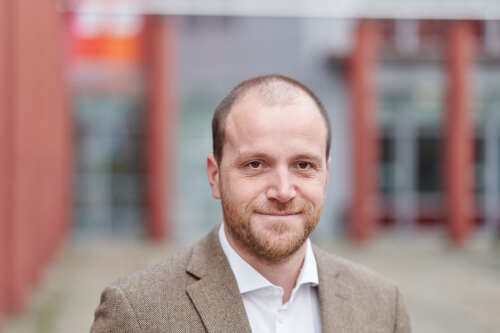
Prof. Dr. Tobias Schroedler
Head of Research Unit Multilingualism and Social Inclusion
Contact:
Universität Duisburg-Essen
Deutsch als Zweit- und
Fremdsprache
Universitätsstr. 12
45141 Essen
Room: R12 R03 B28
Tel.: +49-(0)201-183 6620
Fax: +49-(0)201-183 3959
E-Mail: tobias.schroedler@uni-due.de
Secretary:
Vassiliki Metaxa (DaZ/DaF)
Room: R12 R03 B39
Tel.: +49-(0)201-183 3580
Fax: +49-(0)201-183 3959
E-Mail: dazdaf@uni-due.de

Prof. Dr. Tobias Schroedler is an Educational Linguist, Head of Research Unit Multilingualism and Social Inclusion.

You can find the team of the Research Unit Multilingualism and Social Inclusion here.

A compilation of selected publications by Tobias Schroedler can be found here.

A selection of talks and conference papers by Tobias Schroedler can be found here.

If you would like to write a thesis (BA, MA, Dr. Phil.) supervised by Prof. Dr. Tobias Schroedler, you can find out about suitable topics here. Should you have any particular questions, please do not hesitate to send us an email.

An overview of selected projects of Tobias Schroedler can be found here.

Tobias Schroedler's internationalisation activities in teaching, visiting professorships and cooperations can be found here.

An overview of selected memberships, functions and affiliations of Tobias Schroedler can be found here.