Projects - Prof. Dr. Tobias Schroedler
Current Projects
DaZFlexPro - Flexible Professional Development in Teaching German as a Second Language
Project Coordination in Essen: Prof. Dr. Katja F. Cantone-Altıntaș, Christoph Chlosta, Prof. Dr. Heike Roll und Prof. Dr. Tobias Schroedler
Project Spokesperson (across all locations): Prof. Dr. Tobias Schroedler
Funded by: Stiftung Innovation in der Hochschullehre ("Foundation for Innovation in Higher Education Teaching")
DaZFlexPro is a collaborative project of the Ruhr University Alliance. Within this university consortium, the Technical University of Dortmund, Ruhr University Bochum, and the University of Duisburg-Essen work closely together in teaching and research. In the field of German as a Second Language (DaZ), the research and teaching focuses of the three universities complement each other in a unique way. This forms the basis for further developing the content and structure of German as a Second Language study programs, making them more flexible, and establishing their distinct profile across all three phases of teacher training.
In field of action 1, which is based at the University of Duisburg-Essen, an agile design and flexible study options for professional development for prospective teachers are being developed, transferred to the campuses in Bochum (Ruhr University) and Dortmund (Technical University), and sustainably integrated into professional development at the UA Ruhr. As part of the project, thematic, partially digitized learning stations based on existing content from the module German as a Second Language are being developed for field of action 1, then tailored and supplemented for specific subject groups and school types. Through required and elective stations, students—with close guidance from university instructors—can test the Flexi-Track.
Multilingual Participation in the Labor Market: Use and Value of Heritage Languages in the Workplace (MAriE)
Project Coordination: Prof. Dr. Tobias Schroedler
Funded by: Deutsche Forschungsgemeinschaft (DFG)
The "MAriE project" (“Multilingual Participation in the Labor Market: Use and Value of Heritage Languages in the Workplace”) examines how (heritage) languages are used in the workplace and what value is attributed to them. Questions regarding the utility or value of heritage languages (as well as foreign languages) in the labor market are studied in various disciplines in different ways, and the results are sometimes interpreted very differently. In economic research, it is widely accepted that proficiency in languages other than the majority language generally has no positive impact on employment status or wages (with the exception of English proficiency). In sociolinguistic studies, the use of heritage languages in the workplace is viewed in a more nuanced or ambivalent manner. Various studies point to exploitative effects (also known as the commodification of language) associated with the language skills of multilingual speakers. To date, there have been no systematic studies in Germany on the use and value of heritage languages that examine the situation of multilingual workers in a labor market that is increasingly shaped by migration. In the context of dynamic migration and inflow processes and a steadily growing shortage of skilled workers, it can be assumed that multilingual communication in professional settings is already a reality in many industries or is increasingly becoming so.
Based on various previous studies conducted by the research team, this project will first systematically assess, through quantitative data collection, how frequently and for what purposes migration-related multilingual workers use their heritage language skills at work. Participants will be asked whether (and if so, which) personal professional benefits result from language use, or whether (and if so, which) employer-imposed constraints or (structural) mechanisms of exploitation are at play. Finally, aspects of linguistic confidence and language well-being in professional communication will be addressed. This quantitative survey will be supplemented by a qualitative group discussion study as part of a mixed-methods design. Complementing the questionnaire, the group discussions with multilingual workers, serve to explore external and internal expectations regarding the use of native languages in a professional context.
The goal of the project is to generate knowledge, on the one hand, about how mechanisms of linguistic exploitation, abuse, and commodification can arise in the German labor market, and, on the other hand, about the conditions that must be in place for multilingual speakers with a migration background to participate equally in the labor market with regard to the use of their language skills.


Your Language Counts! All Languages Matter in a Multilingual Society (YLC)
Project Coordination (Goethe-Institut Sweden): Sabine Brachmann-Bosse, Elisabeth Caroline Schmidt
Work Package Lead: Evaluation: Prof. Dr. Tobias Schroedler, Dr. Erkan Gürsoy, Clarissa Diekmann in cooperation with Dr. Tatjana Atanasoska (University of Education Upper Austria).
Funded by: European Union – ERASMUS+ (KA220-SCH)
The ERASMUS+ project "Your language counts! All languages matter in a multilingual society" (YLC) is dedicated to support the integration and educational success of multilingual students with a heritage language background and aims to analyse and improve the situation of heritage language teaching (HLT) in the sense of multilingual-inclusive school development in different European contexts. In an increasingly diverse Europe, multilingualism is the norm, presenting many opportunities but also challenges for students who must navigate a school system dominated by a language different from their heritage languages.
Our vision includes the development, testing, and implementation of a Heritage Language Education model launching in six schools, focusing on the lower secondary years (students aged 12-16) in Finland, the Netherlands and Sweden. A total of 18 teachers and learning groups with six different languages of origin are taking part in the project. The professional monitoring and evaluation of the project by the University of Duisburg-Essen (UDE) and the University of Education Upper Austria (PHOÖ) will result in the development of a handbook with practical recommendations for the implementation of HLT in the school system.
For further information, our newsletter and an overview of all partner organisations please visit the project website.

Video-Vignettes-Based Online Courses for the Professional Development of Teacher Candidates in Language-Focused Instruction (ViViPro)
Project management (UDE): Prof. Dr. Tobias Schroedler, Prof. Dr. Heike Roll
Funded by: OERContent.nrw
The development and expansion of (educational) language skills play a significant role in enabling all students, regardless of their diverse backgrounds, to participate in education. In the spirit of continuous language education, this applies to instruction in all subjects. Against this backdrop, it is essential that teachers of all subjects possess subject-specific competencies in the area of language education.
To prepare teacher candidates for language-focused instruction in biology, art, and history at the lower and upper secondary levels, the project “Video-Vignettes-Based Online Courses for the Professional Development of Teacher Candidates in Language-Focused Instruction” (ViViPro) was developing accessible, didactically coherent, and modularly designed online courses. These courses were designed for the module “German for Students with an Immigrant Background” (DSSZ), which has been a mandatory component of all teacher education programs in North Rhine-Westphalia since 2009. They can be integrated into existing courses by instructors or used by students for self-study.
The center of the project are video vignettes that depict various situations in language-integrated instruction and are accompanied by suggestions for further work as well as a didactic framework. By presenting authentic teaching and learning situations, the video vignettes help to illustrate theoretical approaches to language-integrated instruction using concrete examples from subject-specific teaching and to stimulate reflection on teaching practices.
Participating in the project were research teams from the University of Paderborn (consortium lead; project leadership: Prof. Dr. Constanze Niederhaus, Dr. Mareike Müller, Dr. Matthias Prikoszovits), the University of Wuppertal (project leadership: PD Dr. Corinna Peschel and Dr. Erkan Gürsoy), and the University of Duisburg-Essen (project leadership: Prof. Dr. Tobias Schroedler and Prof. Dr. Heike Roll). Prof. Dr. Sara Hägi-Mead from the Rhineland-Palatinate Technical University of Kaiserslautern-Landau was an associate of the project. The project was made possible by financial support from the state of North Rhine-Westphalia as part of the state-wide digitization initiative (funding line OERContent.nrw).
Evaluation of professional beliefs of future teachers towards compulsory teaching components and linguistic diversity in schools (EvaDaZ)
Project management: Prof. Dr. Tobias Schroedler, Caroline Böning
The project "Evaluation of Professional Beliefs of Future Teachers on Compulsory Teaching Components and on Linguistic Diversity in Schools" (EvaDaZ) surveys needs for improvement of the DaZ lecture in the Bachelor's programme at the University of Duisburg-Essen in the summer semester of 2021. On the one hand, evaluation questions are asked about this compulsory component of the university’s teacher degree, which relate to the content of our lecture on multilingualism/GSL as well as digital learning. On the other hand, the study aims to determine attitudes and beliefs of prospective teachers about linguistic diversity in schools. The survey instrument therefore additionally contains validated scales for collecting data on beliefs about linguistic heterogeneity in schools and teaching.
Completed Projects
Multilingualism and Teacher Education (MultiTEd)
Project management: Dr. Svenja Hammer, Antje Hansen, Prof. Dr. Tobias Schroedler, Prof. Dr. Meike Wernicke
The international project "Multilingualism in Teacher Education (MultiTEd)" aims to find out how teachers in different countries are prepared to work with multilingual groups of students. The first results and research-based presentations from nine different countries have been published in an edited volume (Preparing Teachers to Work with Multilingual Learners) by Multilingual Matters. The project participants would like to continue the story of MultiTEd and are interested in further international comparative work on preparing prospective teachers to deal with linguistic diversity in schools and classrooms. A blog post about the project and the recent book can be found here: (How are Pre-service Teachers Being Prepared to Work in Multilingual Contexts?).
Innovating Exams, Creating Transfer, Promoting Equal Opportunities (PITCH)
Project management: Prof. Dr. Stefan Rumann
Project coordination: Maiken Bonnes and Dr. Julia Liebscher (Center for Higher Education Development and Quality Enhancement (CHEDQE)
The cross-faculty project "PITCH" ("Innovating Exams, Creating Transfer, Promoting Equal Opportunities") aims to to unlock the potential of digital and digitally supported examinations at UDE. To this end, selected examinations are being further developed within a Professional Learning Community of lecturers, students and central offices.
Prof. Dr. Tobias Schroedler and Minh Salzmann-Hoang are participating in PITCH with the aim of improving the examination of the “DaZ” module ("Fundamentals of German as a Second Language"), taking into account equality of opportunities and validity . The courses in the module include key knowledge of teacher training. The large cohort (400-900 students per semester) places special demands on the digital infrastructure. The aim is therefore to draw implications for a competence-oriented further development of the examination tasks by identifying so-called threshold concepts of the respective subject areas and by statistical evaluation of the examination results. You can find more information here (in German).
Family Language Policies as a Result of Socio-political, Economic and Institutional Practices (WeSpra)
Project management: Prof. Dr. Katja F. Cantone, Prof. Dr. Sebastian Otten, Prof. Dr. Nicolle Pfaff, Prof. Dr. Judith Purkarthofer, Prof. Dr. Tobias Schroedler
Funding: Profilschwerpunkt Wandel von Gegenwartsgesellschaften (Profile Initiative "Changes in Contemporary Societies")
In an interdisciplinary research network, the project "Family Language Policies as a Result of Socio-political, Economic and Institutional Practices (WeSpra)" explores the role that migration-induced multilingualism plays among young people and their parents in terms of its benefits, acquisition, use and maintenance. At the centre of the research network's work is the question of what is experienced as successful language maintenance. With an interdisciplinary approach, the intergenerational transmission of languages of origin is examined in the field of tension between individual convictions, interactive, but also economic and institutional practices as well as social discourses. With the inclusion of sociolinguistics and applied linguistics, language acquisition and language maintenance research, labour market and migration economics, as well as educationally oriented migration and inequality research, the network takes on a multi-perspective view at central conditions of migration-induced multilingualism in the context of the family.
North-Rhine Westphalia and its Community Languages
Project management: Prof. Dr. Katja F. Cantone, Franziska Möller, Prof. Dr. Judith Purkarthofer, Prof. Dr. Tobias Schroedler
The project "NRW speaks heritage languages" was initiated on the occasion of the International Mother Tongue Day (UNESCO or UN) 2021. In an open survey for all interested participants, data was collected on which languages play what role in which areas of life of multilingual individuals. In addition to information on the family language use and its benefits in the private and public sphere, the project aims to generate a better understanding of how speakers of other languages of origin perceive the value, importance, social acceptance and also the pragmatic benefits of their languages for schooling, education and the labour market, and how such perceptions are formed.
Inter-DaZ
Project management: Prof. Dr. Tobias Schroedler
Cooperation: Prof. Dr. Barbara Herzog-Punzenberger
Funded by: Corona Cooperation Fund
In the project "International comparative perspectives on German as a Second Language and Multilingualism in schools and classes as an element of teacher education from Germany and Austria (Inter-DaZ)", possibilities for the virtual internationalisation of academic teaching are created. In cooperation with Prof. Dr. Barbara Herzog-Punzenberger and the University of Innsbruck, the aim is to explore differences and similarities in dealing with German as a second language/multilingualism between Germany and Austria.
DaZKom-Transfer
Prof. Dr. Tobias Schroedler is involved in the DaZKom-Transfer project as a cooperation partner. Further information on the project can be found here.
ComeIn
Prof. Dr Tobias Schroedler is a member of the Community of Practice German as a Second Language in the ComeIn project. More information can be found here.
WoLeG
Prof. Dr. Tobias Schroedler and Caroline Böning are participating in the project "Well-being and digital learning of primary school pupils". You can find more information here.
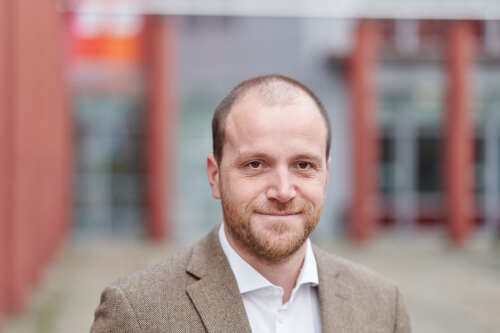
Prof. Dr. Tobias Schroedler
Head of Research Unit Multilingualism and Social Inclusion
Contact:
Universität Duisburg-Essen
Deutsch als Zweit- und
Fremdsprache
Universitätsstr. 12
45141 Essen
Room: R12 R03 B28
Tel.: +49-(0)201-183 6620
Fax: +49-(0)201-183 3959
E-Mail: tobias.schroedler@uni-due.de
Secretary:
Vassiliki Metaxa (DaZ/DaF)
Room: R12 R03 B39
Tel.: +49-(0)201-183 3580
Fax: +49-(0)201-183 3959
E-Mail: dazdaf@uni-due.de

We work on different aspects of research on multilingualism and societal linguistic diversity. Read more here.
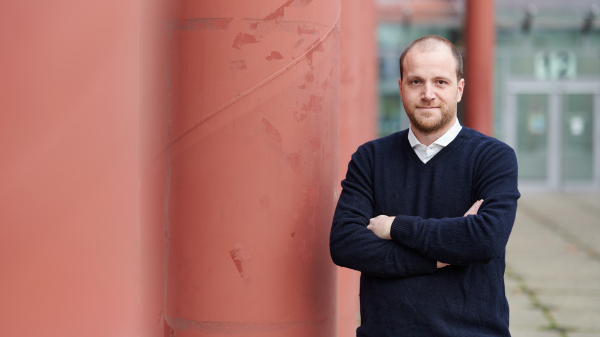
Prof. Dr. Tobias Schroedler is an Educational Linguist, Head of Research Unit Multilingualism and Social Inclusion.
You can find the team of the Research Unit Multilingualism and Social Inclusion here.
A compilation of selected publications by Tobias Schroedler can be found here.

A selection of talks and conference papers by Tobias Schroedler can be found here.

If you would like to write a thesis (BA, MA, Dr. Phil.) supervised by Prof. Dr. Tobias Schroedler, you can find out about suitable topics here. Should you have any particular questions, please do not hesitate to send us an email.

Tobias Schroedler's internationalisation activities in teaching, visiting professorships and cooperations can be found here.

An overview of selected memberships, functions and affiliations of Tobias Schroedler can be found here.