
Sociolinguistics Lab
Who we are and what we do


Language change across the lifespan
Does growing older change the way we speak and which impact do changes in our social environments have on our linguistic patterns? These are some of the central research questions we explore in the study of language change across the lifespan. Spoiler alert: Yes, the way we speak changes when we grow older!


Varieties of English


Linguistic landscapes of the Marshall Islands


Methods in language sciences
Chair
Prof. Dr. Isabelle Buchstaller
Room: R12 S04 H79
Phone: +49 201 183-4712
E-mail: isabelle.buchstaller@uni-due.de
Secretary
Sabine Ressel
Room: R12 S04 H23
Phone: +49 201 183-3696
E-mail: sabine.ressel.anglistik@uni-due.de
Research interests

Language change across the lifespan
Read more
Does growing older change the way we speak and which impact do changes in our social environments have on our linguistic patterns? These are some of the central research questions we explore in the study of language change across the lifespan. Spoiler alert: Yes, the way we speak changes when we grow older!
ZR & YB: As part of the LaVaLi project, the student assistants support the annotation of negation in datasets using ELAN (Lausberg & Sloetjes 2009). This includes coding for a range of linguistic variables, such as type of negator and contraction patterns, alongside other features. Our weekly check-in meetings help to ensure consistency in our coding.
RC & LD: Some student assistants are currently involved in hand-checking force-alignments in Praat (Boersma & Weenink 2026).
Language variation and change
Read more
JG: I am particularly interested in how language variation and change is articulated across social factors in Englishes the world over, creoles and contact languages, as well as under-documented and minority languages, where the study of variation and change has typically been relegated to the margins.
IB: My research focuses on the ways in which language is contingent on and contributes to the expression of social differentiation. I have worked on the geographical distribution of morphosyntactic forms, the linguistic consequences of aging, but also on the meaning making capacity of language as a resource we all draw on.

Historical sociolinguistics
Read more
LS: I’m interested in how methods from modern sociolinguistics can be applied to historical contexts in order to inform our understanding of processes of language change in the more distant past. In my work, I adopt a ‘history from below’ approach that aims to complement histories of standard varieties by investigating unedited non-standard ego-documents, such as letters, written by non-elite members of society.

Varieties of English
Read more
JG: I research a range of English- and English-based varieties, including those of Tyneside in the UK, ethnolects and migrant varieties of Australian English in Sydney, language varieties spoken in Hawaiʻi (including Hawaiʻi Creole and Hawaiʻi English), as well as on my native dialect, California English.
IB: I have worked on a number of varieties of English world-wide, including communities in North America, the Pacific (Hawaii, the Marshall Islands and Australia) and the North of the British Isles. I have also done research on the German-Polish border and I have supervised PhD projects on Caribbean French and on contact varieties of Arabic spoken in Saudi Arabia.
Linguistic and semiotic landscapes
Read more
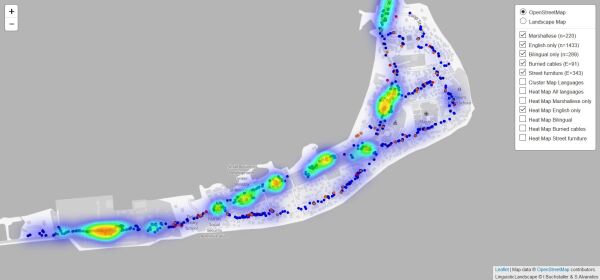
IB: My research has broached out from linguistic landscapes (the competition between Marshallese and English in the linguistic landscape of the RMI, street naming policy in Germany and Poland) towards semiotic landscapes, including the ways in which industrial heritage in the Ruhr area is remediated and commodified. Most recently, I have started to explore the transformative potential of artistic tattoos, especially for individuals affected by scarring.

Language attitudes and ideologies
Read more
IB: My research aims to triangulate analysis of what people do (speech production) with the perceptions and attitudes towards linguistic variation. Previous research has aimed to understand stereotypes towards globally spreading (youth) trends such as “be like”, but I am also fascinated by the way in which multiple co-occurring variability in the speech stream is picked up and evaluated in real time.
Language contact
Read more
JG: I am particularly interested in questions surrounding the contact between language varieties, including investigating how creoles (like Hawaiʻi Creole) have changed over time, and how migration to urban centers has been instrumental in changes over time (in Sydney, Australia).

Methods in language sciences
Read more
JG: Among my interests is evaluating, refining and applying methods used in sociolinguistic inquiry to under-studied varieties. This includes working with a suite of methods that are foundational to the analysis of spoken language, like forced-aligners, corpora management tools, and statistical modelling.
IB: Much of my work is interdisciplinary. I have explored the ways in which cutting-edge human geographical methods can be integrated into dialectological analysis, I have been involved in testing methods for capturing attitudes towards co-occurring linguistic variation that is situated at different levels of the linguistic system. Most recently, I have started to take a more phenomenological approach to understand how space is experienced, created, and policed.
LS: I have applied a number of corpus linguistic tools in the compilation of non-standard diachronic corpora and am particularly interested in POS-tagging, automatic variant detection and TEI annotation standards for correspondence corpora.