
Work Group Socialization Research: News

24.09.2026Interational TraNa Conference
The TraNa Project Team is pleased to report the successful completion of our international conference. The conference, titled “Young People’s (Self-)Positioning in the World: Subjectivities, Discourses, and Inequalities,” took place from September 8-11 in Essen, Germany. It was funded by the DFG and financially supported by InZentIM.
The conference featured numerous exciting presentations, all of which sparked lively discussions among the participants. It also provided the opportunity for networking, and we look forward to future opportunities arising from the conference. Our heartfelt thanks go out to all presenters for their engaged participation.
Most of the presentations were filmed, and the recordings are now available on the TraNa website: www.uni-due.de/biwi/trana/conference.php

22.09.2026The Work Group Socialization Research at the ESA Conference
The Work Group Socialization Research was represented four times at the 17th ESA Conference, which took place in Warsaw, Poland, from August 25-28, 2026.
From the TraNa Project, we presented on the topics "Spatial Mobility From An Immobility Perspective: Stayer Children’s Reflections And Imaginaries" and "Growing Up Transnationally: Children’s Self-Positioning in Transnational Spaces - Constructions of “Abroad” and (Un)Safe Places."
From the EliA Project, we presented on the topics "The Interactive Production of “Good Parents”: Meaning-Making in German Adoption Assessments" and "Becoming “Good Parents” – Organizational Assessment and Preparation of Applicant Couples in German Adoption Processes."

16.09.2026Senior Fellow Xiaorong Gu: Researching for a Collaborative Project with Alexandra König and Jessica Schwittek
Xiaorong Gu, a sociologist of childhood, youth and education, is a senior lecturer at the University of Suffolk, UK. Her research examines children’s and youth’s migration and mobilities, education, socio-emotional lives, relationships, disabilities, and wellbeing – focusing on contemporary China. Her collaborative project with Alexandra König and Jessica Schwittek (University of Duisburg-Essen) seeks to critically examine how individuals growing up in Asian minority communities within European societies negotiate identity, belonging, and agency.
As a Senior Fellow at the College for Social Sciences and Humanities, Xiarong Gu will spend the next six months at the University of Duisburg-Essen. During this time, there will be various opportunities to learn about her research and expertise. The following events are planned:
18.11.2026: Lecture on “Unpacking Asian-European Childhoods: Myths, Multiplicity, and Momentum” at the College for Social Sciences and Humanities
21.02.2027: Lecture on “The Temporal Politics of Mobile Childhoods: Governance, Care, and Education” at the IZfB Colloquium
16.-17.2.2027: Workshop at the College for Social Sciences and Humanities (in planning)
More information about the Senior Fellowship-Programm can be found here: https://www.college-uaruhr.de/news-events/news/news-detail/visiting-researchers-start-fellowships-college

26.08.2026Upcoming International TraNa Conference
The TraNa project team is pleased to announce our upcoming international conference: “Young People’s (Self-)Positioning in the World: Subjectivities, Discourses, and Inequalities.”
Bringing together speakers spanning four continents and 13 countries, the conference promises to be an exciting opportunity to hear new perspectives and exchange research insights.
The conference will take place from September 8-11 and is for invited speakers only. It is funded by the DFG and financially supported by InZentIM.
03.08.2026Poster Presentation at the University of Suffolk
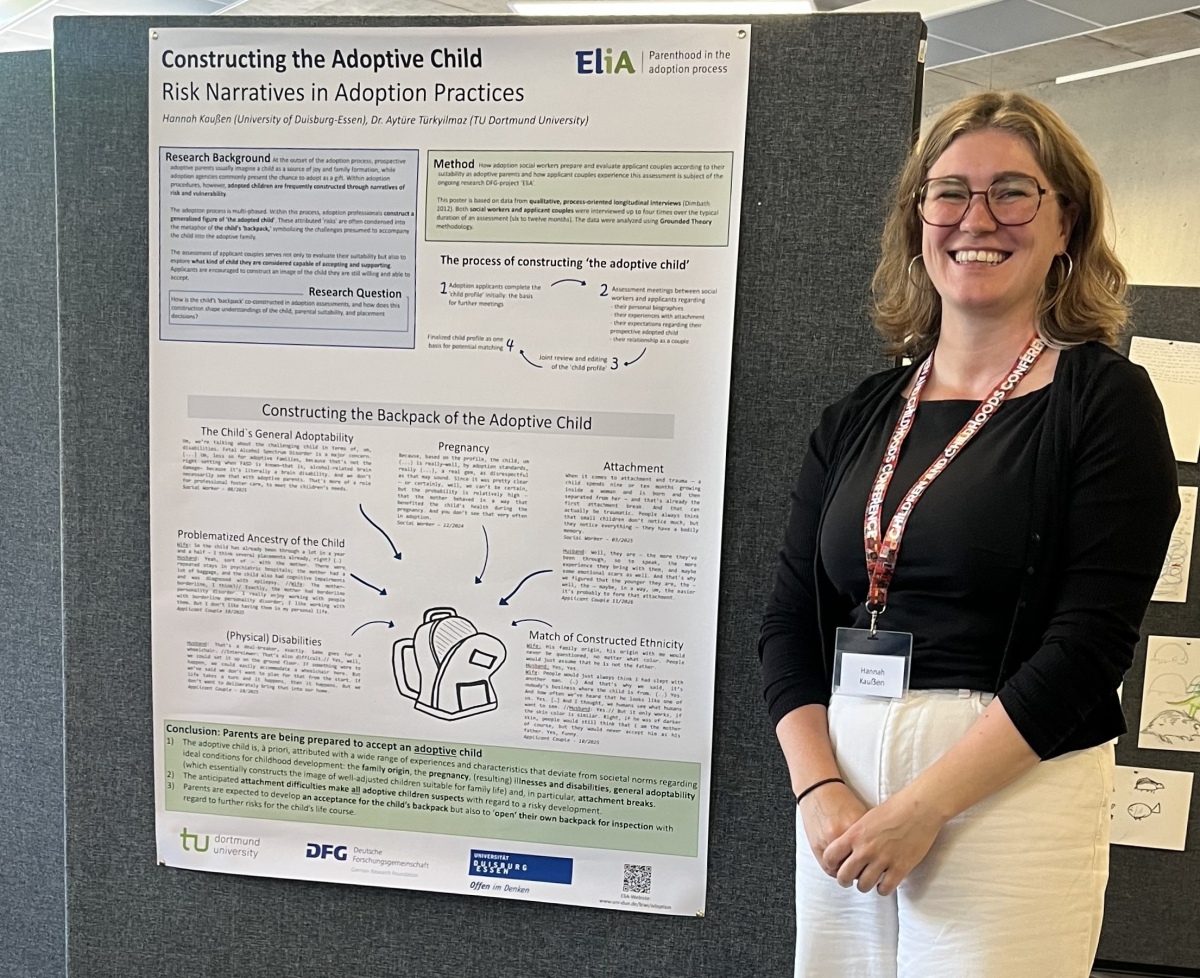
Research associate Hannah Kaußen attended the “Children and Childhoods Conference” at the University of Suffolk from July 15–16, 2026. As part of the EliA Project, she presented a poster titled “Constructing the ‘Adoptive’ Child: Risk Narratives in Adoption Practices.” The focus was on how adoption applicants and professionals negotiate ideas about the future child during parent aptitude tests. The analysis shows how these negotiation processes shape institutional decision-making while simultaneously generating ideas about the future child and expectations of future parenthood.

15.07.2026Workshop at the “Methods of Childhood Research” Summer School in Hildesheim
Research processes involving children in international and multilingual contexts can present many challenges – ranging from cultural and institutional (mis)understandings, to dealing with multilingualism and power imbalances, to differing expectations and the failure of “good” intentions in research with children. Jessica Schwittek and Katarzyna Jendrzey led a workshop designed to address precisely these challenges. The workshop was part of the Summer School “Methods of Childhood Research” at the University of Hildesheim. Together with the participants, they discussed examples from their own research projects and developed potential solutions to challenges encountered in the respective project phases.
The third Summer School took place from July 8 to 10, 2026. The full program is available here.
We would like to thank the participants and the organizing team for three days filled with lively discussions and new thought-provoking impulses.
For more on the challenges of conducting research with children in international and multilingual contexts, see: Schwittek, Jessica/Jendrzey, Katarzyna (2025): Childhood Research in International and Multilingual Contexts. In: Heinzel, F. (ed.), Methods of Childhood Research. Weinheim: Beltz Juventa, pp. 107–122.

12.06.2026Panel Discussion at InZentIm’s Anniversary Conference
On June 9, InZentIm celebrated its 10th anniversary at its Annual Conference on Integration and Migration Research, this year titled “Umkämpfte Teilhabe: Migration, Demokratie und Kontroversen in pluralen Gesellschaften" (Contested Participation: Migration, Democracy, and Controversies in Pluralistic Societies). Dr. Jessica Schwittek, together with Prof. Dr. Helen Baykara-Krumme, moderated a panel discussion on this topic. We would like to thank all panelists – Prof. Dr. Aladin El-Mafaalani (TU Dortmund), and Prof. Dr. Susanne Pickel (UDE) – and participants for their insightful contributions!
For more information on the anniversary conference, please visit: https://www.uni-due.de/inzentim/tim-2026.php
11.06.2026New article by Alexandra König and Jessica Schwittek
A new article from Alexandra König and Jessica Schwittek with the title "Sozialisation in transnationalen Kernfamilien im Kontext der Arbeitsmigration: Eine Meta-Interpretation" (Socialization in transnational nuclear families in the context of labor migration: A meta-interpretation) was published in the latest issue of the journal GISo.
The article is available through Open Access: https://doi.org/10.26043/GISo.2026.1.6


20.05.2026
The Work Group on Socialization Research had the pleasure of hosting Professor Sana Benbelli from Hassan II University in Casablanca at the UDE for two weeks. During this time, students and researchers from the UDE had several opportunities to learn about Sana Benbelli’s research. She gave a lecture on the topic “Disability and Education in Morocco – From Structural Inequalities to Inclusive Horizons” for the IZfB’s Thursday Colloquium series. In addition, she offered individual consultations on research methods and, together with Alexandra König and Jessica Schwittek, organized a block session for approximately 60 students. Here, her lectures on the topics “Superdiversity – Migrants in Casablanca” and “Labor Mobilities of Women Porteadoras” were particularly well-received.
The lectures and the exchange with Prof. Benbelli on her diverse and exciting research topics were valuable for both the students and for us as a work group. She also enriched our project meetings through new perspectives, for which we are very grateful. Furthermore, we developed plans for future collaborations.

Old Town and City Hall in Wrocław

School Visit in Bialystok

Bialystok City Center
19.05.2026
We have exciting news about the TraNa project!
First, we are celebrating the completion of data collection in Poland for the German part of the project! In total, Katarzyna Jendrzey conducted 51 mapping-based interviews with children aged 11 to 16 in various regions of Poland. We would like to sincerely thank all participants for these conversations and for sharing their experiences with us! We would also like to thank their parents and guardians for their trust, as well as all our partners who provided us with contacts and opened doors for us.
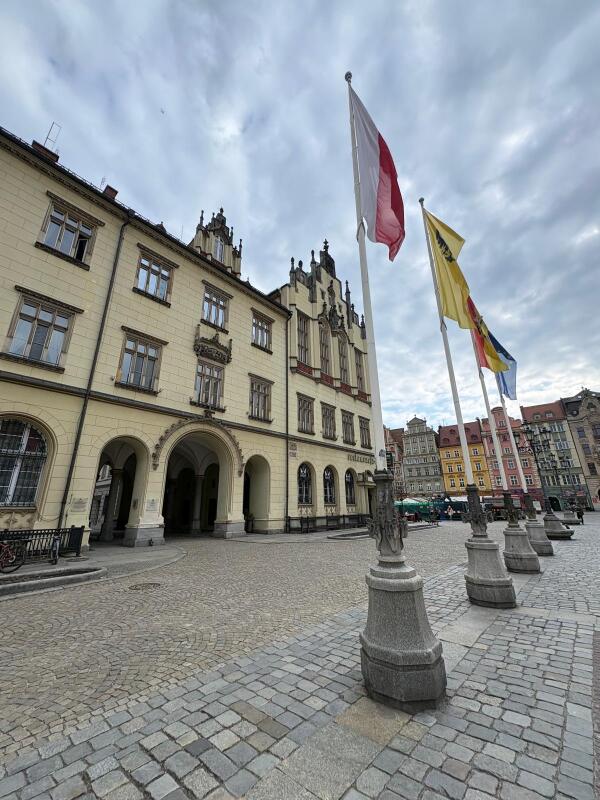
Additionally, Alexandra König, Jessica Schwittek, and Katarzyna Jendrzey were able to visit our project partners in Wrocław in April. There, they were received by the city’s vice mayor and had an interesting exchange on the topics of childhood, family, and the education system. They also visited schools and colleagues in the Podlaskie region.

Wrocław City Hall
Wrocław City Hall

Wrocław City Hall
07.05.2026ESA 2026
Two presentations from the Work Group Socialization Research have been accepted by the European Sociolgical Society's 17th Conference, both part of the EliA Project:
1) The Interactive Production of “Good Parents”: Meaning-Making in German Adoption Assessments
2) Becoming “Good Parents” – Organizational Assessment and Preparation of Applicant Couples in German Adoption Processes
The conference, "Strengthening Democracies: Social Action, Solidarity, and Sustainable Futures," will take place in Warsaw, Poland, from August 25-28, 2026. For more information, visit https://www.europeansociology.org/conference/2026

19.03.2026
Katarzyna Jendrzey participated in the international conference “Narratives of Europe in Uncertain Times,” which took place in Warsaw from March 5–6, 2026. As part of the conference, she presented preliminary findings from the TraNa project in her presentation entitled “Children’s Narratives: Knowledge and Constructions of Migration, European Space, and Self-Positioning in Poland, Europe, and the World.” The presentation showed how children interpret migration and Europe narratively and how they position themselves in Poland, Europe, and the world – thus bringing the perspective of children into the discussion on narratives of Europe.


17.03.2026EliA Workshop at the TU Dortmund University
On February 25 and 26, we hosted our first event as part of the EliA project: a workshop at TU Dortmund University on the topic “Parenting between Individual, Familial, and Organizational Logics.”
Together with the participants, we were able to work intensively and very productively on empirical data in an interpretation workshop and bring together different perspectives. Particularly enriching were two presentations by Mona Motakef and Stephan Dahmen, which provided exciting intellectual stimuli and opened up interesting new possibilities for our project.
Overall, the workshop was a very productive opportunity for us to further develop ideas and initiate new collaborations.
09.02.2026Recognition for articles in FRS Special Issue edited by Alexandra König, Jessica Schwittek, and Viorela Ducu
We are pleased to announce that three out of the five Most Read Articles of 2025 in the journal Families, Relationships and Societies were part of the Special Issue edited by Alexandra König, Jessica Schwittek, and Viorela Ducu – one of which was authored by Katarzyna Jendrzey!
Congratulations to:
Adrienne Lee Atterberry for the article “Migration as a social mobility project: the case of return migrant families in India”
Miroslava Hariuc for the article “‘I have to call them’” (part of the Open Space section)
Katarzyna Jendrzey for the article “Representation of migrating mothers in children’s and young adult literature on transnational families”
A fourth article in the Special Issue was award the 2025 David Morgan Prize. Congratulations as well to Anne Carolina Ramos and Andrea Riepl for their article “Children’s well-being in times of war: analysing the importance of family through home, objects and relationships.”
All four articles are available to read with open access.

06.02.2026Equality Day
The equality team at the Faculty of Educational Sciences – of which Jessica Schwittek is a member – is organizing an Equality Day on the topic "Safe Spaces." After an initial phase exclusively for Flinta, everyone is invited to join for lunch and a second phase.
The equality day will take place on March 4, 2026, from 10 a.m. to 2 p.m.

05.02.2026Open Call for Papers
Young People's (Self-)Positioning in the World: Subjectivities, Discourses, and Inequalities
As part of the TraNa project, we are pleased to announce our upcoming international conference: “Young People’s (Self-)Positioning in the World: Subjectivities, Discourses, and Inequalities.” The conference will take place from September 8-10, 2026, in Essen, Germany.
The Call for Papers is now out, and we are welcoming proposals until March 15, 2026.

29.01.2026EliA presentation at the working group “Organization and Evaluation” of the DGS Section on Organizational Sociology on December 4, 2025, at the University of Gießen
In a presentation titled “Ages of ‘good parents’ – Organizational assessment practices between external recommendations and organizational practice,” Hannah Kaußen presented initial findings from the EliA project at the “Organization and Assessment” conference at the University of Gießen.
Based on the historical development of recommendations for adoption placement, the presentation shows that the establishment of a recommended maximum age for adoption applicants is variable and has been replaced in the latest edition (2022) by a focus on a “natural age gap” between applicants and adopted children. Findings from interviews with adoption agencies show that the age of adoption applicants is a relevant assessment criterion that must be interpreted in the practice of applicant screening. Not only calendar age, but also a co-constructed social and biological age is taken into account when assessing applicants. This shows that professional assessment practices in adoption agencies are closely intertwined with institutional guidelines and normative expectations.