

Projects
DFG-funded Coordinated Priority Programs (SPP)
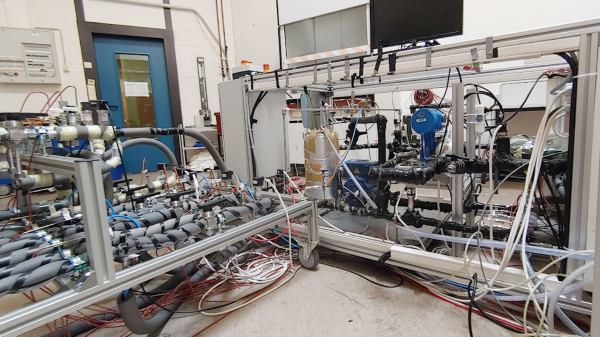
SPP 2403: Carnot Batteries: Inverse Design from Markets to Molecules
More informationDFG-funded Coordinated Priority Programs (SPP)
Information
SPP 2403: Carnot Batteries: Inverse Design from Markets to Molecules
- CENIDE Research Focus:
-
Functional materials for energy applications
- Funding:
- Since 2023
- Contact:
-
Burak Atakan (Coordinator)
- Website:
- https://www.uni-due.de/spp2403
Abstract
The inexpensive, location-independent, and resource-saving storage of electrical energy is the central unsolved problem in the transition to fluctuating energy sources. One possible solution would be the emerging technology of Carnot batteries (CBs), where electrical energy is converted into heat by high-temperature heat pumps, which are then stored in inexpensive materials such as water, stones, or molten salts, and then converted back into electrical energy as needed, e.g., by means of steam turbines. The thermodynamic principle has been known for a long time, nevertheless there are so far no general methods for their design or their evaluation based on the fundamentals and the objectives. Carnot batteries are complex coupled, time-varying systems with a large number of components and degrees of freedom. Published efficiencies and costs are rarely verified or apply only to specific systems; integration into future energy markets is unexplored. The fundamentally new approach of this priority program (SPP) is the comprehensive inverse top-down design methodology, which, starting from the target variables (market) step by step towards the smaller, aims at the optimal design as well as optimal modes of operation, with corresponding cycles, storages, machines, and fluids (molecule), and in turn optimally combines these components - which have not been considered so far. Especially the working fluids and their mixtures are co-optimized with the process configurations and process parameters to find the technical and economical limits. The market needs and the limits of CBs is to be investigated by an interdisciplinary SPP team. By building up a new interdisciplinary community, a high methodological and content-related gain in knowledge is expected, which is transferable to further energy-technological questions. This will be done in the inversely arranged project areas, which build on each other and cooperate intensely: A - Carnot batteries in energy markets, B - Design of Carnot batteries, C - Components for Carnot batteries. The work of the SPP will be pooled and validated by a shared Carnot battery laboratory, which will be set-up within the coordination project and can be used by the participants of the SPP for validation of their models and for investigating the coupling of different interconnected parts of a CB. The cooperation and exchange between the participants will be coordinated, by organizing workshops, student exchanges, seminars, and includes the involvement of internationally renowned scientists from different disciplines. The management of research data will be facilitated and managed by the coordination project, as well as the communication of the results to the public.
SPP 2122: Materials for Additive Manufacturing
More informationDFG-funded Coordinated Priority Programs (SPP)
Information
SPP 2122: Materials for Additive Manufacturing
- Funding:
- Since 2018
- Contact:
-
Stephan Barcikowski (Coordinator)
Anna Ziefuß (Project member)
- Website:
- https://www.uni-due.de/matframe/index.php
Abstract
Lasers in production are becoming increasingly powerful and brilliant, but the materials available are often completely inadequate for the processing tasks currently required. To date, metal powders are used in additive manufacturing that were developed over 50 years ago for a completely different process - thermal spraying. However, in modern laser-based additive processes, these powders lead to process instabilities, porosities, and defects in the component. In the field of polymer powders, there is also a lack of a wide range of materials. Therefore, there is an urgent need to adapt the materials to these widespread production processes, as laser-based processes will dominate important production processes in the long term due to their throughput and precision. In fact, a fundamental research approach already at the beginning of the process chain, the material, is required. Therefore, there is an urgent need for action to defend and further expand Germany's leading position worldwide in photonics and materials science. A coordinated, coherent research program combining materials development and photonics research for the first time, starting at the materials synthesis stage, should help exploit this considerable potential. To ensure feedback between process behavior and material properties, the SPP will fund tandem projects from the fields of "materials" and "laser process", which will cooperate across projects in thematic clusters. The scientific questions will be formulated across materials and focused on the photonic process of additive laser manufacturing. With this, for the first time, chemical, as well as metallurgical and additive-based modifications, will be developed specifically for photonic production. Such a large-scale interdisciplinary study requires targeted coordination and enables a unique Interlaboratory Study (Round Robin), including Research Data Management. Only by this, is it possible to generate an inter-laboratory scientific exchange, which guarantees reproducibility and statistical robustness.
SPP 1980: Sprayflame Synthesis
More informationDFG-funded Coordinated Priority Programs (SPP)
Information
SPP 1980: Sprayflame Synthesis
- CENIDE Research Focus:
-
Gas-phase synthesis of nanomaterials
- Funding:
- Since 2017
- Contact:
-
Christof Schulz (Coordinator)
- Website:
- https://www.uni-due.de/spp1980/
Abstract
Sprayflame synthesis offers a promising approach for the production of functional nanomaterials. The viability of this route has already been proven for a wide range of materials on the laboratory scale. Compared to existing large-scale methods for nanomaterials synthesis in pure gas-phase processes, the sprayflame synthesis provides access to an abundance of additional materials, which cannot be produced with other processes. The actual industrial application of sprayflame synthesis has failed so far due to the necessity of using expensive starting materials and a lack of understanding of the process. This situation should be overcome by an interdisciplinary approach within the SPP1980 which lays the foundations for practical applications of sprayflame synthesis. The chances for this are excellent within an interdisciplinary collaborative network that links recent developments on experimental, theoretical, and simulation techniques that have been previously used in their individual research disciplines. Their combination will allow to analyze and describe the underlying sub-processes. The aim of this priority program is to develop the fundamental understanding and the simulation capabilities for of sprayflame synthesis processes and to establish an interdisciplinary research network. Sub-processes will be analyzed and their understanding will be integrated into a comprehensive model that provides the chance for the development of processes that are based on inexpensive starting materials and that can be scaled-up to an industrial scale for the targeted production of materials with a wide range of properties.
SPP 2289: Creation of synergies in tailor-made mixtures of heterogeneous powders: Hetero aggregations of particulate systems and their properties
More informationDFG-funded Coordinated Priority Programs (SPP)
Information
SPP 2289: Creation of synergies in tailor-made mixtures of heterogeneous powders: Hetero aggregations of particulate systems and their properties
- Funding:
- Since 2021
- Contact:
-
Christof Schulz (Project member)
- Website:
- https://gepris.dfg.de/gepris/projekt/441399220?language=de
Abstract
The mixing of disperse systems (particles and powders) is a traditional unit operation in process engineering. The applications of mixed particulate systems range from the processing of food, pharmaceutical and chemical substances to materials processing and materials engineering. Functional mixing of different particle types (hetero-aggregation) has the potential to create outstanding new properties of disperse products that depend on the mixture composition and various secondary process conditions. A new product property can be created by the direct contact of different particles (heterocontact) and thus by the resulting interface between the respective subcomponents. Many applications have shown that these hetero-contacts are of fundamental importance for certain functional properties. In most cases, the new properties result from the transfer of charges, mass, heat, forces or moments without the need for a chemical reaction between the components. The quality of such a particle mixture is therefore directly related to the contact points and interfaces of the different particles and the details of the interaction between their species in contact. The new property from the contact zone controls the material and product properties of the entire system, which is referred to as hetero-contact in the context of SPP. Direct information on the quality of the hetero-contact (e.g. number of contacts, transport properties between different particle types) could therefore form the basis for a fundamental description of the new properties of the particle mixture. At the same time, the hetero-aggregation process for generating such hetero-contacts must be investigated and controlled. In the remaining three years of the SPP, research will increasingly focus on specific material functions of the hetero-aggregated particulate systems, which will be verified and linked to the process parameters. This focus in turn places special demands on adapted process measurement and control techniques as well as on material and particle characterization. In detail, the SPP has the following objectives: - Utilization of previous findings for multi-stage processes for the production of hetero-aggregates with integrated process control. This includes aerosol processes for the defined generation of hetero-aggregates, with adequate process diagnostics for the detection of mixing processes. - Utilization and coupling of various CFD, particle and reaction models and development of a holistic simulation environment for the design of material functions. - Establishment of standard procedures for the characterization of hetero-aggregates in the sub-micrometer range using sample trains from rapid aggregation processes and tomographic methods for the characterization of hetero-aggregates.