
Frequently Asked Questions on Campus Development
New Master Plan
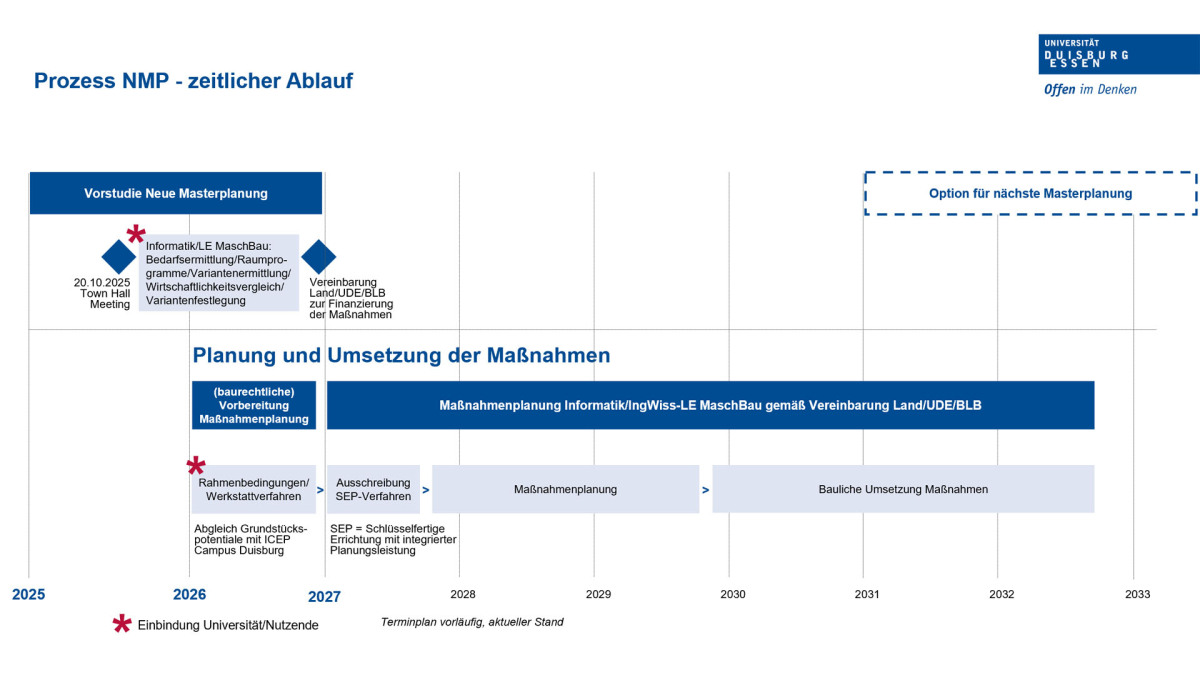
Steps and provisional schedule Timeline
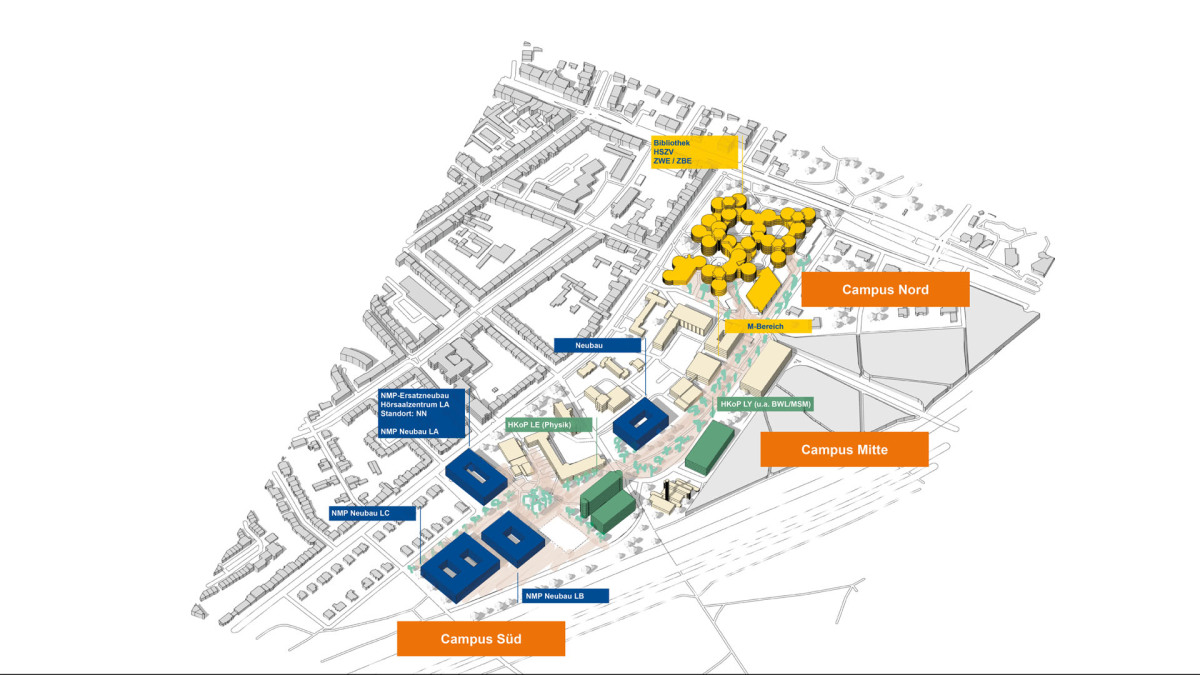
Campus Duisburg Target Image
General questions about campus development in Duisburg
Why is the University of Duisburg-Essen investing so heavily in the further development of the university campus?
With new buildings and renovations, a ‘campus of the future’ is gradually being created that will ensure the university remains competitive in the future. Innovative teaching, internationally competitive cutting-edge research and modern working conditions come together there under ideal conditions. This networked campus of the future will create synergies and offer ideal conditions for our internationally competitive research. The existing space and space extensions will be used in the best possible and most efficient way to quickly create modern, sustainable and, in the long term, climate-neutral space. The project will be implemented in several phases.
When will it start?
The first measures will begin with the university's central administration moving into interim premises in the first half of 2026. The social sciences will then move from the current LE building to the LG building. Further planning is also already underway.
How long will the construction work take?
In the first phase, we are talking about a time frame of approximately 10 years.
What are the relocation plans at this point in time?
The measures will begin in the first half of 2026 with the relocation of most of the university's central administration from building LG. The social sciences (IAQ and IFSO), which are currently still located in the existing LE building, will move into the LG building. The LE building will be renovated and will also receive an extension for laboratories. The Faculty of Physics, which is currently located in the M area, will move there. Upon completion in 2026, the Business Administration/MSM departments, which are currently still located in the LC building, will move into the newly constructed LY building (next to the car park). We will provide a separate graphic representation of the necessary relocation movements in the near future. These may change as the process progresses, but our overarching goal remains ‘as little relocation as possible’.
How much will the new master plan cost to build?
This can only be realistically estimated in 2026, once the planning of measures has been completed.
To what extent do ecological aspects play a role in the construction plans?
Ecological aspects play an important role in the construction planning. The state's climate neutrality targets apply to all new buildings, including sustainability, climate resilience, resource conservation and economic efficiency.
Does the concept include a new canteen?
The canteen is not part of the new master plan, but solutions are also being sought here. A new canteen location on the Lotharstraße campus is currently being examined, but no decision has yet been made. Two options are currently under discussion:
1. Renovation of the existing canteen in the M area.
2. Conversion of one of the existing buildings on campus.
Are there plans for an event centre on campus that would enable conferences and events to be held independently of teaching activities (lecture halls)?
If, as part of the NMP, other buildings in need of renovation beyond the LC building are demolished that contain lecture hall space, the space that is lost will be rebuilt in line with future-oriented teaching and learning environments. Furthermore, a dedicated conference centre is not currently on the list of space requirements recognised by the state for the UDE.
Are the buildings being designed in such a way that events such as smaller trade fairs can also be held there?
The aim of all structural changes is to achieve a high degree of multifunctionality in the spaces. The next step in the NMP is to specify the space requirements in concrete terms.
How is future access to the new car park planned? Will Carl-Benz-Straße be accessible to traffic on both sides again, or are there also considerations to only open the street up to the car park so that, for example, an attractive footpath or recreational areas can be created?
The situation is currently being considered in close consultation with the city of Duisburg, as Carl-Benz-Straße is owned by the city.
Why do renovation measures at the university always take so incredibly long?
Renovation work at universities is usually complex, large-scale projects that take more time due to extensive coordination and approval procedures, legal requirements and the need to ensure that teaching and research activities can continue. In addition, unforeseen structural challenges can arise when renovating older buildings. The university is working with the relevant authorities to make these processes as efficient as possible.
How can UDE members actively participate in the planning process?
As part of the needs assessment that has just begun, the faculties will be involved in the development of the so-called space programme, i.e. the specific construction requirements. The UDE will provide information about the options for participation in the overall campus development. The campus development team welcomes your ideas and suggestions. Please feel free to write to campusentwicklung@uni-due.de.
Are new learning and recreation areas planned for students?
Findings regarding new teaching and learning areas will be incorporated into all new construction and modernisation measures.
When will further information be available?
All employees and students will be kept informed on an ongoing basis, and this FAQ section will be continuously updated and supplemented.
Please send your questions and suggestions at any time to:
campusentwicklung@uni-due.de
Measures for Campus South
How large will the new area for engineering sciences and computer science be?
Precise details on this will only be available at a later date. The plans are based on the space requirements data from the latest university location development plan (HSEP, 2023). What is certain is that both faculties will have a state-of-the-art environment for teaching and research.
37,000 m² for 80 professorships? That's only about 400 m² per chair/professorship. That's a bit tight! - Is that so?
It's not possible to calculate that in such a general way. The average space per professorship does not provide any information about the specific allocation of the respective areas. The requirements of the respective faculties are based on the HSEP 2023, which carried out a differentiated analysis of the respective space requirements. This is based on so-called space parameters, which vary depending on the subject area. This ensures that specific working methods are not treated in a generalised manner, but are taken into account in a differentiated manner.
Will the DuE Kids also be considered in terms of space?
A good long-term solution is being sought for the DuE Kids on both campuses. If the LA building, which is in need of renovation, is demolished as part of the NMP, the DuE Kids areas there will be replaced.
How is the future development and expansion potential on Lotharstraße assessed in the long term (with regard to faculties with large technical laboratories)?
In accordance with HSEP 2023, the space allocation plans within the framework of the NMP also take into account future space requirements with all technical requirements. Further future development space requirements will be considered as part of the workshop process.
Where should the central mechanical workshops be relocated? Or should they be renovated during ongoing operations, as in Essen?
In the M area, renovations during ongoing operations will only be carried out to the extent absolutely necessary to maintain the functionality of the existing buildings. Disruptions to operations will be avoided as far as possible. The aim of the NMP is to maintain functional relationships or, in the case of new construction projects, to bring them together. The ZWW should, of course, be located as close as possible to the new locations of the IngWiss and Physics departments in the L area: this will also be included as a requirement in the so-called workshop procedure.
Was the creation of interdisciplinary shared laboratories (e.g. for experiments or demonstrators for which the specific areas of the working group are not sufficient) taken into account in the planning?
So far, the NMP process has involved planning at the space requirement level of the HSEP 2023. The next step in the process will be to design the respective faculty areas for computer science and mechanical engineering in the engineering sciences by determining requirements and space allocation in direct consultation with the two faculties. The state's specifications on space efficiency apply here, which may also include interdisciplinary shared laboratories. We are happy to take up the core facilities approach together with the users.
Individual buildings
What will happen to LB?
The LB building is not expected to be included in the planning as part of the NMP. Whether the LB building will be demolished in the current first phase of the NMP or only in the subsequent phase is currently being worked out as part of the workshop process.
Will the sports hall in the LD building remain?
In the future, the location of university sports facilities on the Duisburg campus may change, but they will remain in place in any case. They are an important part of the attractiveness of the location and contribute to the well-being of students and employees, who enjoy studying and working here.
What will happen to the basement in the LF?
The BLB will renovate the rooms that are suitable for renovation in the short term. The BLB and UDE will provide replacements for any rooms that are no longer suitable for renovation after the inspection has been completed.
What will happen to the LK building? Has the possibility of retaining the LK building and keeping the University Library in this building been examined from a sustainability perspective?
So far, the campus vision shows that, once the NMP and HKoP measures for physics have been completed and the M area has been vacated, the library will be relocated from LK. The handling of the existing LK building is the subject of preliminary planning considerations.
The existing LS building is not part of the master plan. However, the listed building is in urgent need of renovation. What will happen there?
Parallel to the NMP, plans are being made together with the BLB to renovate other UDE buildings. The LS building (like the LF building) is already the subject of a specific renovation measure by the BLB.
Will the entire administration be located in the M area in future – including the rector's office and the post office?
The current status of considerations regarding the Lotharstraße campus development depends on the further course of the NMP measures and the future NMP budget that the state will make available to the UDE. The aim is to consolidate administrative units, as well as operational and service units, in one location. We will provide concrete and detailed plans in the course of the further procedure.
In the long term, the M buildings are to be renovated, but what will be done in the short term? What will happen to the buildings to ensure they remain usable until the move?
BLB has already provided detailed plans for the renovation of the M area. The most urgent measures have been brought forward and are already being implemented. Renovation is planned during ongoing operations, taking into account the need to minimise disruption to the usability of the space.
What will happen to the Mercator House?
The Mercator House is owned by the city of Duisburg and is leased by the UDE. There are currently no plans to terminate the lease. We are currently examining what the long-term plans might look like here.
Outside the Lotharstraße campus
Is anything happening in the B area?
As electrical engineering is not included in the current “New Master Plan Pilot Study”, the B area will remain in place for the time being. Our goal is to integrate it into the next financing round of the “New Master Plan”. To accompany the New Master Plan and in line with the M area, the BLB is already commissioning specialist planners to develop a technical renovation concept for the B area. This will identify the best possible options for the necessary repairs in order to ensure stable operation of the buildings for a – now plannable – time horizon of 15 to 20 years. In general, the New Master Plan is also designed to be repeated. This means that the process will be repeated every 3-5 years in order to gradually work through all identified space requirements. The findings to date form the basis for this, so we are not starting from scratch.
What is happening in Ruhrort?
Following the planned construction of the new mechanical engineering building, the Ruhrort area can be abandoned in future.
What is happening with Geibelstraße?
The long-term plan is to concentrate the UDE on Lotharstraße. Depending on space requirements, there are also plans to abandon the Geibelstraße area in one of the future rounds of master planning.