
Aktuelles
13. August – 26. November 2026Internationales Seminar der Sozialphilosophie (Gedenken an Jürgen Habermas)

Seminario Internacional de Filosofía Social (Recordando a Jürgen Habermas)
Donnerstags 18 Uhr MEZ
Online-Teilnahme
Registrierung: https://forms.gle/cmdgGNn9eNZ5uzdw5
Kontakt: jorge.zuniga@filos.unam.mx
mit Vortrag von Andreas Niederberger (Duisburg-Essen)
"Will a Pluralistic Foundation Undermine the Strength of Human Rights?"
NeuerscheinungRezension: Stefanie Buchenau, Menschenwürde. Kant und die Aufklärung
Rezension von Andreas Niederberger (Duisburg-Essen): Stefanie Buchenau: Menschenwürde. Kant und die Aufklärung. Hamburg: Meiner, 2023.
09. Juni 2026Vortrag "Wie liberal sollte die Migrationsethik sein?"
Vortrag von Andreas Niederberger (Duisburg-Essen) an der Universität Marburg
16:15–17:45 Uhr
Raum 03B06
Im Rahmen des Institutskolloquiums wird Prof. Dr. Andreas Niederberger (Duisburg-Essen) einen Vortrag mit dem Titel „Wie liberal sollte die Migrationsethik sein?“ halten. Alle Interessierten sind herzlich eingeladen.
28. Mai 2026Vortrag "How Much Universality Do Human Rights Need?"

Vortrag von Andreas Niederberger (Duisburg-Essen) an der Universität Mailand im Rahmen der PPPA/GPS Spring Lectures
10:30–12:15 Uhr
Room 5, Faculty of Political, Economic and Social Sciences
04. Mai 2026Vortrag "Gibt es ein republikanisches Modell der Demokratie?"

Vortrag von Andreas Niederberger (Universität Duisburg-Essen)
04. Mai 2026 – 18:00 Uhr
Universität Graz – Institut für Philosophie
Fachbibliothek Geschichte
Heinrichstraße 26, 4. OG
27. März 2026Internationale Konferenz "Globalizing Political Philosophy" (Ghana)

Universtiy of Ghana, Cedi Conference Centre, Seminar Room 2
9:00–16:00 Uhr
This international conference is an opportunity to do comparative political theorizing in the interest of moving beyond artificial boundaries. Crossing such boundaries is necessary because current political reality makes it abundantly clear that there is a lot to learn from contexts like Africa where political theorists have had to contend for a very long time with the consequences of the deficits of democracy. The lessons we can learn from this context would not mean much, however, if opportunities are not created to enable scholars from the so-called global north to engage with African political thinkers. With this conference, we offer
such an opportunity by bringing together African and European political theorists to explore how current political developments call for reimagination of political philosophy. The conference will focus on philosophical texts by members of the ‘Legon Tradition of Philosophers’ as the springboard for this comparative political theorizing.
The conference is organized by Richmond Kwesi (University of Ghana), Uchenna Okeja (Nelson Mandela University) and Andreas Niederberger (University of Duisburg-Essen).
Zum Programm
23.–24. März 2026Internationale Konferenz "Globalizing Political Philosophy" (Südafrika)

Nelson Mandela University, Ocean Sciences Campus, Gqeberha/South Africa
Increasingly, the humanities must respond to complex questions that cannot be reduced to a specific context. This is especially true for political theorizing. Paradigmatic cases include issues like climate change, the problems related to the outsized influence of social media
on social interaction and politics, but also more generally the current geopolitical reconfigurations. This conference will explore how these developments call for reimagination of political philosophy and theory. Speakers and commentators will consider questions related to the nature, impediments, and prospects of globalizing political theorizing – considering the methodological and other substantive challenges that must be resolved.
Speakers and commentators include: Martin Ajei (University of Ghana), Eva Buddeberg (Marburg University), Christine Hobden (Witwatersrand University), Motlatsi Khosi (UNISA), Richmond Kwesi (University of Ghana), Karabo Maiyane (Nelson Mandela University), Ongama Mtimka (Nelson Mandela University), Andreas Niederberger (University of Duisburg-Essen), Uchenna Okeja (Nelson Mandela University), Anthony Oyowe (University of Western Cape), Christian Scheper (University of Duisburg-Essen), Lemohang Tebeli (Nelson Mandela University), Mpho Tsedu (Nelson Mandela University), and Eva Weiler (University of Duisburg-Essen)
The conference is organized by Uchenna Okeja (Nelson Mandela University) and Andreas Niederberger (University of Duisburg-Essen).
It is co-sponsored by the Centre for Philosophy in Africa, Nelson Mandela University, Gqeberha/South Africa (https://cfpa.mandela.ac.za/) and the Centre for Global Cooperation Research, University of Duisburg-Essen/Germany (https://www.uni-due.de/cgcr/index_en.php).
Buch-NeuerscheinungJustice for Denizens

Hg. v. Johan Olsthoorn
The legal rights of a person within a state depend in part on their migration status. Many states across the world deny non-citizen residents or ‘denizens’ certain political, socio-economic, and cultural rights granted to every citizen alike. This book tackles pressing moral questions raised by legal rights-differentiation by citizenship status by drawing on the ethics of migration, citizenship, multiculturalism, refuge as well as on normative theories of law, territory, and settler colonialism.
Egalitarian values, at the heart of liberal democracy, ground a presumption against legal rights-differentiation. Any deviation from legal equality stands in need of justification. What, if anything, could justify legal rights-differentiations along the lines of citizenship? When, if ever, is it morally permissible for states to deny denizens certain legal rights granted to every citizen alike? This book scrutinizes these politically increasingly salient questions from a wide range of perspectives and drawing on recent literature.
This book will be of great interest to philosophers, legal and political theorists, and researchers studying migration studies, philosophy, human rights, law and politics. This book was originally published as a special issue of Critical Review of International Social and Political Philosophy.
Mit einem Beitrag von Andreas Niederberger (Duisburg-Essen): "Can There be Special Rights for Some Citizens?"
27. Februar 2026Internationale Konferenz "Between Practice and Research: Democratization of Work in the Realm of Transfer Research"

Institute for Social Movements
Clemensstraße 17–19
44789 Bochum
Mit einem Vortrag von Ibrahim Orha (Duisburg-Essen): "Translating workplace (in)equality into democratic participation: migrant workers between hierarchy, codetermination, and union activism"
NeuerscheinungRezension: Thomas Hobbes, Leviathan (Oxford World's Classics), Hg. Noel Malcolm
Rezension von Ibrahim Orha (Duisburg-Essen) der Oxford World's Classics Ausgabe von Thomas Hobbes' Leviathan von 2024, hg. Noel Malcolm, In: Convivium Revista de Filosofia 28 (2025), S. 160–163
12.–13. Dezember 2025Tagung „Freyheit und Aufstand – Zur politischen Philosophie der Bauernkriege“

Tagung an der Universität Oldenburg, Bibliothekssaal (BIS-Saal)
Veranstalter: Philipp Schink (Oldenburg), Kolja Möller (Frankfurt)
Mit Vorträgen von Eva Weiler, Andreas Niederberger und Christopher Tölle (alle Universität Duisburg-Essen)
Buch-NeuerscheinungHandbook of Migration Ethics
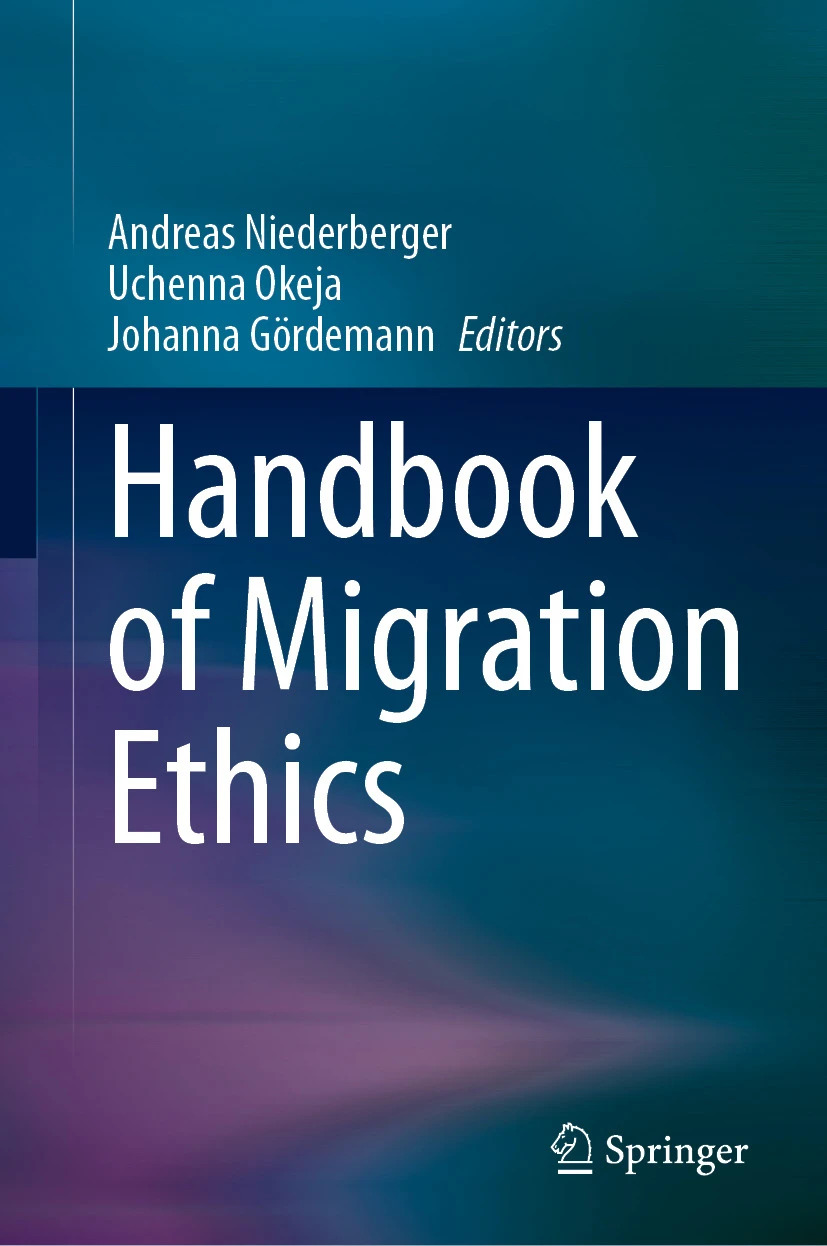
Hrsg. v. Andreas Niederberger, Uchenna Okeja und Johanna Gördemann
This book provides a comprehensive overview of the state-of-the-art literature on migration ethics. The ethics of migration is one of the rapidly growing fields of research in political philosophy, applied ethics, political theory, legal theory, social philosophy and the study of migration in the wider social sciences. Approaches in this field have elaborated possible rights of migrants and host societies, debated permissible criteria for immigration policies, and considered the differences between the claims that refugees and other migrants can make. This Handbook brings together leading international philosophers and social scientists from all regions of the world. In its contributions, it retraces the historical and systematic evolution of normative positions on migration and asylum, introduces the methodologies used in this field and offers concise analyses of the most important controversies in the field of migration – and in particular in the current politically important debate on the ethics of refugees and asylum. The Handbook of Migration Ethics is an indispensable resource for academics, students as well as professionals working in the field of migration. It constitutes a useful starting point for understanding research in this field and its social and political significance, as well as for discovering future research topics.
27. Oktober 2025Vielsprachig, vernetzt, transkulturell: Neue Blicke auf die Philosophie im Mittelalter
Kolloquium zum Auftakt der 4. Serie von „Herders Bibliothek der Philosophie des Mittelalters“
Montag, 27. Oktober 2025
13.00–19.00 Uhr
Goethe-Universität, Norbert-Wollheim-Platz 1, 60629 Frankfurt, Raum 1.314 (Eisenhower-Raum)
Zum Programm
Anmeldung bis zum 20.10.2025 erbeten unter alexander.fidora@icrea.cat
Buch-Neuerscheinung August 2025Philosophie der Menschenrechte
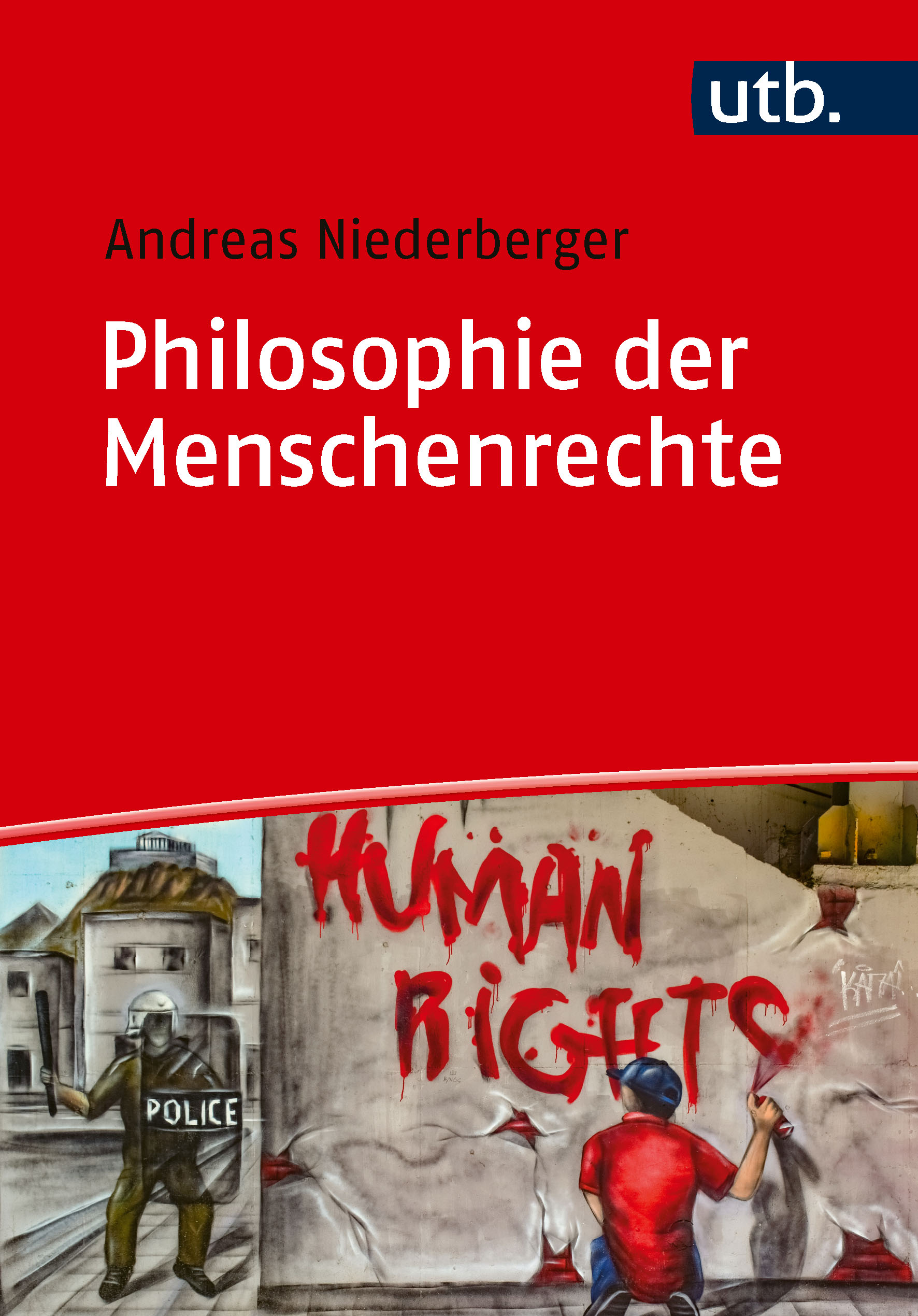
von Andreas Niederberger (Universität Duisburg-Essen)
Seit gut 50 Jahren stehen die Menschenrechte im Zentrum der Politik. Aber warum gibt es sie eigentlich und wie lassen sie sich begründen? Der Philosophie kommt bei diesen Fragen eine besondere Bedeutung zu und sie hat unterschiedliche Theorien des »Wesens« und der Reichweite der Menschenrechte hervorgebracht. Andreas Niederberger führt in wesentliche Kontroversen der Philosophie der Menschenrechte ein und thematisiert ihre Geschichte, die Frage nach dem Universalismus, das Verhältnis von Recht und Moral, aber auch postkoloniale Kritiken und die Bedeutung der Menschenrechte für Flucht und Klimawandel. Die Einführung eignet sich nicht nur für Studierende des Fachs, sondern eröffnet neue Blickwinkel für alle, die sich für die Anwendung, Geltung und Begründung der Menschenrechte interessieren.
6. September 2025"Mehr Menschenrechte"
Gespräch mit Andreas Niederberger (Universität Duisburg-Essen)
17:30 Uhr
Opernplatz, Duisburg – UFO – Junge Oper Urban
im Rahmenprogramm der Veranstaltung "Der Menschheit Stimme"
22. November 2025Ethik Konkret: Migration
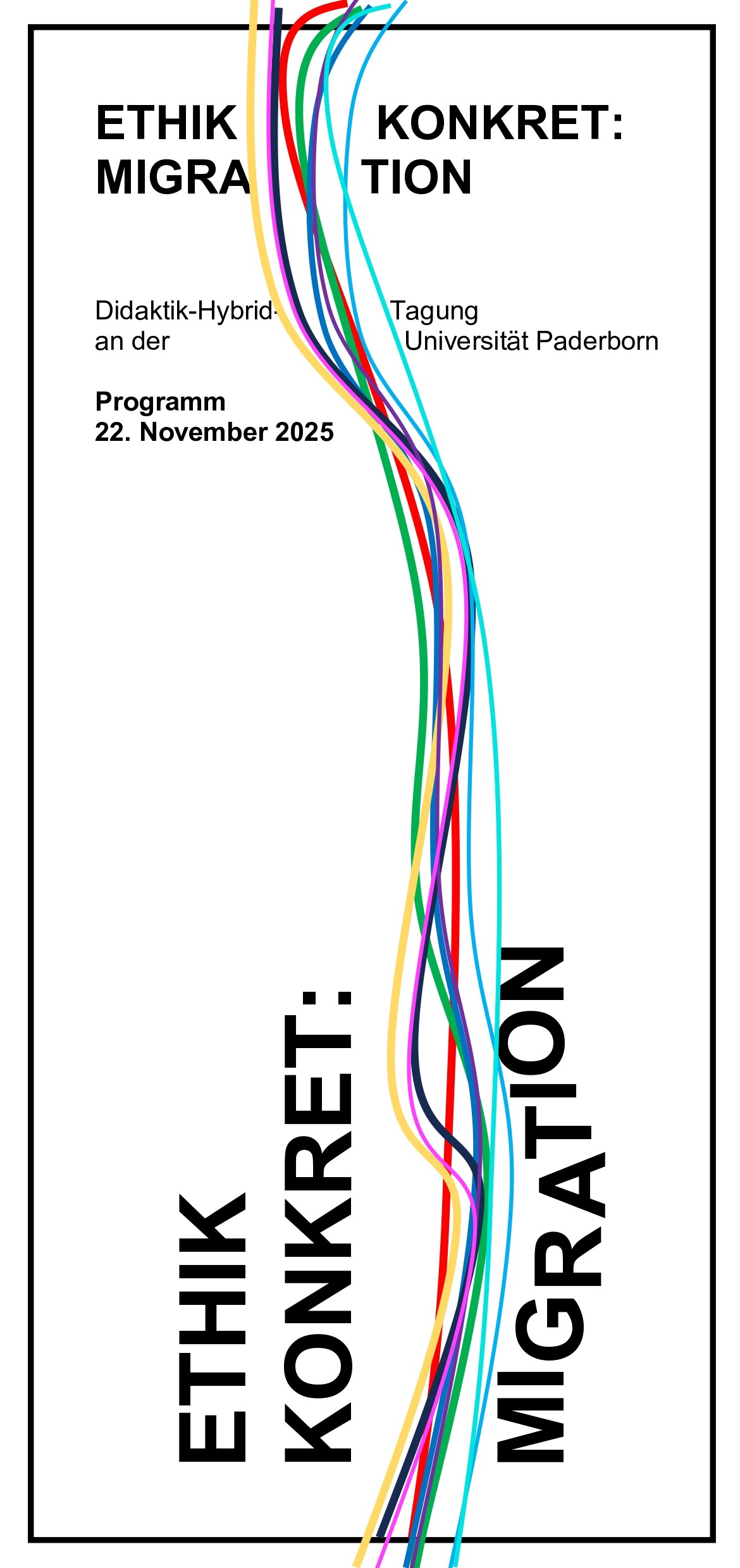
mit Vortrag von Andreas Niederberger (Universität Duisburg-Essen)
"Migrationsethik im Post-Liberalismus"
Universität Paderborn – Stehcafé im Foyer L-Gebäude in L 1.202
Samstag, 22. November 2025
10:15 Uhr
ZUR TAGUNG
Migrationsethische Fragen bewegen sich im Spannungsfeld zwischen dem Recht eines jeden Menschen auf globale Bewegungsfreiheit und dem Recht von Staaten, über Zuwanderung zu bestimmen. Derzeit befördern Rechtspopulist*innen xenophobe, islamfeindliche, antisemitische sowie rassistische Haltungen. Immigrationsfeindlichkeit dominiert den gesellschaftlichen Diskurs sowie die asyl- und migrationspolitische Praxis in Europa und darüber hinaus.
Im Rahmen der Tagung sollen Möglichkeiten diskutiert werden, wie immigrationsfeindlichen Haltungen mittels Philosophischer Bildung entgegengetreten werden kann. Durch einen in die Migrationsethik einführenden Vortrag von Andreas Niederberger und einen Vortrag von Michael Kaup über eine moralphilosophische Betrachtung von Migration in theatral-präsentativen Ausdrucksformen steht der theoretische Zugriff am Vormittag im Zentrum, während in Workshops am Nachmittag die konkrete unterrichtspraktische Umsetzung fokussiert wird.
30. Juni – 1. Juli 2025International Conference "What's the Problem with Property in Democracy?"

Institut für Philosophie & Centre for Global Cooperation Research, University of Duisburg-Essen/Germany
Speakers will include Rutger Claassen (Utrecht University), Margaret Griesse (University of Washington), Regina Kreide (Justus-Liebig-University Giessen), Jason Burke Murphy (Elms College), Amos Nascimento (University of Washington), Christian Neuhäuser (TU Dortmund), Ibrahim Orha (University of Duisburg-Essen), Patricia Rinck (University of Duisburg-Essen), Christian Scheper (University of Duisburg-Essen), Jonathan Warren (University of Washington, Seattle), Eva Weiler (University of Duisburg-Essen), Tilo Wesche (University of Oldenburg), Tim Wihl (University of Erfurt) and Jorge Zúñiga (National Autonomous University of Mexico).
The conference is organized by Andreas Niederberger as part of the research group "Owning Democracy" at the Centre for Global Cooperation Research.
Full program and practical information: https://www.uni-due.de/philosophie/politischephilosophie/owning_democracy.php
Inquiries and registration: events-cgcr@uni-due.de
26. Juli 2025"Critical Theory and Race Evasiveness"
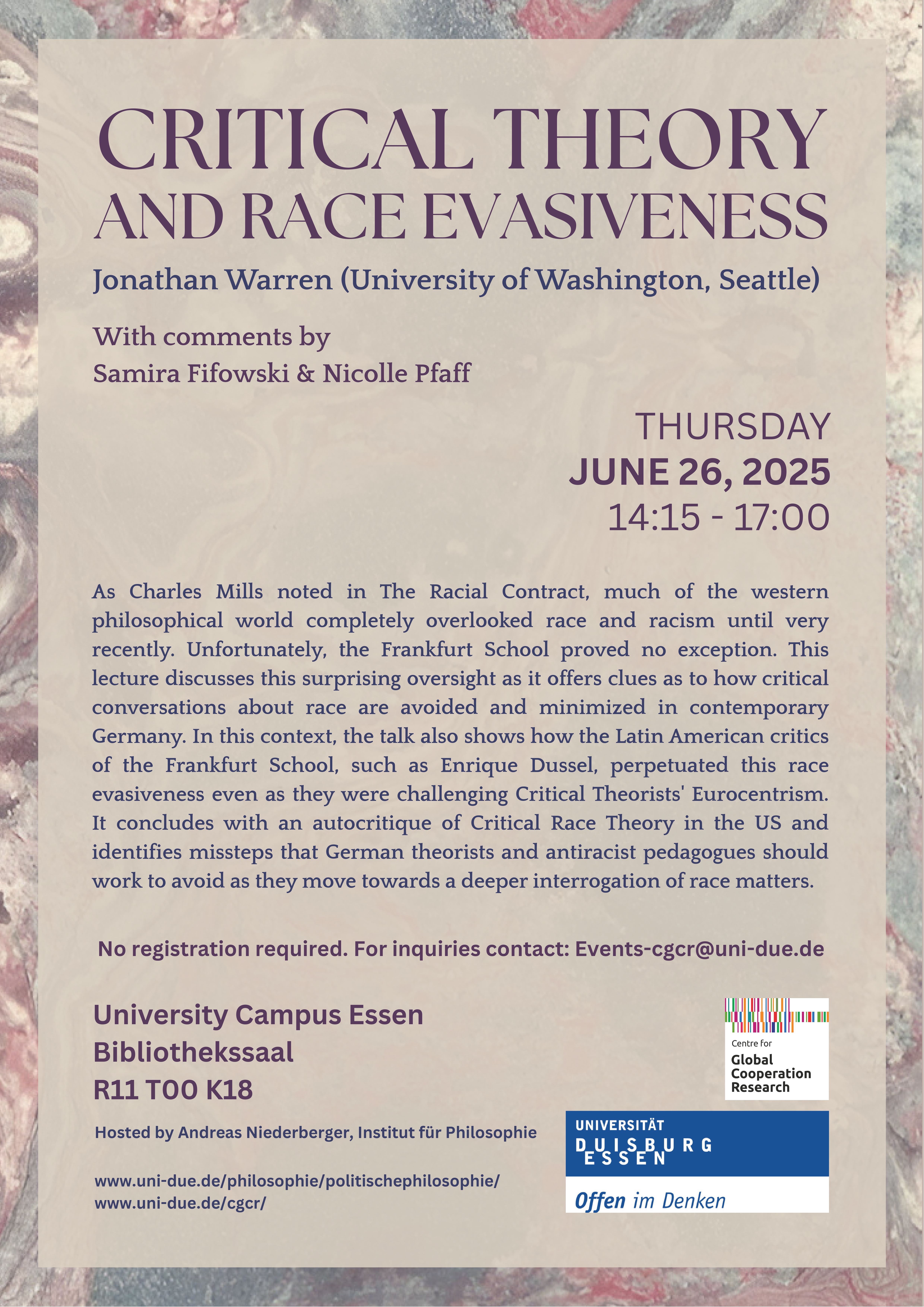
Vortrag von Jonathan Warren (University of Washington, Seattle)
Mit Kommentaren von Samira Fifowski und Nicolle Pfaff
Bibliothekssaal (R11 T00 K18)
26. Juni 2025
14:15–17:00 Uhr
Abstract: As Charles Mills noted in The Racial Contract, much of the western philosophical world completely overlooked race and racism until very recently. Unfortunately, the Frankfurt School proved no exception. This lecture discusses this surprising oversight as it offers clues as to how critical conversations about race are avoided and minimized in contemporary Germany. In this context, the talk also shows how the Latin American critics
of the Frankfurt School, such as Enrique Dussel, perpetuated this race evasiveness even as they were challenging Critical Theorists' Eurocentrism. It concludes with an autocritique of Critical Race Theory in the US and identifies missteps that German theorists and antiracist pedagogues should work to avoid as they move towards a deeper interrogation of race matters.
Herbst 2025Herders Bibliothek der Philosophie des Mittelalters – Serie 4 – Start im Herbst 2025
In der von Andreas Niederberger mit herausgegebenen Reihe "Herders Bibliothek der Philosophie des Mittelalters" sind bisher schon 63 Bände erschienen. Ab dem Herbst wird es eine neue Serie mit weiteren Bänden u.a. zu Thomas von Aquin, Johannes Duns Scotus und Dietrich von Freiberg geben. Weitere Informationen dazu finden sich hier.
Artikel-Neuerscheinung 2024"Can there be special rights for some citizens?"
Artikel von Andreas Niederberger (Open Access)
Erschienen in Critical Review of International Social and Political Philosophy
Abstract
Many argue that, given the all-subjected principle, non-temporary immigrants should have access to citizenship, challenging differences in rights between denizens and citizens. This article reassesses this conclusion by examining the case for a pathway to citizenship for denizens and asking whether former denizens, now citizens, can be denied some rights existing citizens have. It reconstructs Hart’s distinction between general and special rights, demonstrating with reference to Kant how the special right to political citizenship stems from general rights. This elucidates why denizens are entitled to a path to political citizenship. The article further explores how the exercise of citizenship can lead to additional special rights, scrutinizing whether these must also accrue to new citizens. It discusses conditions under which these further special rights might justify a distinction between citizens. The conclusion argues that reserving certain rights for some citizens is interesting for rethinking democratic theory in light of increasing mobility, less for justifying different rights for citizens and former denizens.
22.–23. November17. Dies quodlibetalis – "Gleichheit und individuelle Rechte in der (politischen) Philosophie des Mittelalters"

mit Vortrag von Andreas Niederberger (Universität Duisburg-Essen)
"Haben die Armen oder nur die armen Mönche Rechte? Zum Stand der Kontroverse über eine vermeintliche Schlüsselstellung des 14. Jahrhunderts in der Geschichte subjektiver Rechte"
Senatssaal der LMU München (Hauptgebäude, E 101)
Freitag, 22. November 2024
17:00 Uhr
Artikel-Neuerscheinung 2024"Jenseits von Polarisierung und Fragmentierung. Überlegungen zur demokratietheoretischen Auseinandersetzung mit digitaler Öffentlichkeit"

Artikel von Andreas Niederberger (Open Access)
Erschienen in Theologie und Glaube 4/2024, Themenheft "Demokratie und Digitalität. Philosophisch-theologische Untersuchungen zu einem neuerlichen Strukturwandel der Öffentlichkeit", hg. von Martin Breul und Anne Weber
2.–3. September 2024Workshop: Human Rights in Times of Insecurity

mit Vortrag von Andreas Niederberger (Universität Duisburg-Essen): "Protecting Human Rights by not Protecting Human Rights? On a Different Future for European Migration Policy",
Vortrag von Christopher Tölle (Universität Duisburg-Essen): "Is there a political problem to which Human Rights (in their positive normative vision) are an answer?"
und Vortrag von Ibrahim Orha (Universität Duisburg-Essen): "Rule of Law and Terrorism in Times of the Crisis of Human Rights"
Senatssaal der JLU
Ludwigsstraße 23
JLU Gießen
Buch-Neuerscheinung Juli 2024Migration. Herausforderungen im Spannungsfeld von Theorie und Praxis
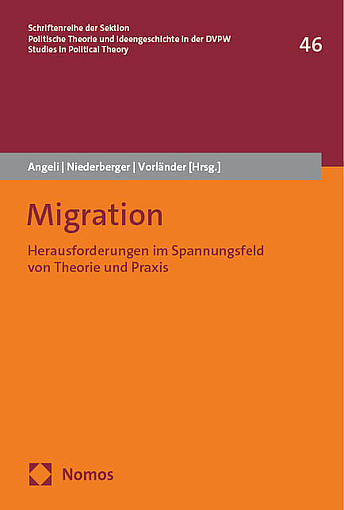
Hrsg. v. Oliviero Angeli, Andreas Niederberger und Hans Vorländer
Migration ist seit einiger Zeit ein zentrales und kontrovers diskutiertes Thema in Wissenschaft und Politik. Auch in der politischen Theorie hat die Migrationsdebatte an Komplexität und thematischer Breite gewonnen. Das Buch zieht eine Zwischenbilanz und erörtert grundlegende Fragen aus empirischer, normativer und methodologischer Perspektive. Dabei zeigt es auch, wie Migration Zugehörigkeitsvorstellungen in Demokratien herausfordert und wie Migration und Rechtspopulismus zusammenhängen.
Das Buch richtet sich an Studierende und Wissenschaftler:innen in den Sozialwissenschaften und der Philosophie, ist aber auch für interessierte Laien zugänglich. Die Beiträge des Buches ermöglichen auch den Einstieg in die politische Theorie der Migration.
Mit Beiträgen von
Oliviero Angeli | Floris Biskamp | Coretta Ehrenfeld | Katja Freistein | Frank Gadinger | Maik Herold | Anna Lübbe | Anna Meine | Andreas Niederberger | Jan Christoph Suntrup | Christine Unrau | Hans Vorländer
14. Juni 2024Von den Stufen der Erkenntnis zur Ordnung von Artes und Wissenschaften bei Alain von Lille und seinen Vorläufern aus der Schule von Chartres
Vortrag von Andreas Niederberger (Universität Duisburg-Essen)
Universität Wien
Freitag, 14. Juni 2024
15:45 – 16:30 Uhr
Schreyvogelsaal (Hofburg)
im Rahmen der Tagung: Artes Liberales Mehr erfahren
Video zum VortragIst die Durchsetzung des Rechts notwendig legitim?
Das Video zum Vortrag "Ist die Durchsetzung des Rechts notwendig legitim?" von Andreas Niederberger (Universität Duisburg-Essen) vom 04. Juli 2023 im Rahmen der Philosphie Kontrovers Reihe "Recht und Gewalt" ist nun hier zugänglich.
27. Februar 2024How much universality do universal human rights need?
Vortrag von Andreas Niederberger (Universität Duisburg-Essen)
University of New Brunswick, Department of Philosophy, Fredericton
Dienstag, der 27. Februar 2024
16:00 - 17:30 Uhr
Toole Hall Room 03
Universality is considered an essential characteristic of human rights. But how exactly should we understand this characteristic? And which are its implications for the theory or philosophy of human rights: must it itself be universalistic and, if so, in what sense?
This lecture takes the Universal Declaration of Human Rights (1948) as its starting point and distinguishes between two dimensions of the universality of human rights: their validity everywhere and their applicability to all human beings. It first examines some philosophical approaches that argue that universal validity does not necessarily require a universalist theory to justify it. Against this background, it then considers the majority of views in the philosophical human rights debate that claim that an adequate understanding and explanation of the universal validity of human rights and, more generally, of the idea and function of human rights requires their justification by a universalist theory. However, the analysis of these arguments shows that their aim to justify the need for a universalist foundation of human rights is often based on additional assumptions about the role of rights, which in turn require justification. In conclusion, this lecture argues that the supposed opposition between universalism and relativism in the field of human rights, which has been at the center of political debates in recent decades, can be better discussed if the universality of human rights is not tied to their justification in a universalist theory.
27. Oktober 2023The State. On the Nature and Norms of the Modern Polity
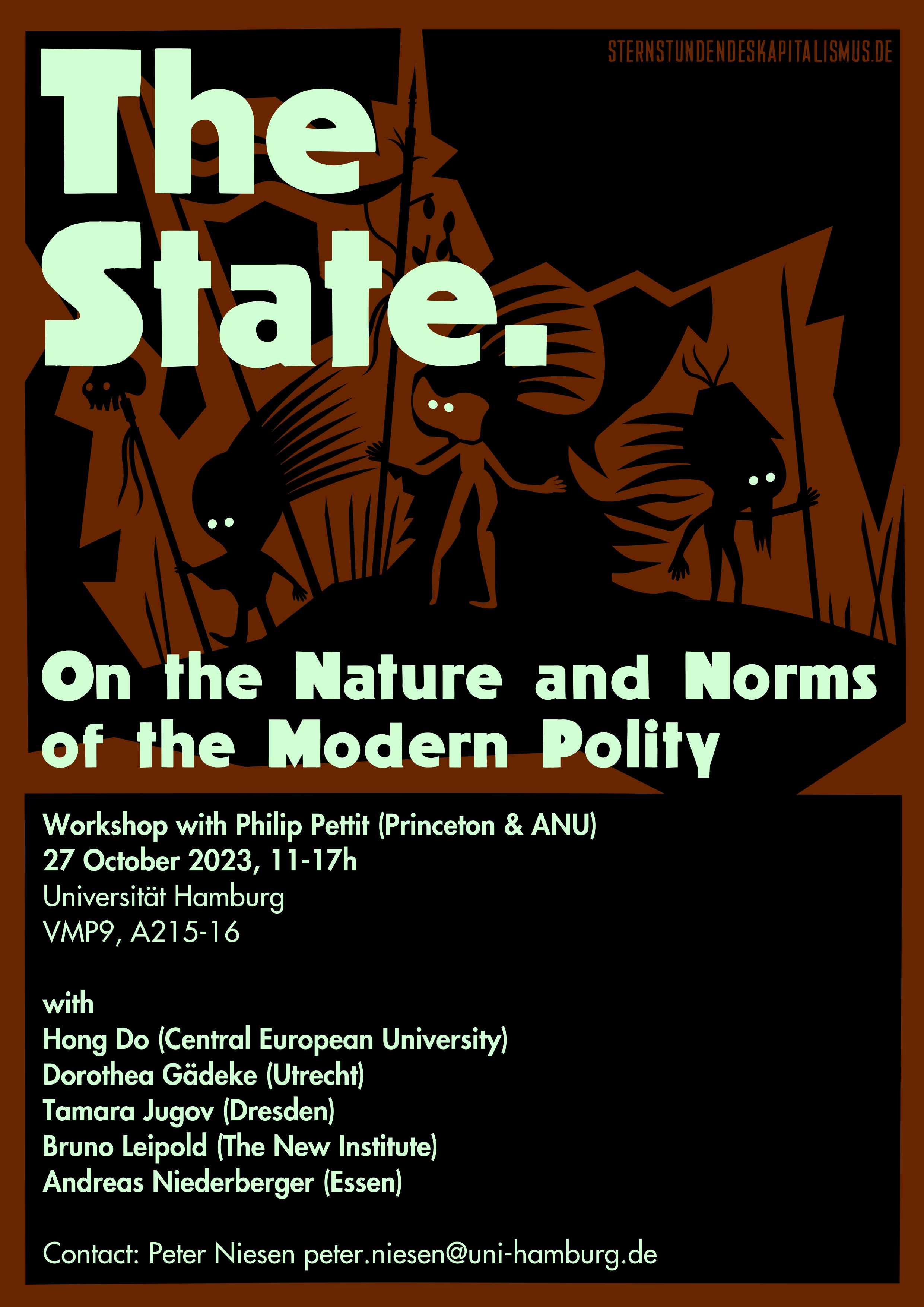
Workshop mit Philip Pettit (Princeton & ANU)
Universität Hamburg
VMP9, A215-16
mit: Hong Do (Central European University), Dorothea Gädeke (Utrecht), Tamara Jugov (Dresden), Bruno Leipold (The New Institute), Andreas Niederberger (Essen)
Buch-Neuerscheinung 3. August 2023Cosmopolitan Norms and European Values. Ethical Perspectives on Europe's Refugee Policy
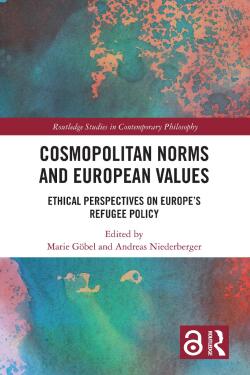
Hrsg. v. Marie Göbel und Andreas Niederberger
This volume offers a systematic philosophical analysis of the normative challenges facing European refugee policy, focusing on whether the response to it can be based on European values. By considering the refugee policy through the lens of European values, cosmopolitan norms and universal human rights, the contributions expose the weaknesses and limitations of existing regulations and make proposals on how to improve them.
The EU is often seen as a cosmopolitan project. Europe is supposed to be a community of states that aspires to be guided by cosmopolitan norms. However, the idea of a cosmopolitan Europe has never been unanimously shared, and in recent years, it has come under increasing scrutiny, particularly with regard to the EU’s refugee policy. The guiding idea of this book is that a deeper philosophical understanding of the normative issues at stake can foster greater conceptual clarity and enrich political debates on the future of European refugee policy. The first part of the book revolves around the question of whether the rise in refugee numbers over the past decade has led to a crisis in the EU and, if so, how this crisis relates to or impacts European values. The second part traces the history of the discourse on “European values” and examines from a philosophical perspective how we can plausibly understand these values in terms of their moral grammar, their normative content and their implications for the behaviour of the EU and its member states. Finally, the third part puts forth recommendations for a feasible and normatively more compelling European refugee policy based on human rights, human dignity, justice and democratic self-determination as the decisive normative requirements.
Cosmopolitan Norms and European Values: Ethical Perspectives on Europe’s Refugee Policy will be of interest to researchers and advanced students working in ethics, political philosophy, political science, social sciences and law.
The Open Access version of this book, available at www.taylorfrancis.com, has been made available under a Creative Commons Attribution-Non Commercial-No Derivatives 4.0 license.