
Welcome to the new Faculty of Computer Science

Departments
Faculty news

Two Perspectives on Current Challenges in Computer Science
The paluno Distinguished Lectures in November will focus on reliable agentic software engineering and the technical, legal, and political challenges of cybersecurity. Featuring Prof. Dr. Eric Bodden on November 3 in Essen and Ingo Ruhmann on November 12 in Duisburg.

Mini Campus Day in Duisburg: Get a Taste of University Life and Discover College Majors
What’s it really like to be a college student? At the Mini Campus Day on November 27, 2026, high school students can explore the Duisburg campus with their class, discover various degree programs, and get a first impression of everyday student life at the UDE. No Registration is not required.

Computer Science Day 2026: A Look Back at a Day Dedicated to Human-Computer Interaction
Over 120 guests, exciting insights into current research, and plenty of opportunity for discussion: Computer Science Day 2026 was entirely dedicated to the question of how humans and technology can come together even more effectively in the future.

Registration for the Gottschalk-Diederich-Baedeker Award Ceremony on November 19, 2026
The University of Duisburg-Essen cordially invites you to the award ceremony for the Gottschalk-Diederich-Baedeker Prize and the subsequent reception on November 19, 2026. This year, Dr. Jessica Szczuka will be awarded the Gottschalk-Diederich-Baedeker Prize. The prize, sponsored by the Gottschalk-Diederich-Baedeker Foundation, is awarded annually for outstanding achievements in research and technology transfer at the University of Duisburg-Essen.

Prof. Dr. Hannes Rothe Awarded the 2026 UNIPRENEUR Prize
Prof. Dr. Hannes Rothe of the School of Computer Science was awarded the UNIPRENEUR Prize in 2026. The award recognizes his exceptional commitment to start-ups and the promotion of entrepreneurship in higher education. UNIPRENEUR is one of the most prestigious awards for entrepreneurial commitment at German universities and research institutions.

AI as a Mentor for Startup Ideas
Prof. Dr. Hannes Rothe from the UDE’s Department of Computer Science is leading the university’s participation in the European project “AURORA seizmic EIT-KIC.” Together with partners, the UDE is further developing an existing platform into an AI-supported mentoring environment for social entrepreneurship. Initial testing is planned for spring 2027.

From a swarm of fireflies to television
Dr. Thorsten Kimmeskamp, director of the mentoring program at the Faculty of Computer Science, brings a fascinating interplay of mathematics, computer science, and nature to the big stage. On the “Große Maus Show,” he demonstrates how about 100 small computers synchronize their behavior, modeled after glowing fireflies—and in the process, brings computer science to life in a playful way. This is an exciting example of his commitment to communicating science in an accessible way and inspiring both students and the next generation to pursue computer science.

When Data Tells More Than One Story
Not every dataset can be explained by a single model. Researchers at the Faculty of Computer Science at the University of Duisburg-Essen, led by Prof. Dr. Torben Weis, have therefore developed a new method that groups data points based on their mathematical behavior. “CluBS” can identify various relationships without needing to know in advance how many patterns or functions are present in the data.

Second Graduation Ceremony 2026
Celebrate your graduation with us! The School of Computer Science invites you to a festive graduation ceremony on November 24, 2026, at the Duisburg campus. Register now to receive all further information about the event after you sign up.
Studies
The Faculty of Computer Science will offer an attractive and diverse range of courses that is unique in the region. It will include, among others, the bachelor's/master's degree programs "Computer Science", "Applied Cognitive and Media Science", "Software Engineering" and "Business Informatics" as well as the teaching degree in Computer Science. All enrolled students can continue their studies as usual.
Information for applicants
Research
In addition to the essential foundations of informatics, we explore emerging systems in their interactions with their environment. This involves interaction with people and other technical systems, as well as embedding these systems in economic and societal contexts. In order to shape the future of digital transformation, we bundle our competencies in three main research areas.
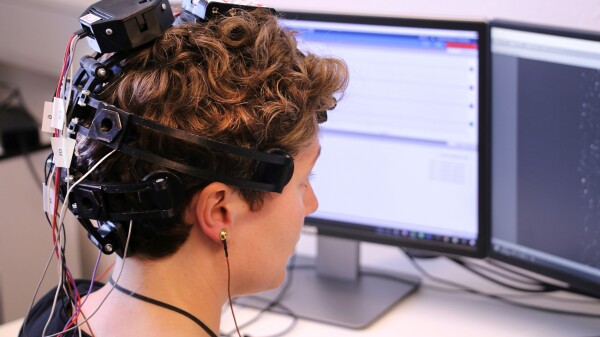
Human-Centered Digital Technology
Focus is on exploring the reciprocal adaptivity of human-technology systems and the empowerment of human users in interaction with increasingly intelligent technologies.

Software Technology
We shape the future of engineering and operation of novel software systems and seek intelligent solutions at the interfaces of complexity, security, and usability. These activities are bundled at paluno - The Ruhr Insitute for Software Technology.

Digitalisation in Service and Trade
We address the challenges of how disruptive technological approaches generate successful innovations in service organizations. Beyond that, we examine the effects that new technologies have on organizations, both internally and externally.