

Hardware-aware NAS

Finding the ideal neural architecture for a particular use case can take a lot of time and trial and error.
Hardware-aware Neural Architecture Search (HW-NAS for short) automates this design step and even finds architectures that outperform those created manually in some cases. Furthermore, even the required resource estimation can be automated by a Deep Neural Network. In this way, the tailored deployment of neural networks is simplified greatly.
Quantization-aware Neural Architecture Search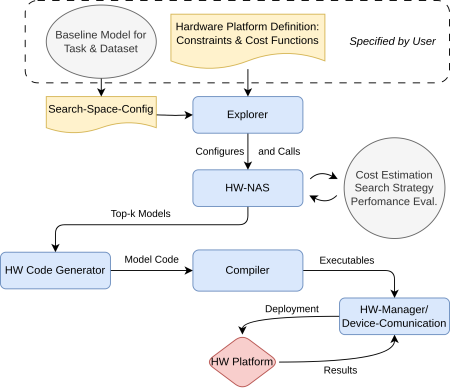
It is becoming increasingly evident that the performance of neural architectures strongly depends on subsequent compression techniques. In most cases, NAS and compression methods such as quantization are considered in completely independent steps to keep the search space manageable. However, this approach has the drawback that dependencies between the chosen architectural parameters and the effects of the applied
quantization scheme are not taken into account during NAS, which can lead to suboptimal models. Our current research therefore investigates ways to combine both approaches in a meaningful manner, with a particular focus on expanding the search space and refining the evaluation strategy for the sampled models.
Contact: Natalie Maman, M.Sc. | Recent Publication
Neural Architecture Search for Audio- and Time-Series Models

A method, which we currently focus on, is based on the combination of evolutionary algorithms and reinforcement learning and discovers optimal architectures by deliberately mutating, recombining and weeding out contenders. Our requirements typically include efficient operation on resource-constrained hardware, hence hardware costs such as latency or energy consumption are included as optimisation criteria in the architecture search.
Our ongoing studies once again focus on applications in the domains of signal processing and time series analysis, e.g. to find latency-optimized architectures for the simulation of time-variant non-linear audio effects.
Contact: Christopher Ringhofer, M.Sc. | Recent Publication
Applied Neural Architecture Search

In our research, we focus on the development of smart surfaces, in which everyday surfaces such as tables are used as interactive interfaces for smart home applications. Instead of relying on additional input devices or visible technology, existing surfaces are augmented through seamlessly integrated sensors and local signal processing.
The approach is based on capturing vibrations generated by gestures such as tapping or knocking on the surface. These vibration signals are acquired by the sensors and are analyzed directly on the device using machine learning methods. By relying exclusively on on-device processing, a privacy-by-design approach is pursued that operates without cameras, microphones, or cloud connectivity. Building on existing work such as Smatable, a complete end-to-end system is being developed that combines hardware, signal processing, and energy-efficient AI models. The focus is on compact 1D CNN architectures that are suitable for deployment on embedded and FPGA platforms.
In future research, we investigate the expansion of the gesture vocabulary, the localization of gestures on individual surfaces, and the transferability to different materials and usage scenarios. The goal is to enable natural, robust, and privacy-friendly interactions with smart everyday surfaces.
Contact: Florian Hettstedt, M.Sc. | Recent Publication