


Driving Urban Transition: PROMISE

The application-oriented funding line “Driving Urban Transition to a Sustainable Future” (DUT) of the EU’s Horizon Europe research program addresses profound transformation processes in cities against the backdrop of multidimensional sustainability issues.
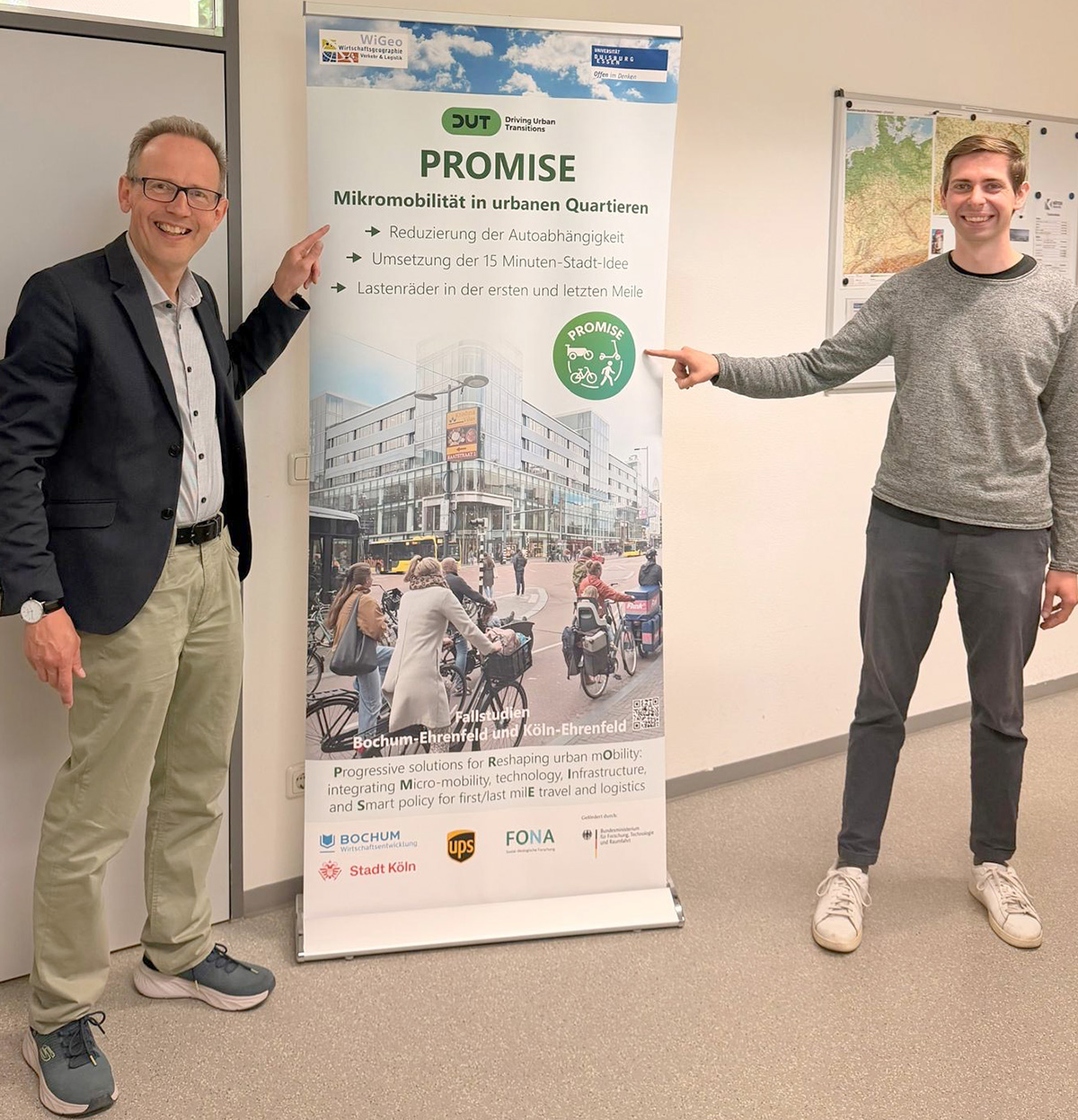
The international research project PROMISE (Progressive Reduction of Car Dependency: cO-creating Solutions by Integrating Micro-mobility, Infrastructure, and Smart Policy in First/Last-MilE Travel and Deliveries) is part of the DUT initiative and aims to develop innovative strategies for reducing car dependency in urban mobility.
The Chair of Economic Geography, with a focus on Transportation and Logistics (Prof. Dr. Rudolf Juchelka), at the University of Duisburg-Essen is participating in PROMISE. The subproject (grant number 01UV2557) will run for three years (01/2025–12/2027).


Research ObjectiveReducing Car Dependence Through Micro-mobility
The goal of the PROMISE project is to integrate micro-mobility strategies for the first and last mile in urban areas, thereby significantly reducing dependence on cars and strengthening the concept of the so-called “15-minute city.” In particular, the study examines the extent to which co-creative approaches to networking among stakeholder groups can facilitate the implementation of micro-mobility. The focus is on identifying and addressing challenges in the areas of safety, regulatory frameworks, infrastructure, and behavioral adaptation.
Project PartnersInternational Research Collaborations
The PROMISE project includes 14 partners from six countries (Denmark, Germany, Greece, Romania, Sweden, and Turkey). The project is coordinated by Dalarna University (Sweden) under the leadership of Prof. Dr. Mia Xiaoyun Zhao. Other partners include:
- Denmark
- Aalborg University , Department of Sustainability and Planning, The Technical Faculty of IT and Design, Geoinformatics & Earth Observation
- Germany
- Bochum Economic Development Agency (Wirtschaftsförderung)
- City of Cologne (Department III – Mobility)
- University of Duisburg-Essen, Department of Economic Geography, Transport & Logistics
- UPS Germany S.à r.l. & Co. OHG
- Greece
- City of Rethymno (City Administration)
- Romania
- BEIA Cercetare
- Brasov Metropolitan Agency for Sustainable Development (Economic Development Agency)
- Sweden
- ModC Networks AB (Modular Cycling)
- Sustainability InnoCenter
- Turkey
- DFAST Dagitim Hizmetleri ve Lojistik A.S. (hepsiJET/HJET)
- City of Osmangazi (City Administration)
- Uzay Tech Bilisim Arastirma Muhendislik Hizmetleri Sanayi ve Ticaret A.S. (Uzay)
Research ObjectivesPROMISE Overall Project
- Establishment of a collaborative planning framework involving relevant stakeholders and development of guidelines for a behavioral shift toward sustainable mobility in urban areas
- Design of an advanced GIS-based mobility decision-making tool (Micro-Mobility Decision Support Tool = MDST) and support for the process of developing urban mobility plans in the context of sustainable urban development
- Empirical studies in five urban areas and an analysis of the impact of micro-mobility strategies on reducing car traffic in Brașov (Romania), Osmangazi (Turkey), Rethymno (Greece), Bochum, and Cologne
- Deriving Micro-mobility Strategies to Reduce Car Use

PROMISE Kick-off Workshop in Essen
The first project meeting with all PROMISE project partners took place on 4th and 5th September 2025, on the Essen campus and was hosted by the Department of Economic Geography, Transportation and Logistics, at the University of Duisburg-Essen in the Department of Geography. Key agenda items for the project meeting included the presentation of and shared understanding regarding the work packages, as well as coordination of the consortium’s future research process.
In addition, the data situation for the development of the GIS-based micro-mobility decision-making tool was reviewed, and workshop planning for the case studies was discussed for the first time.
PROMISE Sub-Project at the University of Duisburg-EssenCase Studies in Germany
The Department of Economic Geography, Transportation and Logistics, at the University of Duisburg-Essen primarily supports the empirical research on the case studies of the two German cities, Bochum and Cologne.
The goal is to test co-creative approaches that actively involve a diverse range of stakeholders and actors in order to observe the reduction in car traffic achieved through micro-mobility solutions for the first and last mile. The GIS-based mobility decision-making tool developed for this project will be applied and evaluated as part of the case studies. The data and insights gained will be used to validate and further develop micro-mobility approaches.
- Bochum-Ehrenfeld Case Study:
The Bochum-Ehrenfeld neighborhood has already benefited from improvements to its bicycle infrastructure and is perceived by many Bochum residents as a bicycle-friendly neighborhood. With support from Bochum Wirtschaftsentwicklung (Economic development agency), research is being conducted to determine how the acceptance of micro-mobility in Bochum-Ehrenfeld can be further increased. As part of this effort, innovative delivery and logistics services – with a focus on the last mile using cargo bikes – are being further developed to reduce dependence on cars while maintaining both spatial and economic sustainability. - Cologne-Ehrenfeld Case Study:
The Cologne-Ehrenfeld district, which serves as the case study, already has a comparatively well-developed bicycle infrastructure and is also characterized by high levels of inner-city traffic and delivery volume. The Cologne-Ehrenfeld case study reassesses the potential of cargo bikes for both urban logistics and the mobility of people with disabilities, seniors, and others with limited mobility. UPS Germany is participating in research on usage patterns and the identification of existing mobility barriers on the ground. - Practicepartner UPS:
As a company focused on sustainable delivery concepts, UPS already uses cargo bikes for package delivery in several cities and plans to further expand this delivery method. In Cologne, UPS operates a micro-depot for inner-city deliveries using cargo bikes. As a logistics service provider, UPS thus contributes valuable practical experience, data, and services to the PROMISE project, particularly to support the case studies. In addition, UPS is participating in the analysis of usage patterns and the identification of existing local mobility barriers on the ground.* In the overall English-language context of the project, a European definition of “Living Labs” in English is used, whereas in the German-language context, the terms “case studies” (in German “Fallstudien”) or “pilot studies” (in German “Pilotstudien”) are deliberately used.

Workshop with stakeholders and actors in Bochum-Ehrenfeld
On Wednesday, 24th June, 2026, from 17:00 to 19:00, the Department of Economic Geography, with a focus on Transportation and Logistics, at the University of Duisburg-Essen hosted the event “Stakeholder Workshop with Users and Those Affected by Micro-mobility in Bochum-Ehrenfeld.” The workshop took place in Bochum at the Rivvers Coworking Space. Working in groups, the participants explored the question of where and how barriers to micro-mobility arise locally in Bochum-Ehrenfeld, and what strategies could be implemented locally to overcome these obstacles.

Workshop with stakeholder and actors in Cologne-Ehrenfeld
In the Ehrenfeld district of Cologne, the Department of Economic Geography, Transportation and Logistics, at the University of Duisburg-Essen hosted another stakeholder workshop for the second case study. While barriers to micro-mobility in Cologne-Ehrenfeld were identified and local areas for improvement were discussed, the issue of inclusion was also a central focus of the workshop. Mobility aids – whether electric or equipped with towing units – place similar demands on cycling infrastructure as cargo bikes due to their comparable track width, which is why the perspective of people with limited mobility is equally important to the PROMISE project. The event took place on 11th August from 17:00 to 19:00 at the Bürgerzentrum Ehrenfeld e. V.

„Geography Connect Convention (GCC)“
The PROMISE poster „Barrieren in der Mikromobilität – Urbaner Verkehr: nachhaltig, sicher und durchgängig“ (in English: “Barriers to Micro-mobility – Urban Transportation: Sustainable, Safe, and Seamless”) was presented and displayed at the Geography Connect Convention (GCC), which took place from 30th September to 2th October, 2026. The GCC was the largest academic conference on geography in Germany in 2026. During the poster session, empirical findings from the case studies in Bochum-Ehrenfeld and Cologne-Ehrenfeld were presented in particular. These findings addressed local barriers faced by cargo bike riders as well as potential solutions for improving the micro-mobility situation. In addition, initial spatial analyses in the form of GIS-based maps were presented.
Zeitstrahl


