

PhenoCycler Fusion
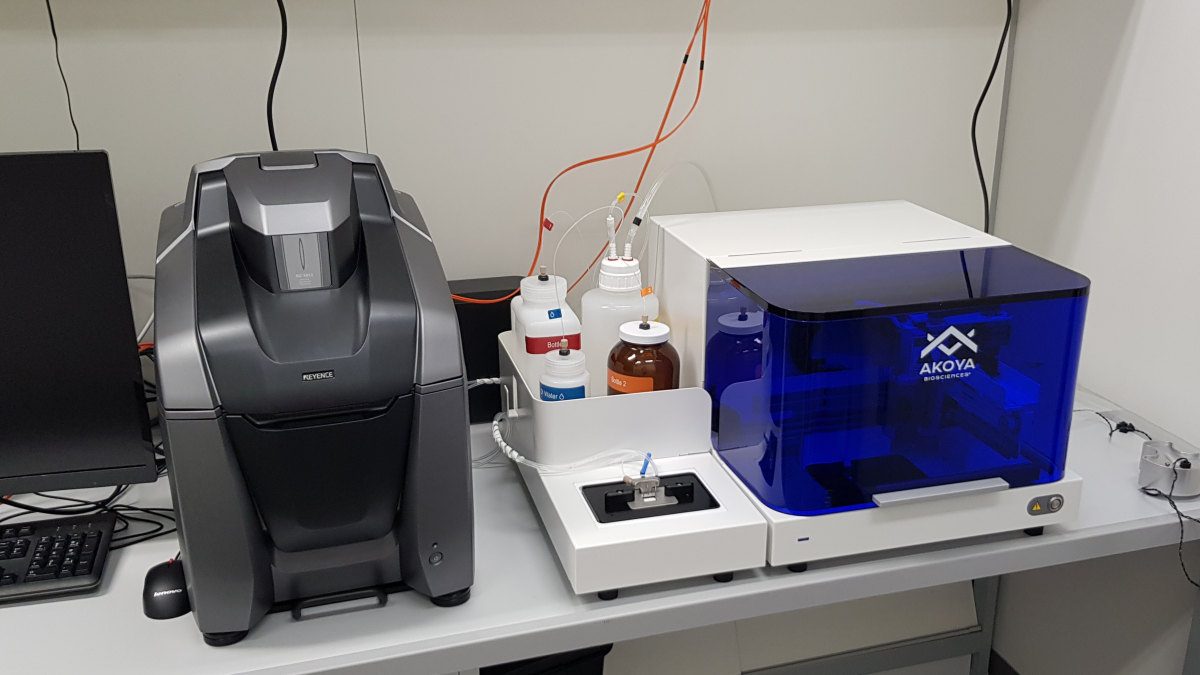
Light MicroscopyAkoya PhenoCycler Fusion
Automated multiplex staining and imaging system, consisting of the Akoya PhenoImager microscope and the Akoya PhenoCycler fluidics system.
The PhenoImager is a highly automated upright microscope - essentially a slide scanner - that is optimized for high multiplex imaging of Akoya's Opal dye series (see below). Software is available for spectral unmixing of the overlapping signals.
The system offers imaging at resolution levels "10x", "20x", and "40x", with effective pixel sizes of 1, 0.5, and 0.25 micrometers, respectively. These resolution levels result from a combination of the choice of objective and of camera pixel binning, both of which are handled fully automatically by the system based on the resolution level chosen by the user.
The system also fully automatically handles selection of regions of interest to scan and focusing on the sample. This also means that using appropriate coverslips (standard glass, thickness # 1.5) is crucial - there is no option to correct the focusing strategy for unconventional coverslip thickness or material. Also, we found that "pap pen" outlines around the tissue section tend to confuse the system. We recommend NOT to use pap pen in preparing samples to be imaged at the PhenoImager.
The PhenoCycler is essentially a pipetting robot for repeated cycles of staining and dye removal on tissue sections. Together with DNA barcode-based labelling reagents, PhenoCycler and PhenoImager allow the sequential imaging of dozens of markers within a single tissue slice. This requires bespoke sample preparation protocols, visit Akoya's web pages, or ask us, for more details.
Spectral bands available for fluorescence are optimized for the following dyes:
- DAPI
- Opal 480
- Opal 520
- Opal 570
- Opal 620
- Opal 690
- Opal 780
These spectral bands are also usable for many of the dyes that are more widespread for immunofluorescence. Note that for the Opal dyes, the numbers in the dye name refer to emission wavelengths, not excitation wavelengths as is common in naming other dyes. For example, Opal 520 is spectrally similar to Alexa Fluor 488. Contact us if more information is needed.