

AG Gaches - Molecular Astrophysics, Cosmic Ray Physics

Welcome!
This is the group page for the AG Gaches Emmy Noether page hosted in the Faculty of Physics at the University of Duisburg-Essen. Our group focuses on studying the role of energetic particles, dubbed cosmic rays, from the atomic to astrophysical scales. The research we conduct is interdisciplinary, including theoretical chemistry, computational astrophysics, and astrochemical modeling, to unify our knowledge from the micron to parsec scales.
See the other group page here.
Research Themes

Research ThemesMolecular Astrophysics
Our group focuses on investigations in molecular astrophysics. In particular, we are interested in the interaction of high-energy radiation processes, such as X-ray and energetic particle radiation. Molecular astrophysics is a field that seeks to 1) use space as a laboratory to understand fundamental chemical processes that cannot be readily studied on Earth and 2) use our understanding of the chemistry to exploit the radiation from molecules to understand the physics of star- and planet-forming gas. The group primarily uses theoretical methodologies, although we have our own observational programmes and are involved in several observational astronomy collaborations.
Cosmic rays drive a diverse and interesting chemistry in both the gas- and ice-phases. Since molecular clouds are very cold (10-20 degrees Kelvin), the gas-phase chemistry is driven primarily by ion-neutral reactions. The bulk of the molecular gas is shielded from external ultraviolet radiation: cosmic ray-driven ionization thus drives the chemistry. Through ion-neutral chemistry, the chemistry becomes complex with the formation of many species, primarily through proton exchange reactions. In the ice, energetic radiation imparts energy through secondary electrons, which produce radicals and anions. These become akin to Lego blocks, sticking together and forming more and more complex organic and prebiotic molecules in the ice.

Research Themes3D chemical models
Our group uses state-of-the-art three-dimensional chemical models of the molecular interstellar medium to understand the physical and chemical processes at play in various molecular cloud environments. The main code that we use is 3D-PDR, a steady-state photo-dissociation region that includes a wide range of physical and chemical processes. During his academic career, the group PI, Dr. Brandt Gaches, has actively implemented a range of improved cosmic-ray physics into the code.
The code is used to model the photo- and cosmic-ray chemistry in molecular clouds. With recent improvements in the code, we can now run high-resolution models on supercomputing facilities over a wide range of external radiation environments. The newly implemented molecular hydrogen physics enables the direct prediction of near- and mid-infrared emission from molecular hydrogen relevant for JWST. These models are being used to constrain the cosmic-ray transport physics along with JWST spectroscopy.

Research ThemesCosmic ray acceleration and accretion physics
Cosmic rays are accelerated in energetic environments. Of particular interest are accretion shocks around protostars, protostellar jets, wind terminal shocks from stars, HII regions, and within the reconnection sites of magnetized turbulence. We have had particular interest in the production of high-energy radiation from protostellar accretion. The high-energy radiation propagates throughout the natal disk and cloud environment, highly irradiating the dense molecular gas. This can drive a substantial amount of ion-neutral chemistry, stimulate ice chemistry, and produce short-lived radioactive isotopes through spallation. However, to understand the production of high-energy radiation, the accretion physics must be well understood.
Simulations of accretion onto actively accreting embedded protostars have historically been sparse. The PI has led the development of the High-resolution Accretion Disks of Embedded protoStars (HADES) simulations, which simulate accretion around model protostars at high resolution. We seek to understand the different accretion physics for a range of parameters, in particular the protostellar magnetic field. The results from these simulations feed directly back into the models for the acceleration of particles at the accretion shocks and the production of high-energy photon radiation.
Research Highlights

HighlightResearch Highlight: Resolving photochemistry in dense photodissociation regions
Photodissociation regions (PDR) occur when far ultraviolet radiation impinges on the surface of a molecular cloud. They are akin to sunburns: the far-ultraviolet radiation scalds the surface of the gas, heating it to hundreds to thousands of Kelvin, resulting in an interesting warm, dense chemistry. PDRs are especially important in our understanding of star formation throughout cosmological times: nearly all the gas emission lines that are used to constrain star formation originate from them! Therefore, understanding PDRs is not only of interest for astrochemistry, but also to the broader fields of star formation, galaxy formation, and the cosmological baryonic cycle. The Orion Bar is the canonical PDR: it has a well-characterized impinging radiation field and is observed to be nearly edge-on, resulting in a clear view of the chemical structure.
We have developed a new high-resolution three-dimensional model of an Orion Bar analogue. We primarily examined the locations and structures of the H2 dissociation front and the C+/C/CO transition front. We also studied the chemistry of light hydrides that are produced through FUV-driven excitation chemistry. Our models are the first to provide self-consistent three-dimensional predictions of the chemical structure and NIR H2 emission lines of a dense photodissociation region.
Publication: Gaches et al., A&A, 2026 (forthcoming). arXiv:2608.04116
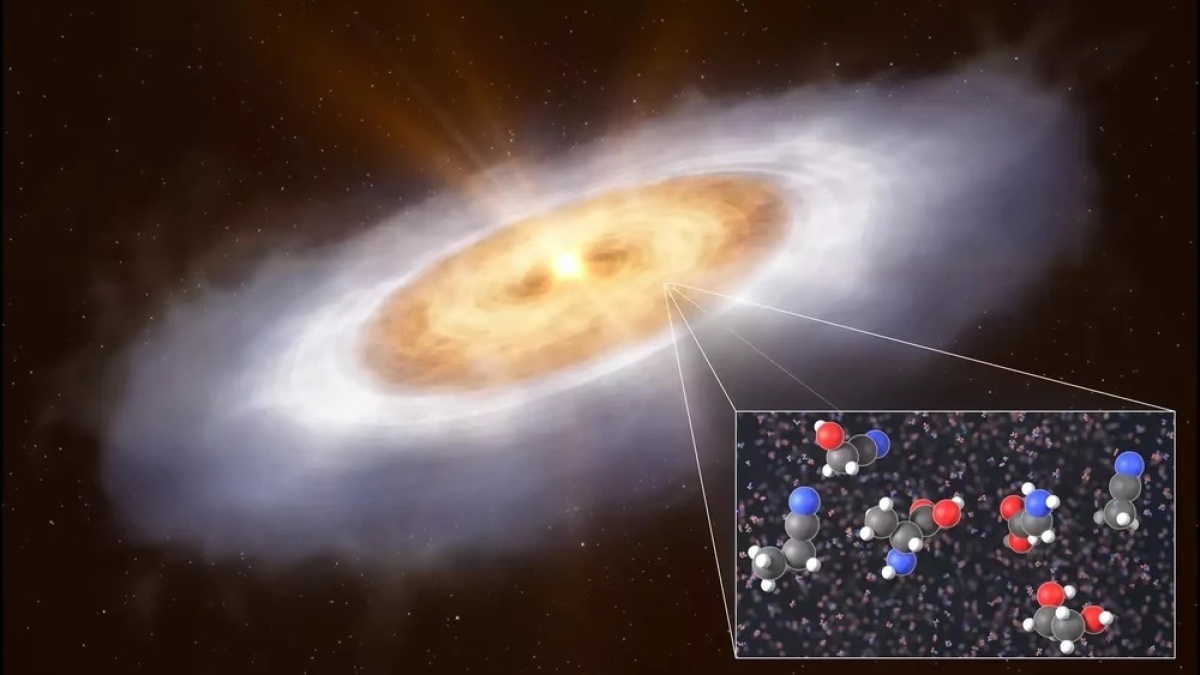
HighlightResearch Highlight: Searching for Prebiotics in Protoplanetary disk V883 Ori
Research carried out by PhD student Abubakar Fadul while at the Max Planck Institute for Astronomy, with Dr. Kamber Schwarz
Complex organic molecules (COMs), typically defined as carbon-bearing species with six or more atoms, have been widely detected in space. A subclass of these, known as prebiotic molecules, are thought to play a key role in the formation of life. We report the first tentative detection of two such prebiotic precursors (ethylene glycol and glycolonitrile) in a protoplanetary disk. These molecules are considered potential precursors to sugars and amino acids, fundamental building blocks of life. Our findings suggest that complex organic molecules are inherited from earlier stages of star formation and continue to evolve during the disk phase. This supports the idea that the chemical conditions necessary for life may be widespread in the Universe, making the emergence of life more universal than previously thought.
Appeared in ApJL, August 2025

Astrochemistry Low-energy electron Cross-Section Database (ALeCS)
Through the group, we manage the Astrochemistry Low-energy electron Cross-Section database, or ALeCS, hosted at alecs-db.org. ALeCS hosts the electron-impact ionization cross sections for over 200 molecules and all relevant astrochemical atoms. We have computed the electronic structure of these molecules using various levels of quantum chemistry theory. The database also provides the optimized structures, ionization energies, and interstellar ionization rates. ALeCS is now the largest public database for these types of cross sections, and we aim to continue to expand the database for more molecules and electron-impact inelastic processes. We are an open collaboration and allow researchers to also request new molecules to be computed as needed.
Interested in joining?
We are always looking for motivated Bachelor’s and Master’s students who are interested in astrochemistry, cosmic ray physics, and star formation! This includes students with primary interests in physics or chemistry, with possible projects ranging from theoretical chemistry investigations of electron-impact physics, astrochemical modeling of molecular clouds, and analyzing magneto-hydrodynamic simulations or data from the James Webb Space Telescope. Interested students should feel free to send me an email!
The group can also act as a host for postdoctoral fellowships. In particular, I would be willing to support and help interested postdoc candidates to apply for independent funding to join the group, such as a Humboldt postdoctoral fellowship, a DFG Walter Benjamin fellowship, or an EU Marie Curie fellowship.
Team

Dr. Brandt Gaches
Emmy Noether Junior Group Leader
MC 364
brandt.gaches (at) uni-due.de

Manuela Adam-Skowranek
Team Office
MC 367
manuela.adam (at) uni-due.de

Abubakar Fadul
Doctoral Student
MG 364

Fynn Wawrzyniak
Master
MC 343

Nils Wolfsdorff
Bachelor
MG 364

Bengisu Kırtaş
Erasmus+ Intern
MG 364
Acknowledgements
The group is funded by the DFG Emmy Noether grant #542802847. We also receive support from Zulip in the form of an upgraded channel for the group.
Privacy notice
By loading this map your IP Address is disclosed to OpenStreetMap.