

Prof. Dr. Christof Hartmann

 DE
DEFunctions
-
Universitätsprofessor/in, Institut für Politikwissenschaft
-
Gruppe der Professorinnen und Professoren, Fachbereichsrat
Fakultät für Gesellschaftswissenschaft / Institut für Politikwissenschaft
AddressForsthausweg 2
47057 DuisburgRoomLF 325FaxE-Mail -
Vorstandsvorsitzende/r, Institut für Entwicklung und Frieden (INEF)
Fakultät für Gesellschaftswissenschaften / Institut für Entwicklung und Frieden (INEF)
AddressLotharstr. 53
47057 DuisburgRoomLS 120PhoneFaxE-Mail
Office hours during the semester break according to the following schedule:
10.8., 14.30-16; 24.8. 14.30-16; 31.8. 14.30-16, 5.10. 14.30-16
in room LF 325 or via Zoom (for access to the Zoom meeting, please write to wencke.rottlaender (at) uni-due.de)
News

Congratulations to Dr. Jannis Saalfeld on his PhD.
On 20 December 2023 Jannis Saalfeld successfully defended his PhD dissertation on Between resistance and integration: Islamism in sub-Saharan Africa and completed his PhD with a summa cum laude. Our congratulations on this excellent performance.

Congratulations to Dr. Henrik Maihack on his PhD.
On 13 October 2022 Henrik Maihack successfully defended his PhD dissertation on Contested Urban Citizenship in Kenya: Citizenship Formation in Urban Informality and completed his PhD with very good success. Our congratulations on this excellent performance. His dissertation has been published with Nomos.
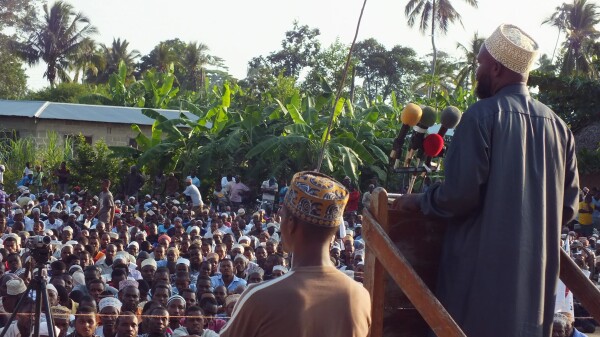
Research Project on Jihadism in Africa
The German Foundation for Peace Research (DSF) finances a new research project which will start at Institute for Development and Peace (INEF) in December 2020 and will deal with local dynamics of jihadist mobilization in Sub-Saharan Africa. In this project, we will investigate the so far neglected potential ‘non-radicalization paths’; and put particular emphasis on the preventive role of political party competition.

We congratulate Nora Schrader-Rashidkhan on her successful defense of her PhD
On 13 August 2020 Nora Schrader-Rashidkhan successfully defended her PhD dissertation on Rebel Parties in African Post-Conflict Elections. Explaining party Formation and Success and completed her PhD with a summa cum laude. Our congratulations on this excellent performance.

DAAD extends financial support to MA Development and Governance within the Helmut Schmidt-Programm
Prof. Hartmann’s application for a new phase of institutional support of the international MA Development and Governance has been approved. For six further years (2020-2025) DAAD provides up to 10 full scholarships for applicants from the Global South. We are happy about this recognition of our program and thank DAAD for the continued support!

Publication on Presidential Term Limits
The journal democratization has published an article of Prof. Hartmann Authoritarian origins of term limit trajectories in Africa; in: Democratization 29 (2022) No.1: 57 - 73

BMBF funded Competence Network ANCIP
Since 2022, the BMBF has been funding a competence network in which Prof. Hartmann, together with colleagues in Frankfurt and Leipzig as well as partners in Europe and Africa, is investigating non-military intervention practices of African regional organizations.
more
Two subprojects are located at INEF. The systematic mapping of networks and coordination between local actors and national and regional institutions in the field of crisis early warning and conflict transformation will provide a more precise understanding of the peace infrastructure in West Africa. The second subproject addresses how relationships between African actors and international partners, on the one hand, and local mediators, on the other, influence the dynamics and outcomes of conflict interventions. Further information on the project and outputs can be found at https://ancip-project.de/.

DFG Project on China’s Influence on political Order in Africa
The German Research Foundation (DFG) is funding the ChiTA research project, which Prof. Hartmann has been conducting together with Prof. Noesselt (IfP/InEast) since 2022. The project in which Dr. Georg Lammich and Dr. Cao Ruixing are also involved, focuses on the question of what influence different political settlements in African states have on the nature of interactions between Chinese and African actors. Further information on the project and its outputs can be found at https://www.chita-duisburg.org/
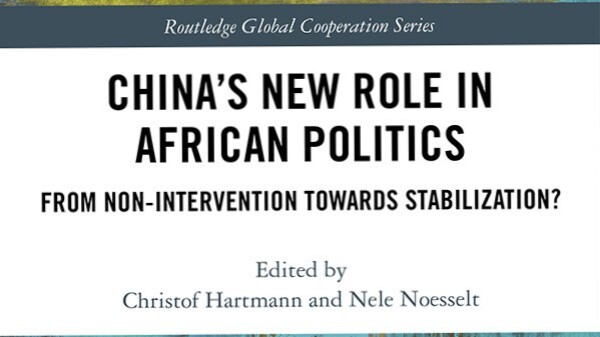
Book on China‘s Role in Africa
The book on China’s New Role in African Politics. From Non-Intervention towards Stabilization? edited by Nele Noesselt and Christof Hartmann has been published by Routledge. The volume integrates African, Chinese and European perspectives on the changing political and security role of China on eth African continent.
CV
read more
► since April 2021
Director, Institute for Development and Peace
► since 2016
Professor of Political Science, in particular International Relations and African Politics, Faculty of Social Sciences; University Duisburg-Essen
► 2010-2011, 2013-14
Managing Director of the Institute of Political Science, UDE
► 2006-2016
Professor of Political Science, in particular International and Development Politics, Faculty of Social Sciences; University Duisburg-Essen
► 2004-2006
Assistant Professor of Transformation Research with emphasis on Africa and Asia, Institute of Development Research and Development Policy; Ruhr-University Bochum; Director at the Institute of Development Research and Development Policy
► 2002-2006
Visiting Lecturer in the MADM Programme, School of Government, University of the Western Cape, South Africa
► 2003-2004
Assistant Professor, Institute of Development Research and Development Policy; Ruhr-University Bochum
► 1999-2003
Senior Research Fellow, , Institute of Development Research and Development Policy;
Lecturer at Faculty of Social Sciences, Ruhr-University Bochum
► 1998-1999
Senior Research Fellow , Institute of Political Science, University Heidelberg (DFG Project Elections in Asia and the Pacific)
► 1997-1998
Lecturer in the Corso di Perfezionamento in Cooperation and Conflict Management, Università di Bologna
► 1994-1998
Ph.D. in Political Science, University Heidelberg
Dissertation: External Factors in Democratization. A Comparative Study of African Countries (Chair: Dieter Nohlen)
► 1989-1994
MA in Political Science (Minors: Modern History and International Law), University Heidelberg
► 1990-1991
Institut d’Etudes Politiques, Aix-en-Provence (Frankreich); Certificat d’Etudes Politiques; Option: Relations Internationales
► 1987-1989
BA in Political Science (Minors: Modern History and International Law), University Freiburg i. Brsg. (Grundstudium)
Team

Wencke Rottländer
Secretariat
Room: LF 314
Phone: (0203) 379 - 2049
Mail: wencke.rottlaender@uni-due.de

Dr. Georg Lammich
Research Associate
Room: LF 326
Phone: (0203) 379 - 3182
Mail: Georg.Lammich@uni-due.de
Profile

Olanrewaju Ogunnubi
Research Associate
Room: LF 326
E-Mail: olanrewaju.ogunnubi@uni-due.de
Profile
Kabutey Doku
Research Associate
Room: -
Phone: -
Malin Walter
Research Assistant
Room: -
Phone: -
Julian Kügelgen
Research Assistant
Room: -
Phone: -
Cassandra Fiebig
Student Assistant
Room: -
Phone: -
Teaching
Prof. Hartmann and his team offer teaching at undergraduate, graduate, and PhD level.
Teaching at the University Duisburg-Essen is mostly in German language, except for international MA programs (such as MA Development and Governance)
Selected modules offered during the last semesters
► Development Theories / Practices and Theories of Development
► Development Problems and North-South Relations
► Introduction to German Development Policy
► African Politics
► African Development
► International Relations of Africa
► Democracy and Governance
► Research Logic and Academic Writing
► Introduction to Political Science
► Global Development Goals
► Institutionalism from a Political Science Perspective
► Conflict Management
► Elections in the Global South
► Practice of Development Cooperation
► The Macro-Political Regulation of Conflict
► South African Politics
► Decentralisation and Poverty Reduction
Electronic link to course offers in the current teaching term: LSF
PhD
Professor Hartmann is currently involved in two PhD programs.
read more
PhD Program Internationale Beziehungen/Friedens- und Entwicklungsforschung at University of Duisburg-Essen
Current PhD projects at the Univ. of Duisburg-Essen
-
Jasmin SCHMITZ Non-state actors’ involvement in Infrastructures for Peace
-
Elvis MELIA: The Political Economy of Digital Transformation in Africa: A Comparison of Kenya, Rwanda, and Ethiopia
-
Olanrewaju OGUNNUBI: When Reforms Fail, What Will Actors Do? Decentralisation, Contested Institutions and Intergovernmental Relations in Nigeria
-
Kabutey DOKU: Policy Continuation in a Competitive Political Settlement: The Case of Ghana
-
Ines REINSTÄDTLER Aid effectiveness: performance of bilateral and multilateral development cooperation from a comparative, co-operation and partner perspective (Co-Supervision with Prof. Dr. Jörg Faust)
PhD program in International Development Studies at the Institute of Development Research and Development Research of the Ruhr – University Bochum
Current supervision in the PhD program in Bochum
-
Zena Mouawad: Explaining drivers of symmetric exchange of resources in inter-organizational relations: A case study of the relationship of United Nations development entities in the context of the SDG Joint Fund
-
Simon Rahn: Agency of regional organizations in the global politics of poverty reduction
Former PhD students
- Jannis Saalfeld: Muslim politics and collective Jihadist radicalisation in sub-Saharan Africa: A comparative case study of Ghana and Mozambique
- Henrik Maihack: Urbanization and Changing Political Interest Organization in Kenya
- Nora Schrader-Rashidkhan: Rebel Parties in African Post-Conflict Elections. Explaining party Formation and Success
- Georg Lammich: Kapazitätsbildende Funktionen von asymmetrischem Interregionalismus – die regionale Dimension der sino-afrikanischen Kooperation
- Johannes Schmitt: Budget Support and Domestic Accountability in sub-Saharan Africa
- Charlotte Heyl: Constitutional Courts’ Contribution to the Democratic Quality of Elections in Sub-Saharan Africa
- Anika Becher: Disaggregating violence. The impact of ethnic politics, land access and inequalities on ethnic and electoral violence in Kenya and Malawi (Duisburg 2015)
- Catherine Promise Biira: Collective Identity and Prospects for Political Integration: The Case of the East African Community (Bochum 2015)
- Martin Goeke: Parteiwechsel und Institutional Engineering: Erklärungen und Auswirkungen von Regulierungen des Parteiwechsels auf die Konsolidierung der jungen Demokratien Afrikas (Duisburg 2014)
- Samson Lembani: Institutions and Actors in Legislative Decisions in Africa: Analysing Institutional Contexts and Veto Players in Legislative Decisions in Malawi (Bochum 2013).
- Ahmed Rasul Minja: Security Architecture in sub-Saharan Africa. The Case of East African Community and the Southern African Development Community (durch ein DAAD-Stipendium an der Universität Duisburg-Essen finanziert) (Duisburg 2013) (LINK: https://scholar.google.com/citations?user=yRyPz9wAAAAJ&hl=en)
- Viviane Brunne: Public-Private Partnerships als Instrument der AIDS-Bekämpfung in Südafrika (Bochum 2007; Zweitgutachter)
- Augustine Magolowondo: Democratisation Aid as a Challenge for Development Co-operation. A Comparative Study of Overall Policies of Two Bilateral and Two Multilateral Development Agencies and How They are Implemented in Malawi (Bochum 2005; Zweitgutachter)
Research
Over the past years, I have focused on three areas of research:
Comparative Analysis of Different Formal Institutions
Firstly, I am interested in processes of institutional change in African countries. My main interest is the comparative analysis of different formal institutions, especially electoral systems and regime types, presidentialism and term limits, political parties and their regulation, and decentralisation and vertical power-sharing. Past research projects dealt with party regulation in Africa (Ethnic Party Bans in Africa) and with local politics and decentralisation (book with Gordon Crawford). I have a longstanding interest in various aspects of elections on the African continent, both with regard to electoral systems (DFG-Project Elections; Hartmann 2007, 2017), but also the dynamics of voting rights, and how they are related to citizenship (Hartmann 2015). I have focused on the relevance and interaction of different institutions for the management and resolution of violent conflict (Hartmann 2013) and continue to be interested in the relevance of political institutions for managing inter-ethnic relations from a comparative perspective (Hartmann 2018). Currently, I am also conducting research on presidential term limits in Africa (Hartmann 2022) and on parties in the context of violent conflict.
Current Research Project: The German Foundation for Peace Research has funded the project Party Competition and Collective Jihadist Radicalisation in Sub-Saharan Africa that deals with the sub-national (non-)occurrence of collective Jihadist radicalization in four African countries: Kenya, Mozambique, Ghana and Tanzania (2020-2023). More infos on this project can be found here.
Regional Co-Operation in Africa
Secondly, I am interested in regional co-operation in Africa with a focus on West Africa. The political and security dimensions of regional co-operation and its impact on member states are at the centre of my research. This includes a concern with the capacity of regional actors to deal with security challenges and an interest in humanitarian intervention by regional actors as well as an interest into the relationship between regional cooperation and the dynamics of domestic political reforms. Empirically my research concentrates on ECOWAS and has dealt with governance transfer (Hartmann 2013), the development of ECOWAS’ extraordinary norms of intervention (Hartmann 2013, Hartmann & Striebinger 2015), the application of Levitsky and Way’s linkage-leverage-model to the relations between African regional organisations and their member states (Hartmann 2016), and to specific ‘pro-democratic interventions’ (Hartmann 2017). More recently, I have concentrated on a better understanding of the different dimensions and effects of overlapping regionalism in Africa (Hartmann 2019, 2020).
Current Research Project: Starting in April 2022 the German Federal Ministry for Education and Research (BMBF) finances a competence network bringing together three German research institutions (Leipzig, PRIF Frankfurt, INEF Duisburg-Essen) with research partners in Africa and Europe, investigating African non-military conflict intervention practices (ANCIP). Christof Hartmann will serve as PI for the UDE projects dealing with the emergence and dynamics of regional and national infrastructures for peace in West Africa and their potential role within a broader portfolio of non-military intervention practices, as well as the international environment and linkages of non-military conflict interventions of regional actors in Africa.
Africa’s Relations with External Actors
A third research area is Africa’s relations with external actors. While initially focusing on different western States and their influence on democratization processes (Hartmann 1998), I am now mainly interested in the role of China. China’s relevance is no longer limited to questions of trade and economic development but has extended to the political sphere. In 2020, a co-edited book on China's influence on political stability and instability was published, combining African, Chinese and European perspectives (Hartmann/Noesselt 2020).
Current Research Project: The German Research Foundation (DFG) is financing a research project on China and the Transformation of Political Order in Africa, jointly led by Christof Hartmann and Nele Noesselt (IfP/InEast) since 2022. The project, which will be implemented in cooperation with Chinese and African partner organisations, analyses the relevance of different political settlements in African countries for engaging and interacting with Chinese actors. More information on this project is found here.
Finally, I have many years of experience in consultancy work and policy transfer, mainly in the areas of electoral system reform and electoral assistance, crisis prevention and conflict management, democracy promotion and political aspects of development cooperation.