
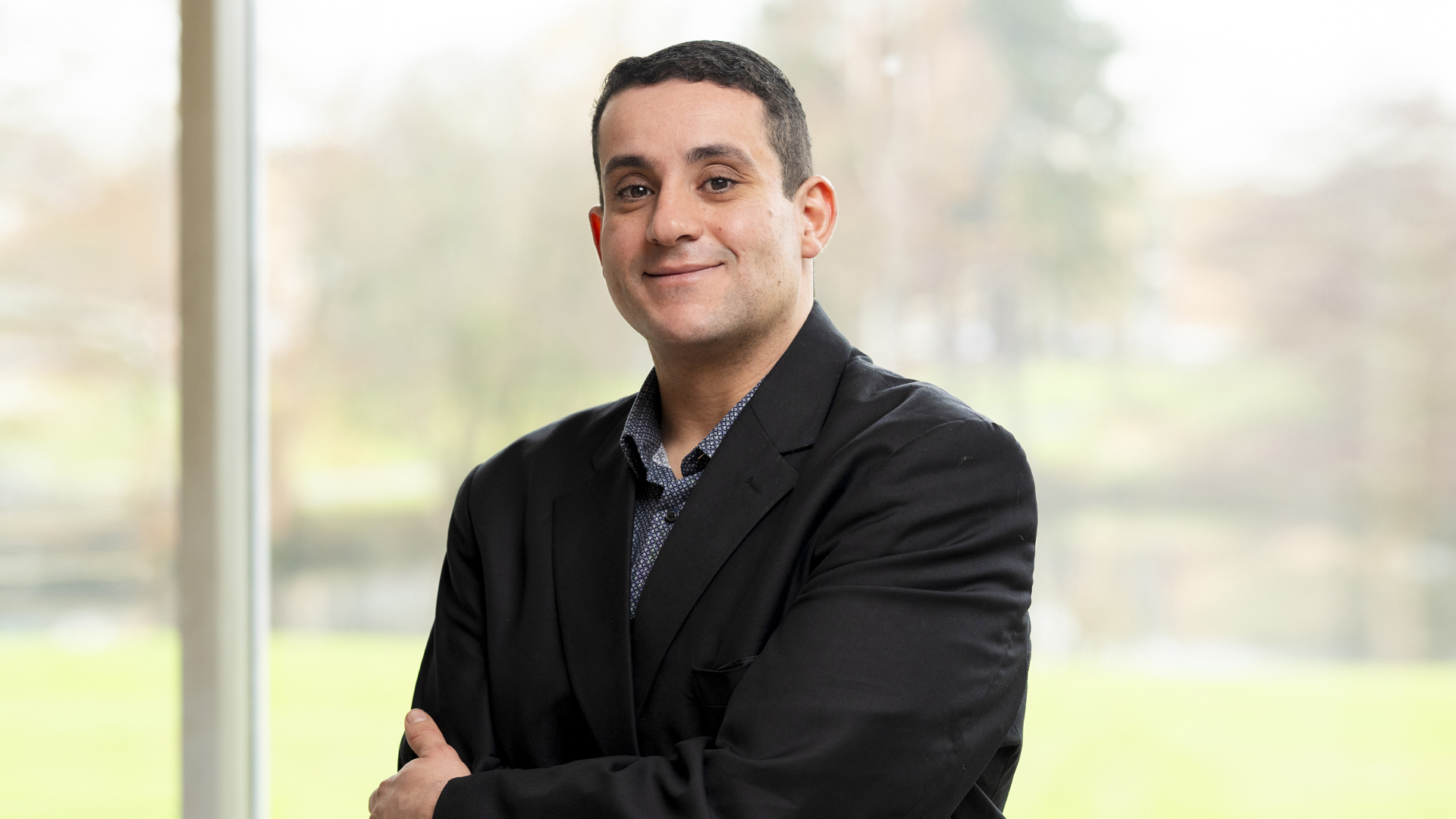
NRW Returning Scholar Dr. Juba Bouaziz
Quantum Materials for Future Computing
- 08.12.2025
Traditional computers are reaching their limits in tasks such as pattern recognition and finding optimal solutions for large-scale systems. New technologies such as neuromorphic computing and quantum computing offer promising alternatives, but they require materials with novel magnetic and electronic properties. This is the focus of theoretical physicist Dr. Juba Bouaziz. At the University of Duisburg-Essen, he has found an excellent environment for pursuing this research. Thanks to the NRW Return Program, the 35-year-old is returning to Germany from Japan to establish his own junior research group.
Dr. Bouaziz develops entirely new materials for ultra-efficient computer architectures. More specifically, he designs structures for neuromorphic computing, which mimics the functioning of the human brain, and for quantum computing, which relies on the principles of quantum physics. These new components are no longer based on classical electronics but instead harness quantum-mechanical effects.
“My methodology is to use classical computers as a platform for discovering and designing quantum materials. To design and optimize materials for neuromorphic components, such as spintronic synapses, I use a multiscale approach that combines quantum simulations and machine learning,” Bouaziz explains. “For quantum computing applications, such as qubits—where every atom counts – I use high-performance computers and large-scale simulations involving hundreds of thousands of atoms. My research will provide a microscopic understanding and design rules for quantum materials, thereby supporting the development of energy-efficient neuromorphic hardware and scalable quantum computing technologies.”
The University of Duisburg-Essen provides him with an excellent scientific environment: With the Center for Nanointegration Duisburg-Essen (CENIDE), the Collaborative Research Center 1242 on non-equilibrium dynamics in quantum materials, and the Transregio 270 on magnetic hysteresis, Bouaziz finds a broad spectrum of complementary expertise. He maintains close links particularly with research groups working on density functional theory, quantum materials, and neuromorphic device concepts.
Bouaziz studied physics in Algeria and joined Forschungszentrum Jülich in 2014. He received his doctorate from RWTH Aachen University in 2019. He subsequently conducted research at the University of Warwick, Forschungszentrum Jülich, and most recently spent two years at the University of Tokyo. He has received several awards, including the Feodor Lynen Fellowship of the Alexander von Humboldt Foundation.