
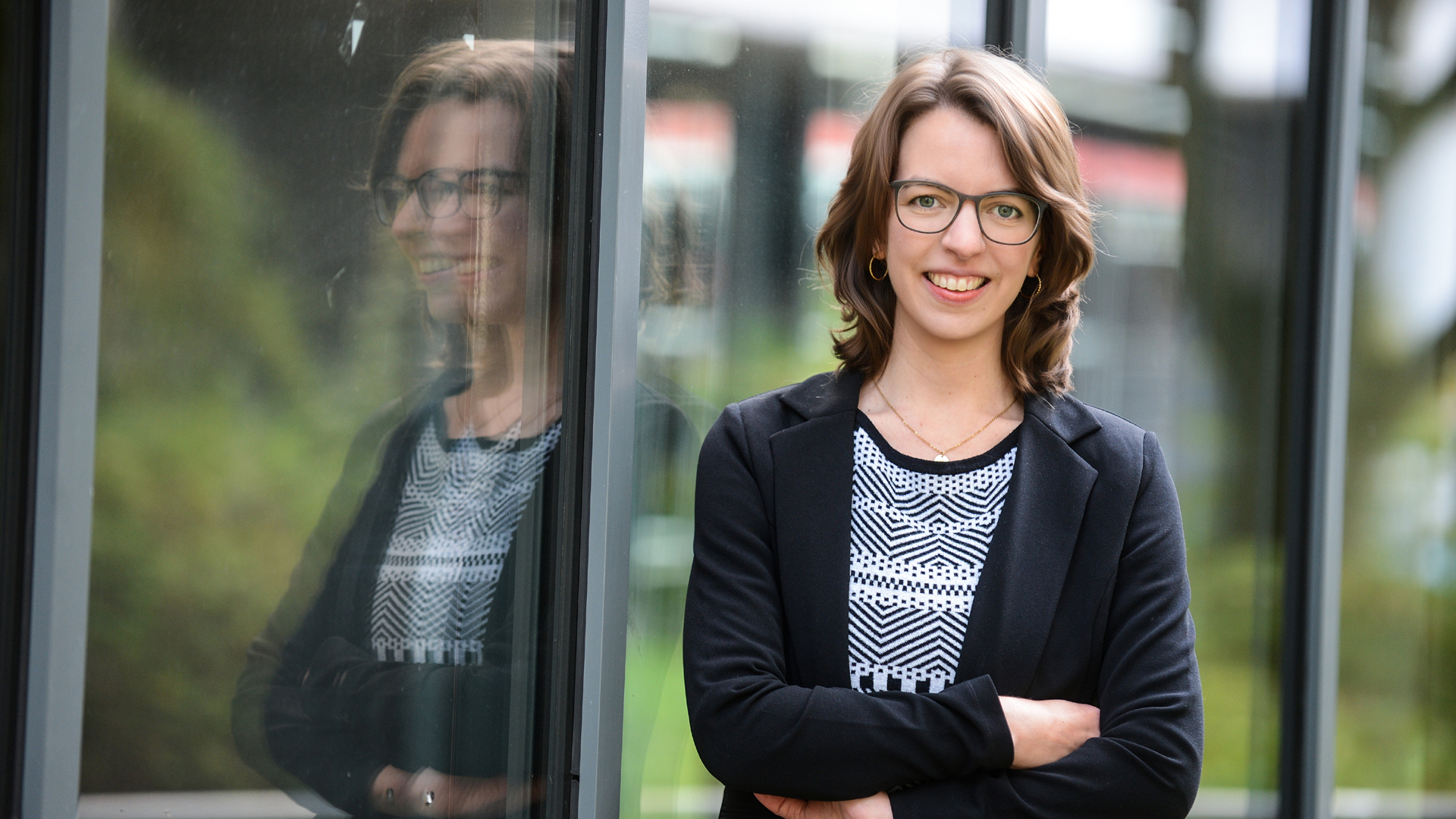
New at UDE: Erna K. Wieduwilt
Plastic Recycling of the Future
- von Dr. Alexandra Nießen
- 08.12.2025
A world without plastic? Unthinkable. Prof. Dr. Erna K. Wieduwilt is researching how it can be recycled, using a natural principle: the enzymatic degradation of plant biomass. Wieduwilt recently became an assistant professor of physical chemistry at the University of Duisburg-Essen. Her promising work is receiving funding from two sources: the return program of the North Rhine-Westphalia Ministry of Science and the Wübben Foundation for Science.
To date, only nine percent of plastic waste is recycled worldwide. The rest is incinerated, sent to landfills, or disposed of improperly in the environment, for example in the oceans. “We have to recycle plastic,” says Prof. Dr. Erna K. Wieduwilt. “However, this is anything but trivial, as most types of plastic are designed to be durable and very stable.” She therefore uses a process found in nature, in which special proteins (enzymes) break down robust plant components. “I have already researched the reaction mechanisms of such enzymes and would now like to apply this knowledge to plastic recycling,” says the 31-year-old. “When enzymes break down synthetic plastic polymers into their monomer building blocks, these can then be used to produce plastic of the same quality as the original.”
At the University of Duisburg-Essen, Prof. Dr. Wieduwilt will investigate enzymatic recycling using computer simulations – from two different perspectives: In the first research approach, funded by the NRW Return Program, the chemist will combine computer simulations with machine learning. “I want to use this to predict the reaction mechanisms of enzymes and then optimize them for plastic degradation,” she explains. The second part of her research project, supported by the Wübben Foundation, focuses on the structural basis of computer simulations: “We want to find out how computer-aided chemistry can help us improve the basic structural models we use to study enzymes. This will enable us to make more accurate predictions about how enzymes work and how they help in chemical processes.”
After studying chemistry (2013-2018) at the University of Bremen, Erna K. Wieduwilt conducted research at the Université de Lorraine (France), where she received her doctorate in theoretical chemistry in 2021. She then moved to the University of Southern Denmark, where she initially worked as a postdoctoral researcher and, from 2024, as a Marie Skłodowska-Curie Postdoctoral Fellow. There, she used mathematical models and simulations to investigate the reaction mechanisms of enzymes involved in the utilization of biomass waste. Her research has received multiple awards and financial support.
More information:
Prof. Dr. K. Erna Wieduwilt, Physical Chemistry, erna.wieduwilt@uni-due.de
Editor: Alexandra Niessen, phone +49 (0)203/37 9-1487, alexandra.niessen@uni-due.de