

Energy Science (Detailed Information)

Solar cells instead of coal
How did energy supply actually work in the past?
Prof. Dr. Martina Schmid's research group is optimising solar cells. While just a few years ago miners were still extracting coal from depths of over 1,000 metres below ground, today solar energy can be converted into electricity. The photo shows the research group at the Recklinghausen training mine.

Prof. Dr. Martin Mittendorff
As chair of the examination board, I am in regular contact with students: Where can I do my industrial internship? How do I register my bachelor's thesis? Who can answer my questions about studying abroad? I am happy to help find answers! It always gives me pleasure to see how friendly the research groups are with each other – we have a very good supervisory relationship! It's the perfect basis for good scientific work!
The spectrum of our final theses ranges from district heating networks and charging stations to catalysis and fuel cells. This shows that the idea of approaching the topic of energy from a scientific perspective works very well in our Energy Science programme!
Many personal conversations with our students returning from their year abroad have shown me that our concept of ‘global challenges – international studies’ is decisively changing perspectives and giving rise to completely new ideas!

Prof. Dr. Martina Schmid
Solar energy has fascinated me for a long time, and I have been working in the field of renewable energies for over 15 years. The growing global demand for energy requires innovation in energy supply and infrastructure.
Qualified specialists form the basis for this – and are urgently needed. The Energy Science degree programme not only provides an insight into the various areas of energy science, from the physical fundamentals to applications, but also ideally prepares students for a broad career field with future potential.

Prof. Dr. Martina Schmid
M.Sc. Energy Science
Why did you choose this degree programme?
The Energy Science degree programme offered the opportunity to combine a sound education in physics with practical applications in the context of energy and technology.

Masterarbeit Christopher Hauk
Climate Change Mitigation in Hong Kong’s Electricity Sector
Research questions: Political analysis: Which barriers in Hong Kong’s political sector hinder reduction of energy consumption? 19 semi-structured interviews with various stakeholders.
Technical analysis: Which impact does largescale solar PV installation have on the dispatch of conventional power plants? Power plant dispatch simulation in Excel VBA 15-minute timesteps for one entire year.

Prof. Dr. Michael Schreckenberg
One million tonnes of CO2 are produced when sitting in traffic jams. It is important to understand traffic jams in order to prevent them and organise traffic instead.
The Energy Science degree programme covers a wide range of issues that will arise in the future in relation to energy topics. The programme not only provides the necessary tools, but also offers a professional future in this field.
I have been interested in energy issues since I started studying. Over time, problem solving has become increasingly important. Today, we face major challenges in shaping a sustainable future – this is a very personal concern of mine.

Julius Kruip
M.Sc. Energy Science
Why did you choose this degree programme?
After graduating from school in Munich, I wanted to move away (from Munich to another city, of course) and study something related to physics. A student advisor suggested Energy Science to me. The focus on an exciting subject area, the social relevance and the international orientation (integrated year abroad) convinced me.

Seminar Energiesysteme im Vergleich
In this seminar, different energy systems are compared and evaluated according to their efficiency, among other criteria. Experts from industry and research present various topics, which are then discussed controversially in lectures given by students during the following week. Excursions to various institutions are also part of the programme.
Illustration Excursion: Tour of the Raffelberg hydroelectric power plant operated by the city of Mülheim
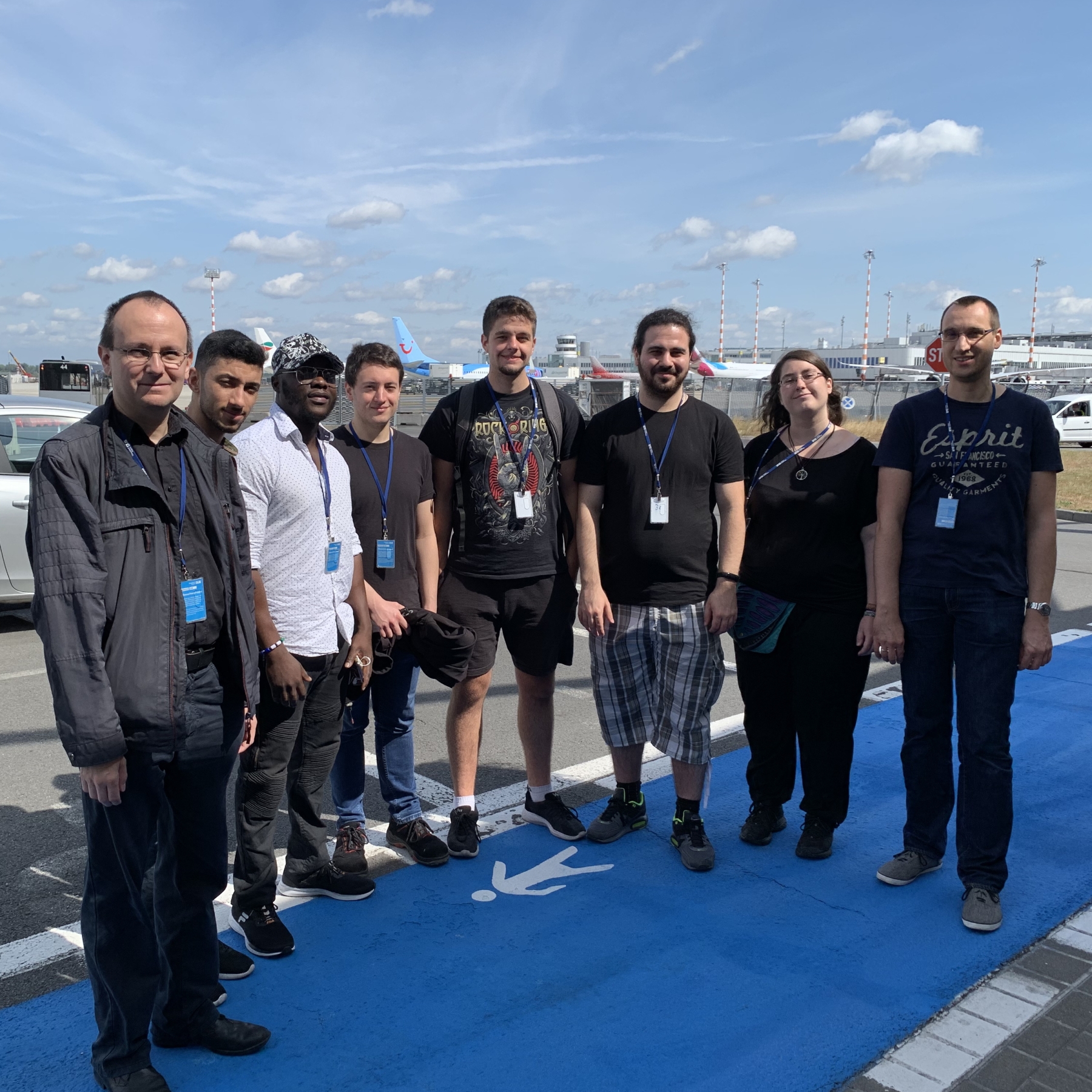
Exkursion zum Flughafen Düsseldorf
Seven students visited Düsseldorf Airport together with Dr Florian Mazur from the Schreckenberg working group. Here, they were able to experience the logistical processes they had learned about in the ‘Physics of Aviation’ lecture at an international airport and see for themselves how important physics is for aviation. This brought the theory from the lecture to life for the participants and made it easier to understand.
After the mandatory security check, a bus took them on a tour of various areas of the airport. This allowed them to witness take-offs and landings, including those of the Airbus 380-800, the world's largest passenger aircraft, at close range. Another highlight was observing the attempts to repair an engine on a Delta Air Lines Boeing 767-400 so that it could make its scheduled flight to Atlanta. Ultimately, however, the attempts were unsuccessful and flight DL 91 had to be cancelled.
The excursion has now become an integral part of the lecture and is offered every semester.